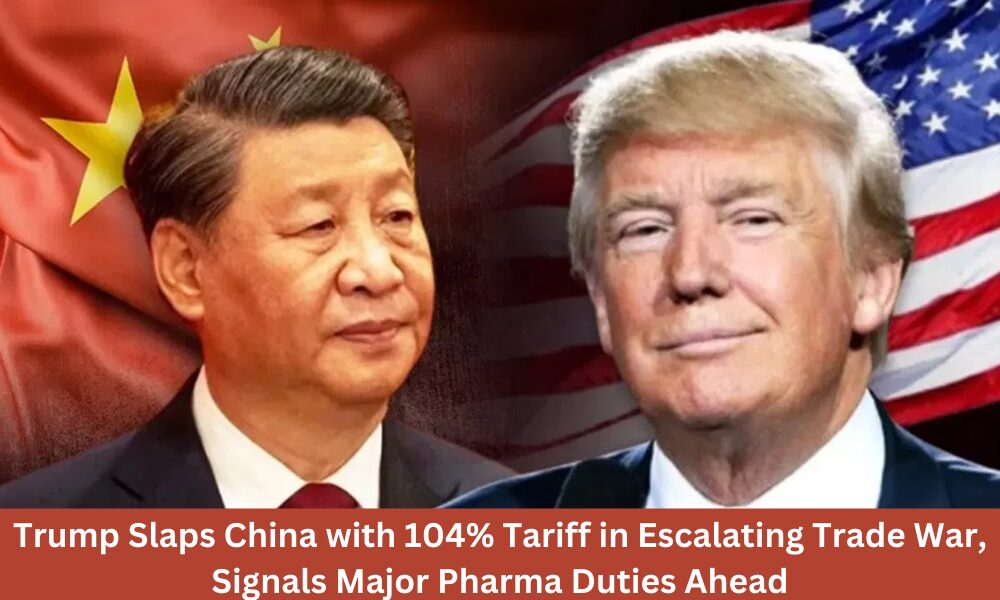
In a dramatic turn of events Trump Slaps China with 104% Tariff in Escalating Trade War, Signals Major Pharma Duties Ahead. A record-breaking 104% tariff on all Chinese imports, effective Wednesday, is officially imposed by President Donald Trump, in a dramatic escalation of the ongoing U.S.-China trade war. The announcement was confirmed just after midnight by the White House.
Trump issued a 24-hour ultimatum to China to roll back its retaliatory 34% tariffs on American goods. In less than a week, Trump’s decision on Chinese imports, marks a near 100% increase in tariffs, pushing global markets into a tailspin. Manufacturers and economists alike warn of economic shocks.
Trump Slaps China with 104% Tariff in Escalating Trade War, Signals Major Pharma Duties Ahead
The Road from 10% to 104% Tariffs in One Week
A 10% tariff was employed on Chinese goods entering the U.S. until early March. Beijing was imposing significantly higher duties on American exports and Trump had criticized this long time back.
The President cited this as “national economic emergency,” and to make it even he launched a “reciprocal tariff” strategy last week. In this, the U.S. would match, or exceed, the tariff rates imposed by trading partners.
Initially, this policy raised tariffs to 44% on Chinese goods. The effective duty was raised to 54% with the addition of 10% “national emergency” tariff. An executive order then added “50% tariff” on Tuesday specifically on China, sealing the total to 104%.
On his social media platform Truth Social, Trump said, “China also wants to make a deal, badly, but they don’t know how to get it started. We are waiting for their call.”
China Hits Back: “We Will Fight to the End”
Beijing, without taking Trump’s ultimatum lightly, the commerce minister responded in strong words accusing U.S. of “blackmail” and warned fierce retaliation.
The commerce ministry said “The U.S. threat to escalate tariffs against China is a mistake on top of a mistake.” “If the U.S. insists on having its way, China will fight to the end.”
The standoff between the world’s two largest economies is what many experts are calling the beginning of the most dangerous trade confrontation in decades.
Global Markets Rattle as Trade Tensions Escalate
The global financial markets are already shaken with the announcement of the 104% tariff. On Tuesday industrial Average of the Dow Jones fell by another 320 points, with its four-day loss summed up to over 4,500 points.
For the first time S&P 500 dropped below 5,000 in nearly a year and now its 19% down from its February high.
With South Korea’s KOSPI and Japan’s Nikkei slipping, Asia-Pacific markets mirrored the sentiment. Meanwhile, the Chinese offshore yuan, against the dollar hit a record low of 7.4242, with the People’s Bank of China setting its weakest midpoint rate since 2023.
Pharmaceutical Imports Next in Trump’s Crosshairs
Tuesday evening President Trump made another bombshell announcement. He said that soon he will introduce “major” tariff on pharmaceutical imports.
Later he went on to say that the move is designed to incentivize drug companies to bring manufacturing back to the United States.
Trump’s reciprocal tariff strategy previously, excluded semiconductors and pharmaceuticals. But now that protection seems to be ending, standing a serious threat to Indian pharmaceutical exporters, who dominate the U.S. generic drug market.
In 2024, India exported pharmaceuticals worth $12.72 billion to the U.S. In 2022 alone of all prescriptions filled in America, Indian generics accounted for 40%, thus saving the U.S. healthcare system an estimated $219 billion.
India’s drug manufacturing sector, is already facing global competition and thin margins. However, tariffs on Indian pharma, experts warn that, it could result in higher U.S. drug prices and a financial squeeze for India’s drug manufacturing sector.
De Minimis Tariffs Target Shein and Temu
Trump, in another significant trade policy shift, signed an executive order on low-value Chinese e-commerce packages, tripling tariffs often used by retailers like Shein and Temu. De minimis packages under $800, previously excluded, will now face a 90% duty and a rise of 150% by June.
This move aims to close a loophole that allowed Chinese retailers to bypass tariffs through international mail. Disproportionately, critics say, it hurt American retailers who had to play by different rules.
South Korea, Canada Respond with Countermeasures
South Korea, in response to America’s sweeping tariff strategy, announced $2 billion in aid for its auto industry, targeted by a recent 25% U.S. tariff. Meanwhile, Canada, announced a 25% retaliatory tariff on certain U.S. vehicles.
Mark Carney Canadian Prime Minister said, “President Trump caused this trade crisis — and Canada is responding with purpose and with force.”
Under a revised trade agreement for Canada and Mexico, older duties remain in place, while they were exempted from the latest U.S. tariffs.
Americans Brace for Price Hikes and Supply Shocks
A recent Reuters/Ipsos poll shows, due to the new tariffs three in four Americans expect a rise in prices. Retailers are already adjusting, like Micron, adding tariff surcharges and others, with some delaying orders.
A shopper, Thomas Jennings in New Jersey said, “I’m buying double of whatever—beans, canned goods, flour, you name it,”
Later this month, broad-based price increases are expected to hit, especially on goods that arrive in the U.S. post-tariff.
Outlook: Trade Talks Uncertain, Risks High
With allies such as Japan and South Korea, President Trump has opened the door to negotiations, while talks with China, White House officials made it clear, are currently not a priority.
Jamieson Greer, Trump’s trade advisor told lawmakers, “The president has been clear, again, that he’s not doing exemptions or exceptions in the near term.”
Consumers begin to feel the pinch, as countries brace for prolonged trade disruptions, economists warn of possible recession risks, rising inflation, and long-term damage to global supply chains.
Just in four days, $5.8 trillion wiped off U.S. markets and China vowing to retaliate, the global economy, not seen since the COVID-19 crisis, may be entering a period of volatility.
Also Read: Trump Threatens 50% Tariffs on China as Trade War Intensifies and Global Markets Tumble
Also Read: ‘We are Chinese’: Beijing vows not to back down as Trump hikes tariffs to 125%
Related Posts:
- 10 Big Takeaways from Trump’s 155% Tariff Warning to China

- 7 Crucial Insights Into Trump and Xi’s High-Stakes…
- “Don’t Want Them To Buy Russian Oil”: Trump Urges…
- Tariff After Tariff: Donald Trump Imposes 100%…
- What’s Next for Donald Trump After Court Rules His…

- Trump to Host 2026 G20 Summit at His Florida Golf…