Trump–Zelensky Meeting 2025: Stylish Yet Strategic White House Talks on Tomahawk Missiles and the Ukraine War. Ukrainian President Volodymyr Zelensky appeared at the White House on Friday in a departure from his familiar olive-green military attire, opting instead for a formal black suit and jacket.
During their lunch in the Cabinet Room, U.S. President Donald Trump took note of the wardrobe change, telling reporters with characteristic flair:
“I think he looks beautiful in this jacket, yes, beautiful, I hope people notice. It’s good, it’s actually very stylish, I like it.”
The exchange marked a lighter start to an otherwise serious meeting focused on the war in Ukraine, U.S. weapons supplies, and Trump’s recent phone call with Russian President Vladimir Putin. Zelensky’s choice of attire symbolized a subtle shift — from wartime defiance to diplomatic engagement — as Kyiv seeks to strengthen U.S. support amid uncertainty over advanced weapons.
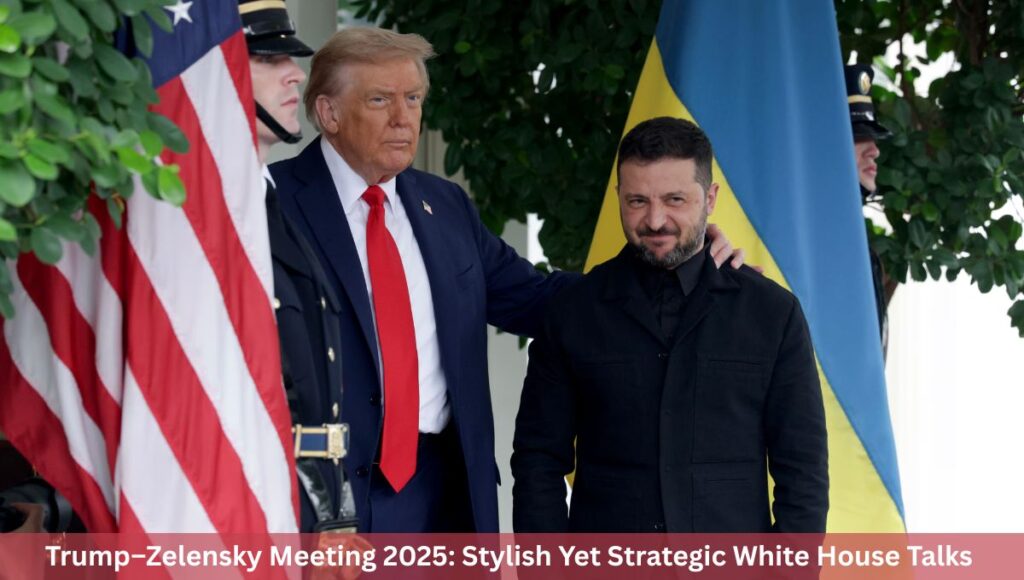
Trump–Zelensky Meeting 2025: Stylish Yet Strategic White House Talks
Not the first time Zelensky adjusted his look for Trump
This was not the first time Zelensky tailored his appearance for the U.S. president. In August 2025, he wore a black jacket and formal trousers for another meeting with Trump and European officials, earning another nod of approval.
“You look fabulous in that suit,” conservative reporter Brian Glenn told Zelensky. Trump chimed in, saying, “I said the same thing,” recalling a previous exchange.
Their first meeting in February had been less cordial. Zelensky’s black polo and military-style trousers reportedly irked Trump and several aides, who interpreted it as a lack of respect. Trump remarked sarcastically at the time:
“All dressed up today.”
The Ukrainian president later explained that he had vowed to wear his military uniform until peace returned to Ukraine, a promise that resonated with many at home.
His now-famous black jacket, designed by Kyiv-based Viktor Anisimov, first appeared at Pope Francis’s funeral in April and has since featured at high-level meetings, including with UK Prime Minister Keir Starmer and at the NATO summit in The Hague.
Diplomatic backdrop: Trump’s call with Putin before the meeting
The meeting came a day after Trump’s phone conversation with Vladimir Putin, in which both leaders agreed to meet soon in Budapest, Hungary.
The White House confirmed that Trump spoke with Putin for more than two hours, discussing possible steps toward ending the Ukraine war.
Trump told reporters:
“The threat of that [the missiles] is good, but the threat of that is always there.”
The timing of the Trump-Zelensky meeting, immediately following the Trump-Putin call, underscored Washington’s dual-track approach — pressing for diplomacy while weighing further military assistance to Kyiv.
Zelensky fails to secure Tomahawk missiles from Trump
Despite a cordial tone, Zelensky appeared to leave Washington without a firm commitment on his primary request: Tomahawk cruise missiles.
The Ukrainian president said he and Trump discussed long-range weapons but agreed not to make public statements “because the United States does not want an escalation.”
Trump’s position appeared cautious:
“Hopefully they won’t need it, hopefully we’ll be able to get the war over without thinking about Tomahawks,” he said. “I think we’re fairly close to that.”
While not ruling out a future deal, Trump emphasized that Tomahawks are a “big deal” and that the U.S. needed them for its own defense.
“We need Tomahawks for the United States of America, too,” he told reporters. “So I don’t know what we can do about that.”
According to Reuters, Trump’s hesitation reflects broader concerns within the administration that sending Tomahawks could deplete U.S. strategic reserves and provoke Russia.
Also Read: Zelensky fails to secure Tomahawk missiles at talks with Trump
Kyiv’s proposal: drones in exchange for missiles
During the meeting, Zelensky proposed a symbolic trade — Ukrainian drones for American Tomahawks. The idea reportedly drew smiles and nods from Trump, who acknowledged Kyiv’s progress in developing advanced drone systems.
“They make a very good drone,” Trump said, adding that he was impressed by Ukraine’s technological innovation despite the ongoing war.
However, Zelensky later told reporters that he remained “realistic” about the missile talks.
“We have to stop where we are, he is right, the president is right,” Zelensky said, echoing Trump’s earlier remarks on halting the war along current front lines. “The step after that would be to speak.”
The suggestion hinted at potential alignment between Washington and Kyiv on pursuing a temporary ceasefire, even as fighting continues across eastern Ukraine.
Trump’s “stop where they are” message signals pragmatic shift
After the meeting, Trump took to Truth Social, urging both sides to “stop where they are” and calling for a negotiated end to the conflict.
“They should stop where they are,” he wrote, a statement interpreted as backing a ceasefire along existing battle lines.
Zelensky appeared open to the idea. In remarks to reporters, he said,
“We have to stop where we are. This is important, to stop where we are, and then to speak.”
The tone was markedly different from earlier months when Kyiv insisted on regaining all occupied territories.
Analysts say Trump’s framing of “stopping where they are” may reflect Washington’s growing fatigue with open-ended military support and a preference for stabilizing the front rather than expanding aid commitments.
Tomahawk hesitation: “We need them too”
When asked about the U.S.’s own military needs, Trump reiterated his reservations:
“That’s a problem, though. We need Tomahawks, and we need a lot of other things that we’ve been sending over the last four years to Ukraine.”
He emphasized that while the U.S. had provided substantial aid, it must also maintain its defense readiness amid rising tensions elsewhere.
“We’ve given a lot,” Trump said. “But we have to be careful.”
The remarks represented a tempered version of his recent statements, in which he had shown openness to arming Kyiv.
The shift followed Putin’s warning that U.S. missile supplies “would not change the situation on the battlefield but would cause substantial damage” to U.S.-Russia relations.
Putin call and the Budapest summit plan
Trump confirmed that his call with Putin lasted two and a half hours, covering “a lot of details.” He said:
“He wants to get it ended. I think that President Zelenskyy wants to get it ended. Now we have to get it done.”
Putin’s aide Yuri Ushakov told Russian media that Moscow viewed the Tomahawk discussion as a potential flashpoint but said the Kremlin welcomed ongoing dialogue.
Trump, meanwhile, noted that both leaders were preparing for a summit in Budapest, though no date has been set.
“I think he wants to make a deal,” Trump said. “We’ll be involved in threes, but it may be separated.”
The idea of a trilateral or parallel format — with the U.S., Russia, and Ukraine engaging separately — has been floated as a way to de-escalate tensions and test Putin’s willingness for compromise.
Zelensky seeks security guarantees and U.S. backing
At a joint press briefing, Zelensky stressed the importance of security guarantees for Ukraine.
“A bilateral security guarantee is the most important thing,” he said, adding that Trump’s success in brokering a ceasefire in the Middle East had given him hope for a similar outcome in Eastern Europe.
“President Trump has really showed for the world that he can manage ceasefire in the Middle East, and that’s why I hope that he can do this and we can also have such big success,” Zelensky told reporters.
Zelensky also emphasized Ukraine’s need for long-range weaponry, air defenses, and energy support as the country prepares for another harsh winter under bombardment.
Russian airstrikes have reportedly destroyed more than half of Ukraine’s gas production capacity, prompting rolling blackouts and rationing.
European response: cautious optimism
Following his meeting, Zelensky said he spoke with European leaders to share details of his talks with Trump.
“The main priority now is to protect as many lives as possible, guarantee security for Ukraine, and strengthen all of us in Europe,” he posted on X.
UK Prime Minister Keir Starmer called the conversation “productive” and reaffirmed that the UK will continue to send humanitarian aid and military support to Ukraine.
In Brussels, EU officials privately expressed concern about Trump’s “stop where they are” message, fearing it might freeze the conflict rather than resolve it. However, others saw it as a potential opening for renewed diplomacy.
On the ground: resilience amid devastation
Back in Kyiv, the war’s toll was evident. The BBC spoke to a shopkeeper named Volodymyr, repairing his store destroyed by Russian missile strikes. When asked about Trump’s planned meeting with Putin, he said:
“Truth and democracy will win, and all the terrorism and evil will disappear. We just want to live, we don’t want to give up, we just want them to leave us alone.”
Such voices underscore the contrast between diplomatic rhetoric and daily reality in Ukraine, where civilians continue to endure bombardment even as peace overtures dominate headlines.
Analysis: Diplomacy amid symbolism
The Trump-Zelensky meeting highlighted the dual nature of contemporary diplomacy — symbolism intertwined with strategy. Trump’s light-hearted comments about Zelensky’s attire captured headlines, yet beneath the humor lay a complex web of geopolitical calculations.
For Zelensky, the meeting reaffirmed the necessity of maintaining close ties with Washington even amid uncertainty. For Trump, it demonstrated his balancing act — keeping open channels with Putin while reassuring allies of U.S. engagement.
Despite the absence of a missile deal, Ukraine left Washington with modest diplomatic gains: renewed visibility, European alignment, and a U.S. president publicly advocating a negotiated end.
What lies ahead: Cautious optimism before Budapest
As Trump prepares for a Budapest summit with Putin, expectations remain tempered. The White House insists it seeks “peace through strength,” while Kyiv braces for renewed offensives as winter approaches.
Both leaders — Trump and Zelensky — appeared to agree that diplomacy remains the only viable path forward, even if the details remain murky.
“Hopefully we’ll be able to get the war over without thinking about Tomahawks,” Trump said.
“We have to stop where we are,” Zelensky echoed. Those statements — pragmatic, restrained, and calculated — may well define the next phase of the war and Washington’s evolving role in it.
Related Posts:
- Trump’s Bold 2025 Move: Tomahawk Missile Warning to Russia

- Impacts of the Trump-Putin Call on Ukraine’s 2025 Strategy

- Awkward and Hilarious Moments at Gaza Peace Summit 2025

- Trump Stole the Show at 2025 Gaza Peace Summit in Egypt

- Rubio’s Urgent Note to Trump Before Gaza Peace Deal…

- Donald Trump’s 24-Karat Gold White House Makeover:…