9 Explosive Revelations as Trump Declares His Health “Perfect” in Wall Street Journal interview.At 79 years old, United States President Donald Trump has once again found his health thrust into the political spotlight.
In a wide-ranging and unusually detailed interview with The Wall Street Journal, Trump directly confronted months of speculation surrounding his age, physical fitness, visible bruising, medical scans, and moments when cameras appeared to catch him nodding off during public appearances.
The president’s message was blunt and unequivocal.
“My health is perfect,” Trump said.
Yet the length, depth, and tone of the interview suggest a president increasingly frustrated by persistent scrutiny—scrutiny that mirrors the intense focus once directed at his predecessor, Joe Biden, whose age and mental acuity ultimately derailed his 2024 re-election bid.
Trump’s remarks offer rare insight into his medical routines, personal beliefs, and resistance to conventional health advice. They also underscore a broader political reality: in an era of aging leaders, presidential health has become a defining issue of governance, credibility, and public trust.
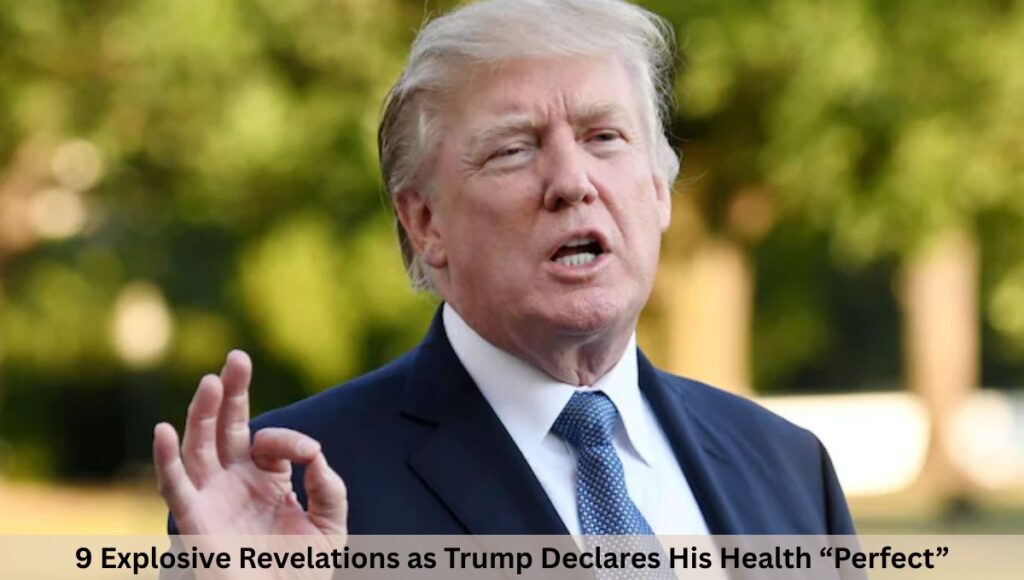
9 Explosive Revelations as Trump Declares His Health “Perfect”
Trump at 79: The Oldest President in US History
Donald Trump became the oldest person ever sworn into the US presidency when he returned to office in January 2025 at age 78.
Now 79, he is already older than Ronald Reagan was when Reagan left office, and should Trump complete his second term, he will be 82 years old, surpassing even Joe Biden’s age record.
That milestone alone has intensified scrutiny.
Just as Biden faced relentless questions about memory lapses, physical frailty, and cognitive sharpness, Trump now finds himself confronting similar doubts—many amplified by social media, viral photographs, and political opponents eager to turn age into a vulnerability.
Trump, however, has made clear he views such concerns as exaggerated, unfair, and politically motivated.
“Let’s Talk About Health Again for the 25th Time”
The Wall Street Journal interview opened with visible irritation from the president.
“Let’s talk about health again for the 25th time,” Trump told reporters, signaling his frustration with a topic he believes has been overplayed.
Throughout the interview, Trump repeatedly returned to a central theme: that nothing is wrong, nothing has changed, and that the public obsession with his health says more about the media than about him.
He denied having any serious ailments, rejected suggestions of cognitive decline, and framed recent medical procedures as routine and precautionary rather than diagnostic.
The Medical Scan Controversy: MRI or CT?
Confusion That Fueled Speculation
One of the most talked-about episodes in recent months occurred in October, when Trump told reporters he had undergone a magnetic resonance imaging (MRI) scan.
The statement immediately triggered speculation, as MRIs are often associated with serious medical investigations involving the brain, heart, or soft tissues.
Trump later acknowledged that the test was not an MRI, but a computed tomography (CT) scan, a faster and less detailed imaging procedure.
“It wasn’t an MRI,” Trump clarified to the Journal. “It was less than that. It was a scan.”
His physician, Navy Captain Sean Barbabella, confirmed that the CT scan was conducted as a precautionary cardiovascular screening while Trump was already scheduled to visit Walter Reed National Military Medical Center.
“In Retrospect, It Was Too Bad I Took It”
Trump expressed regret over agreeing to the scan, arguing that it unnecessarily fueled speculation.
“In retrospect, it’s too bad I took it because it gave them a little ammunition,” he said. “The fact that I took it said, ‘Oh gee, is something wrong?’ Well, nothing’s wrong.”
According to Barbabella, the scan results were “perfectly normal” and revealed no abnormalities in Trump’s cardiovascular or abdominal systems.
Daily Aspirin: A Higher Dose Than Doctors Recommend
325 Milligrams a Day
Perhaps the most striking revelation from the interview was Trump’s admission that he takes 325 milligrams of aspirin daily, a dosage significantly higher than the 81 milligrams commonly recommended for preventive heart care.
“They’d rather have me take the smaller one,” Trump said of his doctors. “I take the larger one, but I’ve done it for years.”
Trump framed the decision in characteristically vivid terms.
“They say aspirin is good for thinning out the blood, and I don’t want thick blood pouring through my heart,” he said. “I want nice, thin blood pouring through my heart.”
Doctors Raise Questions
Medical experts quoted in the reporting noted that while aspirin can reduce the risk of clotting, higher doses increase bleeding risk without offering additional cardiovascular benefit—especially in older adults.
Trump’s physician acknowledged that the president has taken aspirin regularly for 25 years, and Trump himself admitted he is “a little superstitious” about changing long-standing habits.
Bruised Hands and Makeup: A Visual Mystery Explained
Aspirin and Handshakes
For months, photographs of Trump’s right hand showing visible bruising—sometimes covered with makeup or bandages—have circulated widely.
Trump attributed the bruising to a combination of daily aspirin use and frequent handshaking.
“What it does do is it causes bruising,” he said.
The White House has echoed this explanation, adding that Trump routinely shakes hundreds of hands during public events.
The Pam Bondi Incident
Trump also offered a more personal anecdote, claiming that Attorney General Pam Bondi once accidentally struck his hand with her ring during a celebratory high-five.
“I get whacked again by someone,” Trump said, explaining why he sometimes uses makeup to conceal marks. “It takes about 10 seconds.”
“I’ve Never Been a Big Sleeper”: Denying the Dozing Claims
Public Appearances Under the Microscope
Trump has been photographed multiple times with his eyes closed during cabinet meetings and Oval Office events, prompting speculation that he may be falling asleep.
One notable instance occurred during a December cabinet meeting when Trump appeared to slouch forward with drooping eyelids.
Trump forcefully denied that interpretation.
“I’ll just close [my eyes]. It’s very relaxing to me,” he said. “Sometimes they’ll take a picture of me blinking, blinking, and they’ll catch me with the blink.”
A Longstanding Claim
Trump reiterated a claim he has made for years: that he does not require much sleep and has never been a heavy sleeper.
His daily routine, he said, starts early and often runs until 7 or 8 p.m., dismissing any suggestion that fatigue affects his performance.
Exercise Is ‘Boring’: Golf Over the Gym
A Consistent Position
Trump made no attempt to hide his disdain for traditional exercise routines.
“I just don’t like it. It’s boring,” he told the Journal. “To walk on a treadmill or run on a treadmill for hours and hours—that’s not for me.”
Instead, Trump said golf remains his primary form of exercise, a position he has maintained since his first term.
He regularly plays at courses he owns in Florida, New Jersey, and Virginia, often during weekends and holidays.
A Paradox in Policy
Despite his personal aversion to fitness routines, Trump announced last year that he would relaunch the Presidential Fitness Test in US schools—a program phased out in 2013.
The move has drawn criticism from those who note the contrast between Trump’s personal habits and his administration’s rhetoric on physical fitness.
Compression Socks and Venous Insufficiency
A Common Condition in Older Adults
Earlier this year, the White House disclosed that Trump had been diagnosed with chronic venous insufficiency, a condition in which leg veins struggle to return blood to the heart, causing swelling in the ankles and lower legs.
Trump confirmed he briefly tried wearing compression socks but abandoned them.
“I didn’t like them,” he said.
Instead, he claimed to walk more and avoid sitting for long periods to encourage blood flow.
Hearing Concerns Brushed Aside
When asked about reports suggesting hearing difficulties, Trump downplayed the issue.
“I only struggle when there’s a lot of people talking,” he said, adding that he otherwise hears normally.
Genes, Not Doctors, Get the Credit
Throughout the interview, Trump repeatedly credited his physical resilience to genetics.
“Genetics are very important,” he said. “And I have very good genetics.”
It is a refrain Trump has returned to for years, often positioning himself as naturally resilient rather than dependent on medical intervention or lifestyle discipline.
The Political Irony: From ‘Sleepy Joe’ to Scrutiny Himself
Trump’s health controversy carries a sharp political irony.
During the 2024 campaign, Trump relentlessly attacked Joe Biden as “Sleepy Joe,” questioning his mental acuity and physical stamina.
Those criticisms intensified after Biden’s disastrous June 2024 debate performance, which ultimately led him to abandon his re-election bid.
Now, Trump finds himself confronting similar questions—about sleep, age, stamina, and transparency—underscoring how quickly political narratives can reverse.
A Long American History of Aging Presidents
Trump is hardly the first president to face health-related doubts.
- Franklin D. Roosevelt concealed paralysis
- John F. Kennedy hid chronic illness
- Ronald Reagan faced competency rumors and later developed Alzheimer’s
Yet modern media, instant photography, and viral speculation have magnified every visible bruise, blink, or pause into headline material.
Transparency vs. Trust
Despite repeated assurances from Trump and the White House that his health evaluations are normal, critics argue that the mixed messaging—MRI versus CT, vague descriptions, delayed disclosures—raises unnecessary questions.
Supporters counter that Trump has been unusually open, granting one of the longest interviews on presidential health in recent memory.
Conclusion: “Nothing’s Wrong,” Trump Insists
Donald Trump’s Wall Street Journal interview offers a rare, unfiltered look at how the president views his own body, mind, and mortality.
He rejects medical caution.
He resists lifestyle changes.
He dismisses critics.
He trusts his instincts—and his genes.
“My health is perfect,” Trump said.
Whether the public accepts that assurance may matter as much politically as any policy decision he makes, especially as the United States grapples with a new reality:
presidents who are governing well into their late seventies and early eighties.
For now, Trump’s message is clear—and defiant. Nothing is wrong.
Also Read: 7 Alarming Moments: Trump Appears to Doze Off During Marathon Cabinet Meeting
Also Read: Trump boasts of ‘PERFECT Marks’ from top doctors in third medical exam this year