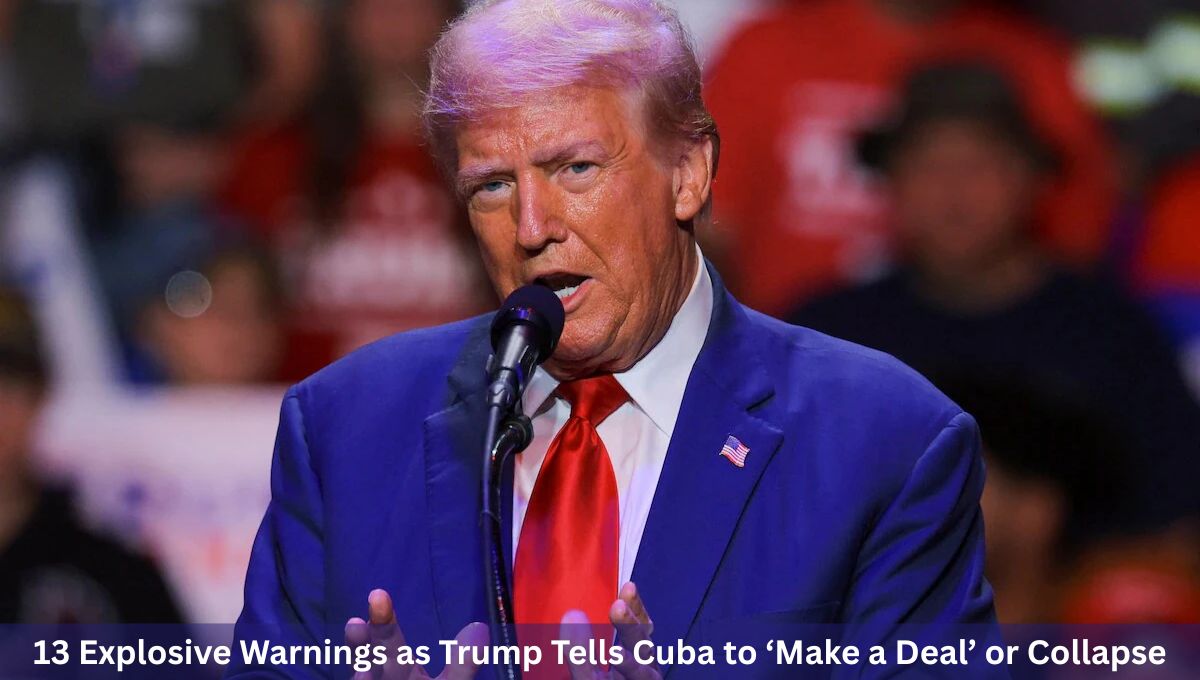
13 Explosive Warnings as Trump Tells Cuba to ‘Make a Deal’ or Collapse after US Venezuela operation.United States President Donald Trump has issued one of his starkest warnings yet to Cuba, declaring that the island nation must “make a deal” with Washington or face devastating economic consequences.
In a series of posts on his social media platform Truth Social, Trump announced that no more oil or money would flow from Venezuela to Cuba, following the US military operation that captured Venezuelan President Nicolás Maduro earlier this month.
“THERE WILL BE NO MORE OIL OR MONEY GOING TO CUBA – ZERO!” Trump wrote. “I strongly suggest they make a deal, BEFORE IT IS TOO LATE.” The warning has triggered sharp responses from Havana, deepened fears of an energy collapse inside Cuba, and raised fresh questions about whether Washington is once again pursuing regime change in the Caribbean nation.
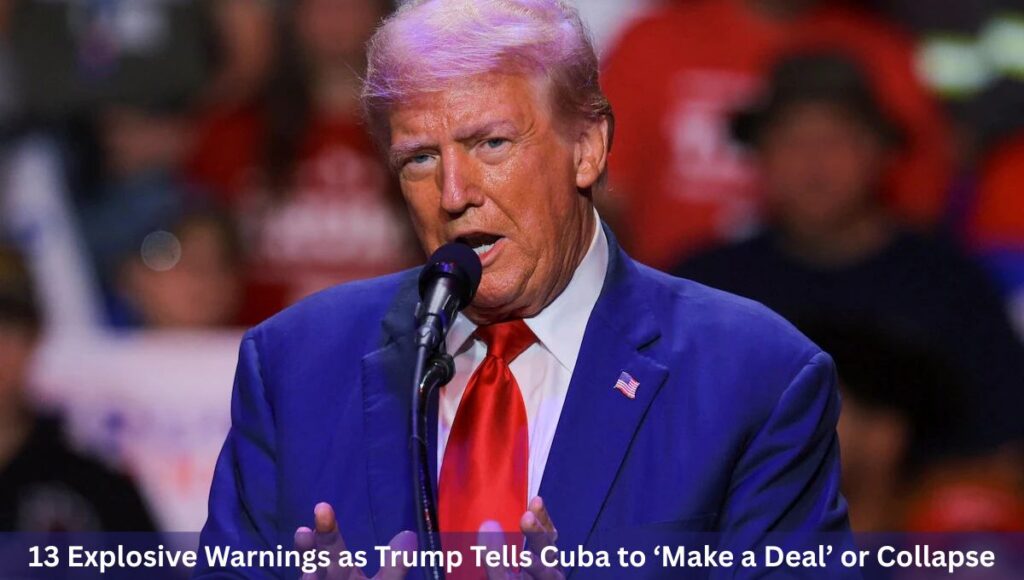
13 Explosive Warnings as Trump Tells Cuba to ‘Make a Deal’ or Collapse
Why Trump Is Targeting Cuba Now
The Venezuela Operation Changed Everything
For decades, Venezuela has been Cuba’s most important economic lifeline, supplying subsidised oil in exchange for medical personnel, intelligence cooperation, and security assistance.
That arrangement was upended after:
- US forces captured Nicolás Maduro and his wife, Cilia Flores
- Maduro was flown to New York to face federal narcoterrorism charges
- Washington pressured Venezuela’s interim leadership to redirect oil supplies to the United States
Trump has since declared that the US will receive 30 to 50 million barrels of Venezuelan crude, dramatically altering the regional energy balance.
“Cuba lived, for many years, on large amounts of OIL and MONEY from Venezuela,” Trump wrote. “BUT NOT ANYMORE!”
Trump’s Core Threat: Oil, Money, and Isolation
‘Zero’ Support Going Forward
Trump’s message was blunt and uncompromising:
- No Venezuelan oil for Cuba
- No Venezuelan financial support
- No exceptions
He argued that without Venezuelan backing, Cuba’s government is nearing collapse.
“Without Maduro and without that oil, Cuba looks like it’s ready to fall,” Trump told reporters aboard Air Force One.
However, US intelligence assessments paint a more complex picture.
What US Intelligence Actually Says About Cuba
According to Reuters, confidential US intelligence assessments describe:
- Severe strain in agriculture
- A collapsing tourism sector
- Widespread blackouts
- Chronic fuel shortages
Yet intelligence agencies do not support Trump’s assertion that Cuba is on the verge of immediate collapse.
The CIA believes:
- Governance would become significantly more difficult without Venezuelan oil
- The loss would deepen public hardship
- But political collapse is not inevitable
How Much Venezuela Oil Does Cuba Really Get?
The numbers underline why Trump’s threat matters.
Between January and November last year:
- Venezuela supplied about 27,000 barrels per day
- This covered roughly 50% of Cuba’s oil deficit
- Data comes from shipping records and PDVSA documents
While supplies had already declined in recent years, Venezuela remained Cuba’s largest oil provider.
Without it, Cuba faces:
- More blackouts
- Fuel rationing
- Transport disruptions
- Economic contraction
Cuba’s Immediate Response: Defiance
Díaz-Canel: ‘No One Dictates What We Do’
Cuban President Miguel Díaz-Canel responded swiftly and forcefully.
“No one dictates what we do,” he said on X. “Cuba is a free, independent, and sovereign nation.”
He accused Washington of aggression, saying:
“Cuba does not attack; it is attacked by the United States for 66 years.”
Díaz-Canel added that Cuba was prepared to defend itself “to the last drop of blood.”
Cuba’s Foreign Minister Calls US a ‘Criminal Hegemon’
Foreign Minister Bruno Rodríguez escalated the rhetoric further.
He asserted:
- Cuba has the absolute right to import fuel
- No country can dictate its energy partners
- Claims that Cuba traded security services for oil are false
“The US behaves like a criminal and uncontrolled hegemon,” Rodríguez said, accusing Washington of threatening global peace.
Trump’s Allegation: Security for Oil
Trump claimed that:
- Cuba provided “security services” for Venezuela
- This support protected “two Venezuelan dictators”
- That relationship is now over
Cuban officials categorically denied:
- Receiving financial compensation
- Exchanging security for oil
- Participating in mercenary activities
Civilian Cost: What Cubans Are Saying
Fear, Frustration, and Defiance
Reactions on the streets of Havana reveal a divided mood.
Paola Perez told Reuters:
“Cuba is not to blame for US-Venezuelan relations, but we will be affected, quite a lot.”
Maria Elena Sabina was more desperate:
“There’s no electricity, no gas, no power. Change is needed — quickly.”
Others expressed resilience.
Luis Alberto Jimenez said:
“That does not scare me. The Cuban people are prepared for anything.”
Mexico and the Search for Alternative Oil
Cuba has sought to diversify fuel sources:
- Mexico supplies smaller volumes
- President Claudia Sheinbaum said Mexico has become an “important supplier”
- But volumes are insufficient to replace Venezuela
Analysts warn that finding replacements under US sanctions will be extremely difficult.
Marco Rubio: A Personal Crusade
Why Rubio Matters
Secretary of State Marco Rubio has emerged as a central figure in the renewed pressure campaign.
The son of Cuban immigrants, Rubio:
- Built his political career opposing the Castro regime
- Has long advocated regime change
- Views Cuba’s collapse as a historic turning point
“If I lived in Havana and was in the government, I’d be concerned,” Rubio said.
Trump later reposted a suggestion that Rubio could become President of Cuba, adding:
“Sounds good to me!”
Trump’s Mixed Signals on Regime Change
Publicly, Trump says:
- The US does not need to take action
- Cuba may fall on its own
Privately and rhetorically:
- He praises pressure tactics
- He welcomes weakening Havana
- He endorses provocative ideas
This ambiguity keeps both allies and adversaries guessing.
A Long History of Failed US Regime Change Efforts
Bay of Pigs (1961)
- CIA-backed Cuban exiles invaded Cuba
- Operation collapsed within three days
- Strengthened Fidel Castro’s rule
Operation Mongoose
A covert campaign authorised by President Kennedy:
- Economic sabotage
- Psychological warfare
- Assassination plots
Declassified plans included:
- Exploding cigars
- Poisoned milkshakes
- Contaminated diving suits
- Explosive seashells
How Many Times Was Castro Targeted?
- Official US count: 8 assassination plots
- Cuban intelligence claim: 638 attempts
Despite it all, Cuba’s leadership endured.
Why This Time Is Different
Venezuela’s Collapse Removes a Shield
In 2019, a US-backed attempt to remove Maduro failed partly due to Cuban intelligence support.
This time:
- Maduro is in US custody
- Venezuelan oil flows are redirected
- Cuba loses a strategic ally
That makes Havana more vulnerable than at any time since the 1990s.
Military Pressure and Regional Anxiety
US naval movements near Cuba have been noted:
- Warships repositioned closer to the island
- Heightened surveillance
- Strategic signaling
Latin American leaders, including Colombia’s Gustavo Petro, have called for regional unity against US coercion.
China Weighs In
China’s Foreign Ministry responded sharply:
- Voiced strong support for Cuba’s sovereignty
- Opposed US sanctions and blockades
- Urged Washington to cease coercion
China’s backing underscores the risk of great-power rivalry escalating in the Caribbean.
Domestic Politics Back in Washington
While Trump focuses on foreign pressure:
- Americans face rising living costs
- Housing and food prices remain high
- Some supporters question overseas military actions
Analysts warn that foreign confrontations may strain Trump’s “America First” narrative.
Conclusion: Pressure, History, and Uncertain Outcomes
Donald Trump’s demand that Cuba “make a deal before it’s too late” marks a dramatic escalation in US-Cuba relations.
The strategy hinges on:
- Cutting off Venezuelan oil
- Economic pressure
- Political isolation
History suggests such pressure:
- Rarely delivers quick regime change
- Often deepens civilian suffering
- Strengthens nationalist resistance
As Cuba braces for deeper shortages and Washington sharpens its rhetoric, one reality remains unchanged:
Cuba has survived six decades of US pressure — but the loss of Venezuela may be its toughest test yet.
Whether this moment leads to negotiation, collapse, or prolonged confrontation will shape the Caribbean’s future — and test the limits of American power — for years to come.
Also Read: 32 Dead: Cuba’s Fierce Fighters Killed in Shocking U.S. Venezuela Raid
Also Read: Maduro Extraction: How Marco Rubio’s childhood shaped Donald Trump’s Venezuela policy