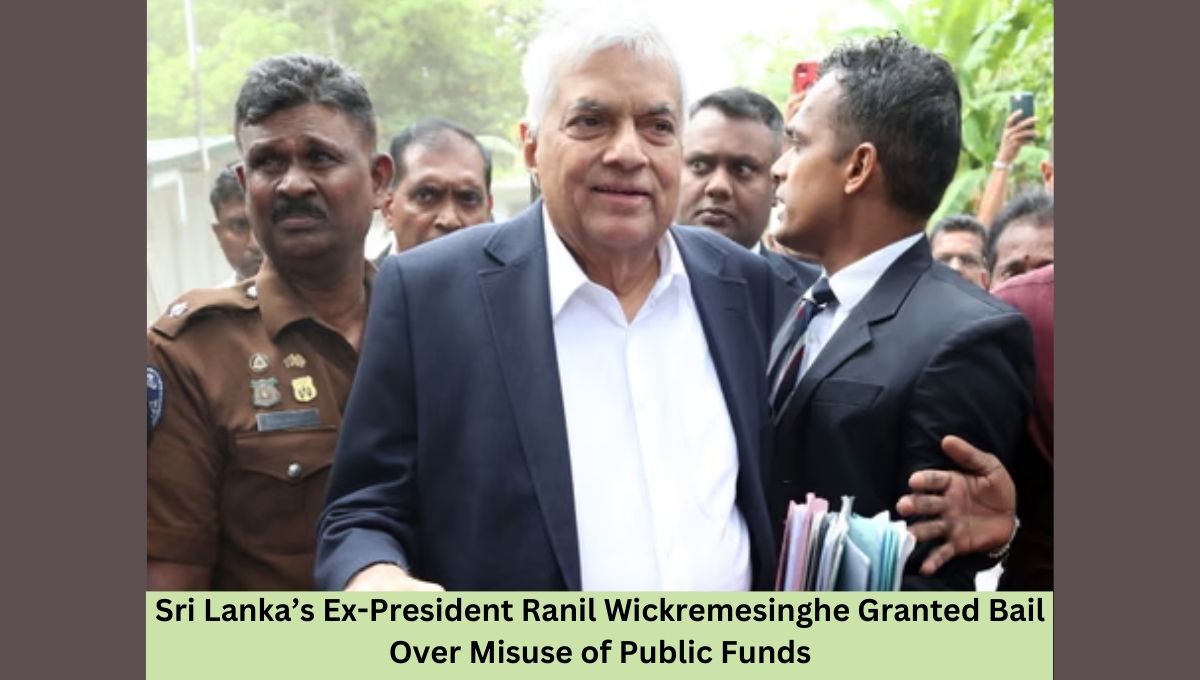
While his arrest triggered widespread protests, Sri Lanka’s Ex-President Ranil Wickremesinghe Granted Bail Over Misuse of Public Funds. Colombo witnessed a day of high political drama as former Sri Lankan President Ranil Wickremesinghe was granted bail on Tuesday following his arrest last week over allegations of misusing public funds. The decision came after a tense court hearing amid tight security, while thousands of supporters gathered on the streets in protest.
Wickremesinghe, who served as president from July 2022 to September 2024, was arrested on Friday, accused of using state funds to attend his wife’s graduation-related ceremony in London in 2023. He is the first former Sri Lankan head of state to face arrest, making this case a historic moment in the island nation’s turbulent political landscape.
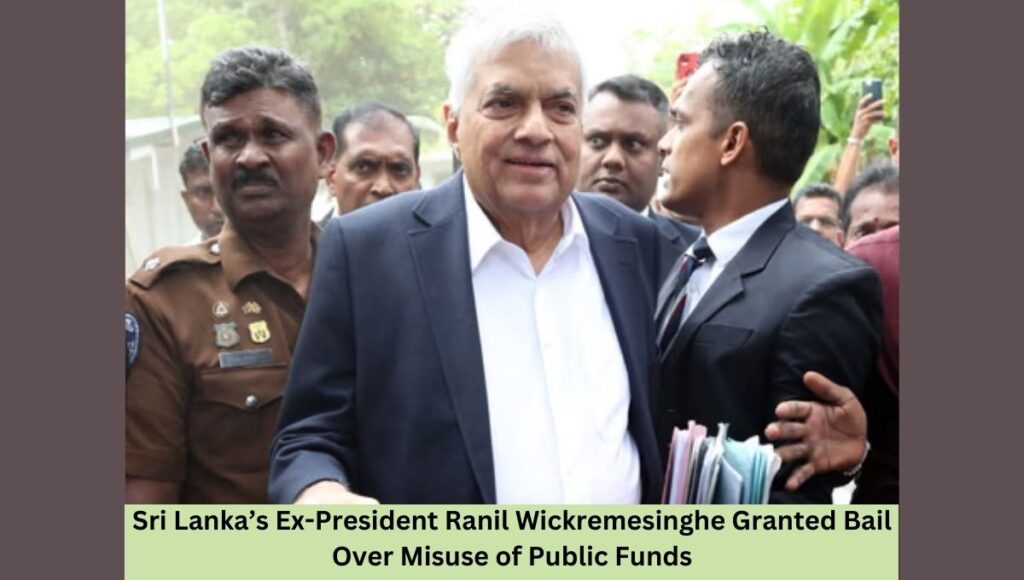
Sri Lanka’s Ex-President Ranil Wickremesinghe Granted Bail Over Misuse of Public Funds
Bail Decision After Court Hearing
The Colombo Fort Magistrate’s Court ordered Wickremesinghe’s release on a 5-million-rupee bond ($16,600) after an extended hearing that drew widespread attention both domestically and internationally.
The 76-year-old former leader joined the court session via Zoom from the Colombo National Hospital, where he has been receiving treatment in the intensive care unit after suffering from dehydration and complications related to diabetes and high blood pressure.
Court officials confirmed that Wickremesinghe was permitted to remain under medical supervision while the case continues, though he will be required to comply with further inquiries by the authorities.
Allegations of Misusing Public Funds
The case stems from Wickremesinghe’s official foreign tour in September 2023, which included attending the G77 summit in Havana and the UN General Assembly in New York.
On his return trip, he made a stop in London, where he reportedly attended a graduation event related to his wife’s honorary professorship at a British university.
Prosecutors allege that $55,000 of state funds were improperly used to cover expenses during the stopover.
Wickremesinghe’s United National Party (UNP) has strongly denied the charges, stating that his wife’s travel expenses were met personally and that the visit to the university was part of his official itinerary.
Protests and Public Outcry in Colombo
News of the former president’s arrest sparked large-scale protests across Colombo. On Tuesday morning, thousands of supporters and opposition activists took to the streets leading to the Magistrates’ Court, carrying black flags, wearing black clothing, and chanting slogans demanding his immediate release.
Some protesters carried banners reading: “Immediately release ex-president Ranil Wickremesinghe” and accused the government of conducting a political witch hunt.
Among the demonstrators was Samarasiri Kuruwitaarachchi, 69, who said:
“We condemn the arrest of Wickremesinghe, who has done so much for the country. The government has failed to deliver on its promises and is now trying to hunt down political opponents.”
Outside the courthouse, UNP deputy leader Akila Viraj Kariyawasam described the protests as a sign of Sri Lanka’s democratic spirit:
“We came out in support of democracy and due process. The government should continue measures to fight corruption. We have no objection to that but this case is politically motivated.”
Government Denies Political Revenge
Despite the uproar, the ruling administration under President Anura Kumara Dissanayake rejected claims of political persecution.
Transport and Highways Minister Bimal Rathnayake told local media that Wickremesinghe’s arrest was not a political vendetta, but part of the government’s legal obligation to investigate alleged malpractice:
“This is not about revenge. The law will be applied equally to everyone. The government has a clear mandate to probe corruption of previous administrations.”
President Dissanayake, who rose to power in 2024 on a strong anti-corruption platform, has promised to root out endemic corruption that contributed to Sri Lanka’s devastating economic crisis in 2022.
More than a dozen former ministers, senior officials, and political figures are currently under investigation for alleged financial wrongdoing.
Solidarity from Former Presidents
In a rare show of unity, three of Wickremesinghe’s predecessors Chandrika Kumaratunga, Mahinda Rajapaksa, and Maithripala Sirisena publicly condemned the arrest and expressed solidarity with him.
- Kumaratunga (80) described the move as a “calculated onslaught on democracy,” warning that the consequences of such political prosecutions would undermine the rights of all citizens.
- Mahinda Rajapaksa (79) personally visited Wickremesinghe in custody before he was moved to intensive care, calling the case politically motivated.
- Maithripala Sirisena (73) said the arrest was part of a systematic campaign to silence government critics, comparing it to “polishing the lid of a coffin to bury democracy.”
Their joint stance marked a significant political statement, given their history of being bitter rivals of Wickremesinghe.
Wickremesinghe’s Legacy and Political Career
Ranil Wickremesinghe is no stranger to controversy or political comebacks. A lawyer by profession, he served as Sri Lanka’s prime minister six times before taking over the presidency in 2022, following the dramatic ousting of Gotabaya Rajapaksa amid mass protests during the country’s worst economic crisis.
Under Wickremesinghe’s leadership, inflation declined, the Sri Lankan rupee stabilized, and foreign reserves improved, but his government also introduced tough austerity measures that were deeply unpopular with the public.
Though he lost the September 2024 presidential election to Dissanayake, Wickremesinghe remained politically active.
His UNP party insists that the ongoing legal cases are aimed at blocking his potential comeback.
Supporters Celebrate Bail
As news of his bail spread, supporters outside the courthouse cheered, danced, and lit firecrackers.
For many, the court’s decision was not just about Wickremesinghe but about what they see as protecting Sri Lanka’s democratic process.
“Today’s ruling is a victory for democracy,” said one protester. “We will continue to fight against injustice and political revenge.”
The Road Ahead
Wickremesinghe’s legal troubles are far from over. While he has secured bail, the case will proceed in the coming months, with prosecutors expected to present further evidence of alleged misuse of state funds.
Observers say the trial will be a litmus test for President Dissanayake’s anti-corruption campaign, which has so far received both praise and criticism for its sweeping investigations.
With political tensions running high, the coming months could further polarize Sri Lanka’s fragile democracy, especially if Wickremesinghe attempts a political resurgence.
Conclusion
The arrest and bail of former President Ranil Wickremesinghe have once again thrust Sri Lanka’s political turbulence into the spotlight. For supporters, his release is a relief and a reaffirmation of judicial independence. For critics, the case underscores the urgency of tackling corruption at the highest levels of power.
Whether this episode marks the beginning of Wickremesinghe’s political revival or the deepening of Sri Lanka’s political divisions remains to be seen. What is certain is that the case has ignited debates about justice, accountability, and democracy in a nation still recovering from crisis.
Also Read: Shehbaz Sharif Says ‘Begging Bowl’ Era Is Over as Pakistan Seeks Trade, Not Aid
Also Read: Protests Erupt In Sri Lankan Capital Over Ex-President Wickremesinghe’s Arrest