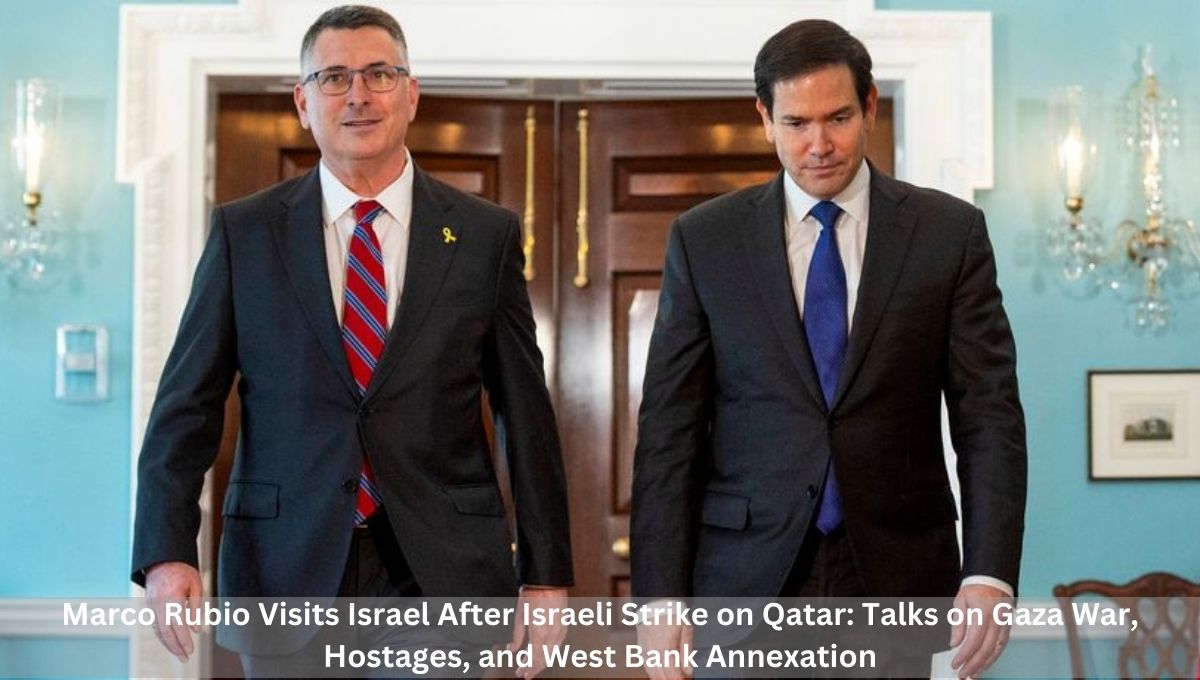
US Secretary of State Marco Rubio Visits Israel After Israeli Strike on Qatar: Talks on Gaza War, Hostages, and West Bank Annexation. United States Secretary of State Marco Rubio arrived in Israel this weekend in the shadow of a dramatic escalation: Israel’s unprecedented strike inside Qatar, a close US ally, targeting Hamas leaders.
The controversial attack has unsettled Washington’s regional diplomacy, strained relations with Arab states, and complicated ongoing negotiations for a ceasefire in the Gaza war. Rubio’s trip marks a critical moment for US foreign policy under President Donald Trump, who has expressed rare public criticism of Israel over the Doha strike but remains firm in his support for Prime Minister Benjamin Netanyahu.
The visit is expected to cover a wide spectrum of urgent issues—from the release of 48 hostages still held by Hamas, to Israel’s settlement expansion in the West Bank, and the rising international momentum for recognition of Palestinian statehood at the United Nations General Assembly later this month.
Marco Rubio Visits Israel After Israeli Strike on Qatar: Talks on Gaza War, Hostages, and West Bank Annexation
US Position: ‘Not Happy’ With the Strike, But Relations Unchanged
Speaking before boarding his flight in Washington, Rubio emphasized that Trump and the US government were “not happy” about Israel’s strike on Qatari soil, which killed six people including a Qatari security officer.
“What’s happened has happened. Obviously, we were not happy about it, the president was not happy about it,” Rubio told reporters. “It’s not going to change the nature of our relationship with the Israelis, but we are going to have to talk about it—primarily, what impact does this have on the truce efforts.”
The Doha strike targeted senior Hamas officials who had gathered to discuss a US-backed ceasefire proposal. While the leadership survived, the attack jeopardized Qatar’s role as a mediator and drew widespread condemnation from Arab states. US officials described it as a “unilateral escalation” that served neither American nor Israeli interests.
Despite this, Rubio made clear that the US-Israel alliance remains intact. “We need to move forward and figure out what comes next, because at the end of the day, when all is said and done, there is still a group called Hamas, which is an evil group,” he said.
Netanyahu’s Message: Hamas Leaders Still a Target
Israeli Prime Minister Benjamin Netanyahu has taken a hard line in the wake of the strike. In a Saturday evening post on social media, he hinted strongly that Hamas’s top leadership survived the attack in Doha and should remain targets.
“The Hamas terrorists chiefs living in Qatar don’t care about the people in Gaza,” Netanyahu wrote. “They blocked all ceasefire attempts in order to endlessly drag out the war. Getting rid of them would rid the main obstacle to releasing all our hostages and ending the war.”
Israeli defense sources, however, indicated that much of the security establishment had advised against the strike. Reports in the Washington Post revealed that the Mossad intelligence agency opposed a planned ground operation in Doha out of concern it would derail hostage negotiations and damage ties with Qatar.
Hamas identified those killed as close associates and relatives of senior official Khalil al-Hayya, including his son Hammam. The funerals in Doha, attended by top Hamas leaders and the Qatari emir, underscored the strike’s diplomatic repercussions.
The Human Toll of the Gaza War
Rubio’s visit comes as the Gaza war, now approaching its second anniversary, continues to exact a devastating toll. According to local authorities, over 64,000 Palestinians have been killed in Israel’s military campaign, which began after Hamas’s October 7, 2023 attacks that killed 1,200 Israelis and resulted in 251 hostages being taken.
The humanitarian crisis has escalated into a severe hunger emergency, with international organizations warning of famine conditions. Israel faces growing accusations of genocide, including from the world’s largest association of genocide scholars earlier this month.
Hamas still holds 48 hostages, whose fate remains central to both the conflict and international negotiations. Qatar, alongside the United States, has been a key mediator in efforts to secure a deal that would involve their release in exchange for a ceasefire and Israeli withdrawal.
Rubio’s Mandate: End the War, Free the Hostages
Rubio outlined Trump’s objectives before departing for Israel.
“The president wants this to be finished with. And finished with meaning 48 hostages released all at once. Hamas is no longer a threat, so we can move on to the next phase, which is, how do you rebuild Gaza?” he said.
Trump, according to Rubio, expects an all-at-once resolution: hostages freed, Hamas defeated, and the war ended in “short order.”
But Rubio acknowledged the complexities: “Who will rebuild Gaza? Who will pay for it? Who will be in charge of the process? These are questions still to be determined.”
His visit aims to extract clearer answers from Netanyahu’s government on its post-war plans, which remain ambiguous even as Israel accelerates settlement expansion and entertains annexation of the West Bank.
Qatar’s Stance: Sovereignty and Mediation
The Qatari government reacted with fury to the Israeli strike, calling it a “blatant attack” on its sovereignty. Prime Minister Sheikh Mohammed bin Abdulrahman al-Thani vowed that Qatar would take all necessary steps to protect its security.
At the same time, Qatar reiterated its commitment to mediation. A Foreign Ministry statement highlighted meetings between Qatari leaders and US officials, including Rubio, Vice President JD Vance, and Trump’s special envoy Steve Witkoff.
“Qatar is a reliable strategic ally of the United States of America,” the statement read, noting that Washington expressed appreciation for Doha’s role in pursuing peace.
Yet the strike has complicated Qatar’s position. Hamas maintains its political leadership in Doha, and Netanyahu has openly called for their expulsion. Whether Qatar can continue as an impartial mediator remains uncertain.
Also Read: US, Qatar Near Defence Pact After Israeli Strike on Doha Amid Gaza Ceasefire Talks
International Fallout: Push for Palestinian Statehood
Beyond the Gaza war itself, Rubio’s trip coincides with a diplomatic turning point at the United Nations General Assembly. Frustrated by Israel’s conduct, major Western allies including France and the United Kingdom are expected to recognize Palestinian statehood later this month.
The UN General Assembly on Friday voted to revive the two-state solution, openly defying Israel’s opposition. For many European governments, recognition of Palestine has become a means to signal disapproval of Netanyahu’s policies in Gaza and the West Bank.
The Trump administration, however, opposes the move. Rubio warned that recognition could backfire: “Washington says such recognition would bolster Hamas,” he said, suggesting it could also spur Israeli annexation of parts of the West Bank.
West Bank Annexation: The Next Flashpoint
According to reports in Axios, Netanyahu is seeking clarity from Rubio on how far the Trump administration will tolerate Israeli annexation moves.
Two Israeli officials told the outlet that Rubio had “signaled in private meetings” that he would not oppose annexation, and that Trump would “not stand in the way.” But US officials privately fear such a step could collapse the Abraham Accords and tarnish Trump’s legacy.
Netanyahu recently signed off on new settlement expansions in the occupied West Bank, a move that critics say makes a Palestinian state virtually impossible. His government’s right-wing coalition has repeatedly pressed for formal annexation.
For Rubio, navigating this issue will be a delicate balancing act. On one hand, he must reassure Netanyahu of unwavering US support; on the other, he must prevent an Israeli move that could fracture Washington’s regional alliances and derail Trump’s diplomatic ambitions.
Symbolism and Domestic Politics
Rubio’s visit will also feature symbolic gestures aimed at reinforcing ties with Israel. He is scheduled to visit the Western Wall in Jerusalem with Netanyahu, and confirmed plans to attend the inauguration of a new tunnel leading to the Temple Mount/Al-Aqsa Mosque compound in Jerusalem’s Old City.
The tunnel, part of the City of David archaeological site, has long been contentious. Palestinians view such projects as attempts to strengthen Israeli claims over East Jerusalem, which they envision as the capital of a future Palestinian state.
Domestically, Rubio’s high-profile diplomatic role underscores his stature in Trump’s administration and signals his influence over Middle East policy. His performance in Israel will be closely scrutinized both abroad and within Washington.
The Road Ahead: Diplomacy in Disarray
Rubio’s mission encapsulates the central contradictions of US policy in the Middle East today.
- The US wants the Gaza war ended quickly, yet backs Israel militarily even as its strikes undermine ceasefire talks.
- Washington depends on Qatar as a mediator, yet Israel has attacked its territory and demands Hamas’s expulsion.
- Trump seeks to protect his Abraham Accords legacy, but Israel’s West Bank ambitions threaten to unravel it.
- Western allies are moving toward recognizing Palestine, while the US clings to Israel despite mounting international outrage.
Whether Rubio can reconcile these tensions during his visit remains to be seen. What is clear is that the war in Gaza—and Israel’s widening conflict with its neighbors—is pushing the US into uncharted diplomatic territory.
Conclusion
As Marco Rubio meets Benjamin Netanyahu in Jerusalem, the stakes for US diplomacy are enormous. The aftermath of the Israeli strike on Qatar has exposed deep cracks in Washington’s Middle East strategy.
Trump wants the war wrapped up, hostages freed, and Hamas defeated. Netanyahu is doubling down on military force, settlement expansion, and confrontation with Hamas leaders abroad. Qatar seeks to preserve its role as mediator while defending its sovereignty. Meanwhile, the international community edges closer to recognizing Palestinian statehood, defying both Israel and the US.
Rubio’s challenge is to bridge these divides, calm the regional fallout, and chart a course toward ending the war in Gaza. But with distrust mounting and the human toll climbing, the path forward looks fraught with obstacles.
Also Read: Israel takes ‘full responsibility’ for attack on Hamas leaders in Qatar, says PM Netanyahu
Related Posts:
- 5 Key Dimensions of U.S.–Israel Relations Amid…
- Israel–Hamas Ceasefire Under Strain: 4 More Hostage…

- Trump’s 20-Point Gaza Peace Plan Gains Urgent Global…

- 5 Key Developments as Israel Confirms Hamas Handed…

- Trump Unveils 21-Point Gaza Peace Plan at UNGA: Arab…
- Trump Says He Will Not Allow Israel to Annex West…