

In his opening statement, President Xi Jinping said, ‘Dragon and Elephant Must Come Together’ as PM Modi and Xi Jinping Hold Historic Talks in China After 7 Years. Prime Minister Narendra Modi and Chinese President Xi Jinping met on Sunday in Tianjin, China, on the sidelines of the Shanghai Cooperation Organisation (SCO) Summit 2025, marking a significant thaw in ties between Asia’s two largest countries.
This was PM Modi’s first visit to China in seven years, a period marked by tension following the deadly Galwan Valley clash of 2020 and subsequent military standoffs along the Line of Actual Control (LAC).
Both leaders struck a conciliatory tone, underlining the need for India and China to work together, not only for their own populations but also for global stability.
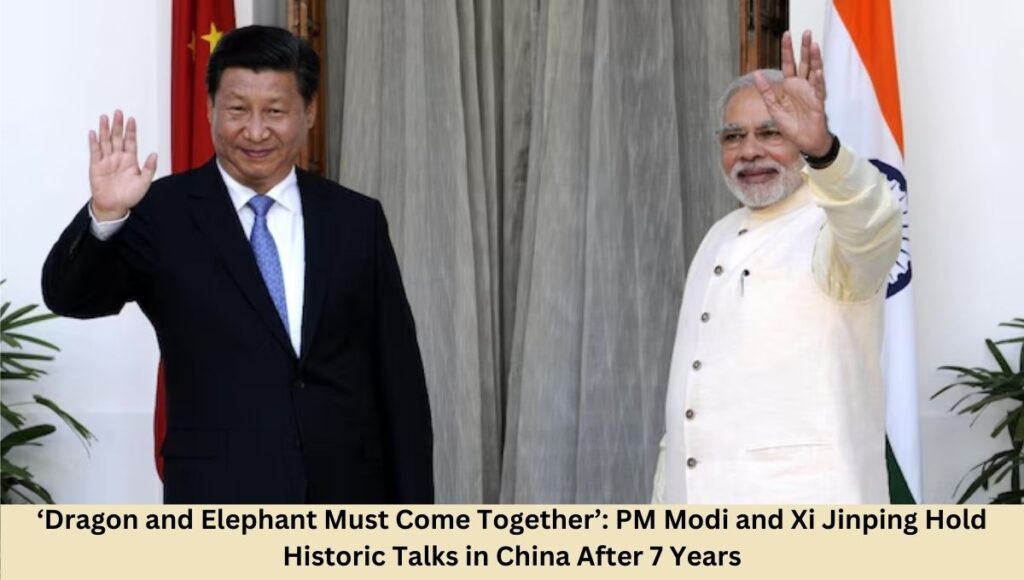
‘Dragon and Elephant Must Come Together’: PM Modi and Xi Jinping Hold Historic Talks in China After 7 Years
Xi Jinping: “The Dragon and the Elephant Must Come Together”
In his opening remarks, President Xi Jinping invoked a symbolic metaphor, stressing the importance of cooperation between China and India.
“The world is going towards transformation. China and India are two of the most civilizational countries. We are the world’s two most populous countries and part of the Global South. It is vital to be friends, good neighbours, and for the Dragon and the Elephant to come together,” Xi said.
Xi noted that 2025 marks the 75th anniversary of China-India diplomatic relations and urged both sides to adopt a strategic, long-term perspective in managing ties.
He called on New Delhi and Beijing to step up their “historic responsibilities” to uphold multilateralism, a multipolar world order, and greater democracy in international institutions, while working for peace and prosperity across Asia and the globe.
Modi: “Ties Must Be Based on Mutual Trust, Respect, and Sensitivity”
In response, Prime Minister Narendra Modi emphasized that the future of nearly 2.8 billion people is linked to India-China cooperation.
“The interests of 2.8 billion people of both countries are linked to our cooperation. This will also pave the way for the welfare of the entire humanity. We are committed to taking our relations forward on the basis of mutual trust, respect, and sensitivity,” said Modi.
The prime minister highlighted positive developments since the border disengagement agreement of 2024, including:
- Resumption of direct flights between the two nations.
- Restart of the Kailash Mansarovar Yatra, a pilgrimage route closed since the Galwan clashes.
- Greater peace and stability along the LAC following disengagement at Demchok and Depsang.
Why This Meeting Matters
The Modi-Xi meeting comes at a delicate moment in global politics. With US-India ties strained by steep tariffs imposed by President Donald Trump, both New Delhi and Beijing are recalibrating their strategies.
- Trump’s 50% tariffs on Indian goods, including punitive duties on Russian oil purchases, have pushed India to diversify trade partnerships.
- China, facing its own economic slowdown and high tariffs from Washington, sees potential in reviving ties with India.
- Both nations recognize that their combined economic and political weight could shape the future of Asia and the Global South.
Einar Tangen, Senior Fellow at the Taihe Institute, framed the meeting as more than bilateral diplomacy:
“India has an opportunity. At this juncture, India can stand up as a balancing power both at SCO and BRICS. This is not solely about India and China, but about the direction of global multipolarity.”
SCO Summit 2025: The Backdrop
The meeting took place during the Shanghai Cooperation Organisation Plus (SCO+) Summit in Tianjin, where 20 world leaders gathered.
Notable attendees included:
- Russian President Vladimir Putin
- Leaders from Iran, Kazakhstan, Kyrgyzstan, Pakistan, Tajikistan, Uzbekistan, and Belarus
China, as the rotating chair of the 10-member Eurasian bloc, positioned the summit as a platform for regional peace, trade, and security cooperation.
India-China Relations: From Panchsheel to Galwan to Détente
Early Foundations
- 1949: India recognized the People’s Republic of China.
- 1954: Nehru and Zhou Enlai signed the Panchsheel Agreement, emphasizing peaceful coexistence.
- 1962: Relations soured after a brief but intense border war.
Renewed Engagement
- 1976–1990s: Diplomatic ties were gradually restored, with high-level visits by Rajiv Gandhi (1988) and Narasimha Rao (1993).
- 2003: PM Atal Bihari Vajpayee’s visit led to agreements over Tibet and Sikkim.
- 2005: China supported India’s bid for a UN Security Council permanent seat.
Crisis and Conflict
- 2020: The Galwan Valley clash left 20 Indian and four Chinese soldiers dead, plunging ties to their lowest point in decades.
- 2022–2023: Skirmishes in Arunachal Pradesh and Ladakh kept tensions alive.
Gradual Thaw
- August 2023: Modi and Xi met in Johannesburg at BRICS, initiating de-escalation talks.
- October 2024: Both nations reached an agreement on patrolling protocols along the LAC.
- July 2025: External Affairs Minister S. Jaishankar visited China, calling for troop pullbacks and trade normalization.
- August 2025: Chinese Foreign Minister Wang Yi visited New Delhi, saying India and China must regard each other as “partners, not rivals.”
The Economic Dimension
Both India and China stand at pivotal moments in their economic trajectories.
- China remains the world’s second-largest economy, but faces headwinds from trade disputes and slowing growth.
- India, with projected growth above 6%, is on track to become the world’s third-largest economy by 2028, according to the IMF.
Bilateral Investments
- Chinese investments in India (2023): $60.37 million
- Cumulative Chinese investments in India (since 2015): $3.2 billion
- Indian FDI in China (till March 2025): $2.5 billion
Trade Pressures
Trump’s tariffs have disrupted India’s access to US markets, making China a more attractive trade partner. Both nations are now considering:
- Expanding energy cooperation
- Reviving stalled infrastructure projects
- Promoting cross-border investments in technology and manufacturing
Symbolism of the Meeting
PM Modi’s decision to visit China after seven years of diplomatic freeze carries both political and symbolic weight.
- The “Dragon and Elephant” metaphor underscores the shared responsibility of two Asian giants.
- Modi’s references to mutual trust and sensitivity mark a departure from years of hardened rhetoric.
- Xi’s emphasis on civilizational ties and multilateralism signals China’s interest in moving past border conflicts toward a strategic partnership.
Challenges Ahead
Despite the warm optics, unresolved challenges remain:
- Border Disputes: While disengagement has eased tensions, a permanent settlement of the LAC remains elusive.
- Strategic Competition: Both nations continue to compete for influence across South Asia, Africa, and the Indo-Pacific.
- Security Concerns: India’s deepening ties with the Quad (US, Japan, Australia) continue to irk Beijing.
- Trade Imbalances: India’s trade deficit with China remains a pressing concern.
Looking Forward: What Stronger India-China Ties Could Mean
- Regional Stability: Improved ties could reduce the risk of conflict in the Himalayas and promote stability in South Asia.
- Economic Opportunities: Closer trade and investment ties could help both nations weather US tariffs and global economic uncertainty.
- Global Leadership: As leaders of the Global South, India and China could jointly push for reforms in multilateral institutions like the UN and WTO.
- Energy Security: Both countries, reliant on Russian oil, could form cooperative frameworks to counter Western sanctions.
Expert Views
- Qian Liu, CEO, Wusawa Advisory (Beijing):
“The world has traditionally focused on the US-China rivalry. It is time we shift more focus on how the second and third-largest economies, China and India, can work together.” - Indian Foreign Policy Analysts:
“A stable, predictable India-China relationship is crucial for Asia’s multipolarity. While disputes remain, economic interdependence offers a foundation for cooperation.”
Conclusion: Dragon and Elephant at the Crossroads
The Modi-Xi meeting at the SCO Summit 2025 may not resolve decades-old disputes overnight, but it represents a strategic turning point.
By resuming direct flights, reopening pilgrimage routes, and stressing mutual trust, both sides have signaled a willingness to move past conflict.
The message from Tianjin is clear:
In an era of global flux marked by trade wars, shifting alliances, and multipolar politics, the dragon and the elephant must come together not only for their own people, but for the stability of the wider world.
Also Read: China supports UN’s global role, Xi tells Guterres before SCO summit
Also Read: Meet Xiao He: Humanoid Robot Assisting Journalists at SCO Summit 2025 in Tianjin
Related Posts:
- China Hosts SCO Summit 2025 and Military Parade as…
- PM Modi, Xi Jinping, Putin Will Join 20 World…
- Xi and Putin Unite at SCO Summit as China Pushes…

- The Hongqi L5: State Car in Which PM Modi Travelled…

- Silent Standoff at SCO: Modi, Shehbaz Keep Distance…

- Meet Xiao He: Humanoid Robot Assisting Journalists…
