China’s Rare Earth Export Curbs: Bold New Move ahead of a key Trump–Xi meet. China has moved to strengthen control over its rare earth industry, tightening export regulations on critical minerals and related technologies that power everything from smartphones to fighter jets. The decision, announced by the Ministry of Commerce, formalizes existing export rules and expands them to restrict cooperation with foreign companies without explicit government approval.
The ministry said the measures were introduced “to safeguard national security and interests,” signaling a more assertive stance on the use of strategic resources amid growing competition with the United States and its allies.
The announcement comes just weeks before Chinese President Xi Jinping and U.S. President Donald Trump are expected to meet on the sidelines of the Asia-Pacific Economic Cooperation (APEC) summit in South Korea — a meeting closely watched for signs of easing tensions between the world’s two largest economies.
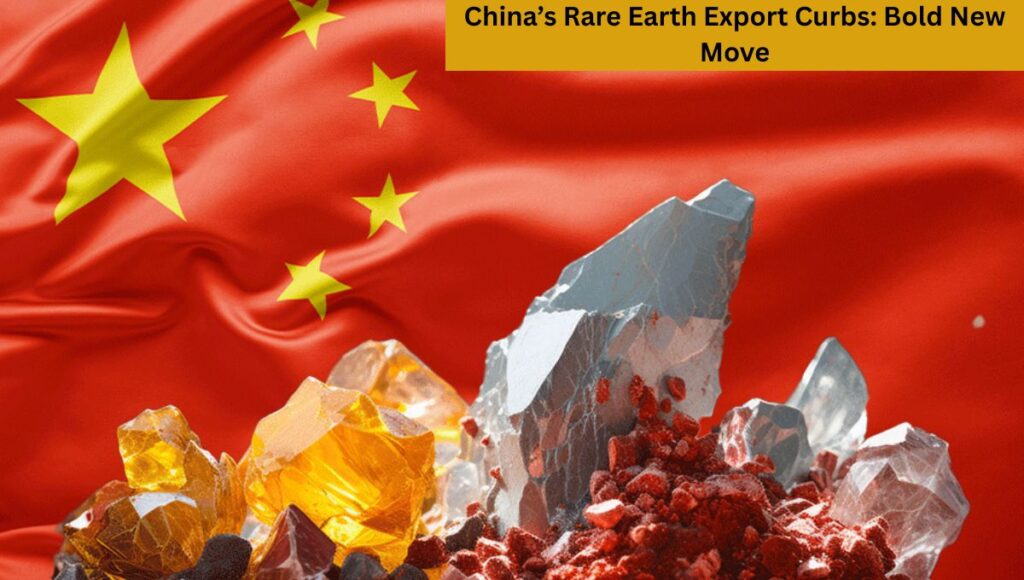
China’s Rare Earth Export Curbs: Bold New Move
Beijing Expands Oversight on Rare Earth Exports
Under the new framework, licenses are now required for the export of technologies involved in rare earth mining, smelting, separation, and magnet manufacturing. This includes not only the physical materials but also the equipment, processes, and know-how used in production.
The Ministry of Commerce specified that license applications will be rejected “in principle” if the exports are deemed to have potential military or defense-related applications. Exports related to advanced computing, semiconductor manufacturing, and artificial intelligence will face a case-by-case review, particularly when such technologies could be used in strategic or sensitive areas.
China’s new rules also prohibit Chinese nationals and companies from assisting in overseas rare earth projects — such as mining, refining, or magnet production — without explicit government consent.
“Some overseas organizations and individuals have transferred Chinese rare earth materials and technologies for military or other sensitive uses, posing threats to China’s national security,” the ministry said in a statement.
A Strategic Resource in Global Competition
Rare earth elements — a group of 17 chemically similar metals — are essential in the production of a wide range of high-tech devices and defense systems. From neodymium magnets used in electric vehicles and wind turbines to yttrium and europium used in display panels and radar systems, these minerals are critical to modern technology.
While rare earths are not truly “rare,” they are difficult and environmentally hazardous to extract. China has long dominated this field, accounting for around 70% of global mining and nearly 90% of processing, according to the International Energy Agency (IEA).
This dominance gives Beijing immense leverage over industries worldwide. Analysts note that China’s rare earth policy has become a strategic instrument, similar to how the U.S. restricts advanced chip exports to China.
Parallels to U.S. Chip Export Controls
The new export curbs mirror the United States’ restrictions on semiconductor equipment sales to China. Washington’s rules — intended to curb Beijing’s ability to produce advanced chips for military applications — have significantly slowed the growth of China’s high-end chip sector.
Now, China appears to be reciprocating with rare earths, targeting an area where it holds near-monopoly power.
“Beijing has identified critical vulnerabilities in U.S. electronics and weapons manufacturing,” said Alex Capri, a trade expert based in Singapore. “These new regulations are specifically timed ahead of the Xi–Trump meeting and serve as leverage in the broader trade negotiation framework.”
Impact on the Defense and Semiconductor Sectors
The restrictions are expected to hit defense contractors and semiconductor manufacturers hardest. Rare earths are vital in precision weapons, jet engines, and radar systems, while the semiconductor industry depends on them for chip polishing and magnetic components in fabrication equipment.
Companies in Japan, South Korea, Europe, and the U.S. may face supply disruptions and rising prices. Already, traders have reported upward pressure on rare earth prices in anticipation of tighter supply.
“Global supply chains are fragile, and China’s latest move adds another layer of uncertainty,” said a Hong Kong-based commodities analyst. “If these licensing rules are strictly enforced, manufacturers could face delays and higher input costs for months.”
Ripple Effects Across Global Supply Chains
The global manufacturing ecosystem — already under strain from post-pandemic disruptions and trade restrictions — is bracing for further volatility.
The United States, Australia, and India have been accelerating efforts to diversify rare earth supply chains and reduce dependency on Chinese refining.
- Australia’s Lynas Rare Earths recently partnered with U.S. defense contractors to expand non-Chinese processing capacity.
- India, meanwhile, is exploring domestic mining and recycling programs to secure stable access to key minerals.
Despite these efforts, experts say China’s dominance remains overwhelming, especially in refining technology and magnet production. Even if alternative mines are developed, most ores still require processing in China, making it difficult for other nations to fully bypass Beijing’s control.
A Calculated Move Before the Xi–Trump Meeting
The timing of China’s announcement is widely seen as strategic. With the Trump administration imposing additional restrictions on Chinese tech firms and expanding tariffs on imports, Beijing’s decision underscores its intent to push back.
In April, China added seven rare earths and related materials to its export control list, triggering shortages and price spikes across industries. A temporary agreement reached in June allowed limited exports, but many manufacturers are still struggling with residual effects.
By tightening rules again, China signals that it is prepared to leverage its rare earth monopoly in response to U.S. trade measures — just as Washington has used chip restrictions to slow Beijing’s technological rise.
“Both sides are testing the limits before the summit,” said George Chen, a partner at The Asia Group. “Rare earths will remain a key negotiation point, and these moves are as much about signaling as they are about substance.”
International Reactions: Concern and Contingency Planning
Governments and industries worldwide are now reassessing their exposure to Chinese rare earths.
In Washington, the U.S. Commerce Department said it is “closely monitoring” the implications of Beijing’s announcement. Officials are reportedly in talks with allies, including Japan and Australia, to strengthen supply resilience.
European Union officials echoed similar concerns, emphasizing the need for “strategic autonomy” in critical raw materials. The EU has already listed rare earths as part of its Critical Raw Materials Act, which aims to reduce dependence on non-EU suppliers.
In Tokyo, Japanese manufacturers — heavily reliant on rare earth magnets for electric vehicles and robotics — are reportedly seeking alternative suppliers in Vietnam and Malaysia.
India, which imports rare earths for both civilian and defense uses, has been asked by Beijing to guarantee that Chinese-origin materials will not be re-exported or used for military purposes. Indian firms have offered end-use assurances to maintain trade continuity.
Also Read: China outlines more controls on exports of rare earths, technology
Economic and Environmental Implications
Beyond geopolitics, China’s move could reshape the economics of rare earth production. The new licensing regime will likely increase administrative oversight and compliance costs for exporters, while discouraging illegal or grey-market sales that have long plagued the industry.
From an environmental perspective, analysts note that tighter controls may help Beijing enforce cleaner production standards. Rare earth processing generates toxic waste, and Beijing has in recent years cracked down on smaller, polluting operators to consolidate control under state-approved enterprises.
However, critics warn that this environmental rationale also strengthens state control over pricing and exports, giving Beijing a powerful economic and political tool.
A Mirror Image of U.S. Strategy
China’s rare earth curbs represent a mirror image of Washington’s technology containment strategy.
Where the U.S. seeks to restrict China’s access to high-end semiconductors, Beijing is now limiting the flow of the raw materials and technologies that make those chips possible.
This tit-for-tat approach has deepened the global technology cold war, with both sides weaponizing critical supply chains in pursuit of strategic advantage.
“It’s not a full-blown decoupling yet,” said one Beijing-based academic specializing in international trade law, “but both powers are clearly building protective walls around their most vital industries.”
Future Outlook: Uncertain Path Ahead
The full impact of the new rules will depend on how strictly China enforces export licenses and whether exemptions are granted for certain civilian uses.
If the licensing process becomes a political tool, industries could face unpredictable supply disruptions — affecting everything from electric vehicle batteries and renewable energy components to defense systems and consumer electronics.
At the same time, the move may accelerate global investment in rare earth alternatives, recycling, and substitution technologies. Several Western research groups are exploring synthetic magnets and non-rare-earth materials to reduce dependency.
For now, China’s decision underscores its resolve to maintain tight control over strategic resources, positioning itself as both a gatekeeper and a global power broker in the minerals essential to the 21st-century economy.
Conclusion
China’s new export controls on rare earths mark another escalation in the ongoing economic and technological rivalry with the United States. By extending oversight to technologies and partnerships, Beijing has effectively reinforced its monopoly on critical materials that power the world’s defense, semiconductor, and renewable industries.
As both nations prepare for the Trump–Xi meeting, the rare earth issue highlights the delicate balance between economic interdependence and national security — a balance that continues to define the contours of global geopolitics.
Also Read: Trump Confirms Rare Earths Deal with China, Signals “Very Big” India Trade Agreement Ahead