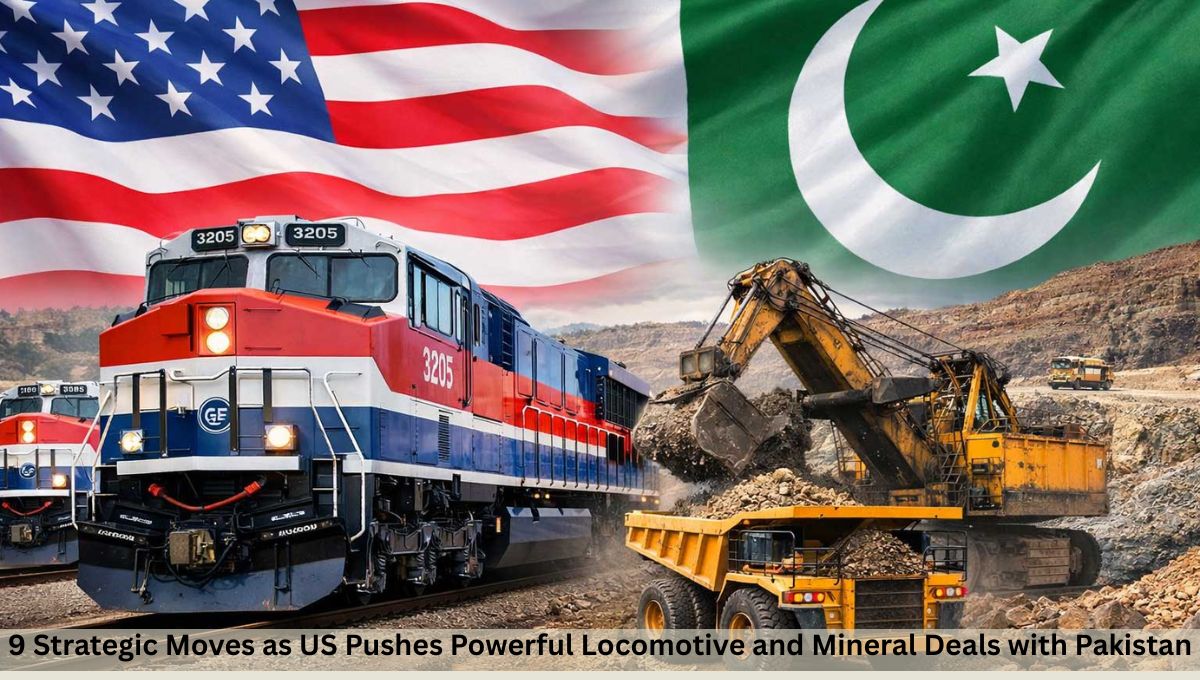
9 Strategic Moves as US Pushes Powerful Locomotive and Mineral Deals with Pakistan, signalling deeper economic engagement in South Asia.The United States under President Donald Trump has stepped up efforts to expand its commercial and strategic footprint in Pakistan, approaching Islamabad with proposals that span American locomotive sales, mineral exploration partnerships, digital connectivity, and financial cooperation, according to multiple reports citing Pakistani government sources.
The discussions, revealed by The Express Tribune, took place during Finance Minister Muhammad Aurangzeb’s visit to Washington in October, on the sidelines of the International Monetary Fund (IMF) annual meetings.
They reflect a broader US push to align trade, investment, and geopolitics—particularly in sectors Washington views as strategically critical, such as transport infrastructure, critical minerals, artificial intelligence, and digital finance.
Pakistani authorities have since held internal consultations to assess the scope, feasibility, and implications of the American proposals, while official responses from the Ministry of Finance and Ministry of Railways remain pending.
9 Strategic Moves as US Pushes Powerful Locomotive and Mineral Deals with Pakistan
Talks Held During High-Level IMF Meetings
Washington Meetings With Senior US Officials
According to the report, Aurangzeb met with several senior American officials, including Raymond Emory Cox, Special Assistant to the US President for International Economic Relations, and Ricky Gill, Special Assistant to the President and Senior Director for South and Central Asia at the US National Security Council.
These meetings focused on boosting bilateral economic engagement and identifying areas where US commercial interests could align with Pakistan’s development needs—particularly at a time when Islamabad is navigating fiscal stress, IMF conditionalities, and a pressing need for foreign investment.
US officials reportedly stressed that protecting and advancing American business interests is a top priority of the Trump administration, while calling for a “level playing field” for US companies operating in Pakistan.
American Locomotives at the Center of Talks
Renewed Push for US-Built Engines
One of the key issues raised by US officials was Pakistan’s purchase of American-manufactured locomotives under a tender that has already been issued. Ricky Gill reportedly sought Islamabad’s support for the procurement, highlighting past cooperation between the two countries in the rail sector.
Pakistan Railways had previously acquired 55 locomotives from the United States as part of efforts to modernize its aging railway infrastructure. However, current financial realities present a major hurdle to any new large-scale purchases.
Pakistan Railways’ Financial Struggles
Pakistan Railways is facing severe liquidity constraints, forcing it to prioritize repair and refurbishment of existing locomotives rather than investing in new rolling stock.
Officials noted that a project to rehabilitate 100 diesel-electric locomotives has seen its cost revised upward to Rs16 billion, underscoring the fiscal pressure on the railway system.
With frequent breakdowns, outdated infrastructure, and limited budgetary space, Pakistan Railways remains one of the most financially distressed public-sector entities—raising questions about its capacity to absorb additional foreign purchases without concessional financing or external support.
US Interest in Pakistan’s Critical Minerals
Strategic Resources Take Center Stage
Beyond railways, Washington placed strong emphasis on cooperation in Pakistan’s critical minerals sector, an area of growing global competition amid the energy transition and rising demand for high-tech materials.
US officials reportedly described critical minerals as a strategic priority, essential for clean energy technologies, defence systems, and advanced manufacturing. Pakistan’s largely underexplored mineral wealth—particularly in Balochistan—has increasingly attracted international attention.
Reserve Assessments and Offtake Agreements
Senior US State Department official Thomas Lersten, from the Bureau of Economic, Energy and Business Affairs, proposed collaboration on:
- Mineral reserve assessment studies
- Offtake agreements
- Accelerated extraction frameworks
Such cooperation would aim to move projects from exploration to production more quickly, while potentially securing long-term supply chains for US and allied industries.
Reko Diq and the Bigger Minerals Picture
US Financing Signals Long-Term Interest
The report highlighted that the US Congress has established a $135 billion global fund dedicated to investments in critical minerals.
In addition, the US Export-Import Bank has approved a $1.25 billion loan for the Reko Diq Mining Company in Balochistan—home to one of the world’s largest undeveloped copper and gold deposits.
The Reko Diq project has become a cornerstone of Pakistan’s mining ambitions and a test case for foreign investment following years of legal disputes and restructuring.
US engagement in Reko Diq signals not just commercial interest, but a strategic effort to diversify global mineral supply chains away from overdependence on rival powers.
Artificial Intelligence and Energy Cooperation
AI Framed as a Strategic Priority
American officials also flagged artificial intelligence (AI) as a strategic priority that could intersect with future mineral, energy, and industrial projects. Lersten reportedly emphasized AI’s growing role in resource management, extraction efficiency, and industrial planning.
There was also discussion of a possible visit by US Under Secretary for Energy Jacob Helberg, indicating potential follow-up talks in the energy and technology domains.
Starlink and Digital Connectivity Talks
Licence Request for Rural Internet Access
Another notable issue raised during the meetings was Starlink’s licence application to operate high-speed satellite internet services in Pakistan.
US officials sought favourable consideration for the company, particularly to expand connectivity in rural and remote areas.
The move aligns with Washington’s broader push to support US technology firms abroad, while Pakistan sees digital connectivity as key to economic inclusion and service delivery.
Digital Finance and Stablecoin Frameworks
US Focus on Private-Sector Solutions
Aurangzeb also met Robert Kaproth, Assistant Secretary of State for International Finance, who discussed:
- Regional financial developments
- Digital finance cooperation
- Cross-border payment systems
US officials reportedly expressed interest in private-sector digital finance solutions, including stablecoin-based frameworks, rather than central bank digital currencies (CBDCs). This reflects Washington’s evolving stance on digital finance governance and cross-border interoperability.
Withdrawal of Digital Services Tax Welcomed
US officials welcomed Pakistan’s decision to withdraw a proposed 5% digital services tax, which had been introduced in the federal budget but later removed.
The withdrawal was reportedly seen as a gesture to facilitate a broader trade understanding with Washington and ease concerns of US technology companies operating in Pakistan.
Geopolitical Undercurrents in Economic Talks
Beyond Commerce
While framed as commercial engagement, the discussions carry clear geopolitical undertones. US outreach on locomotives, minerals, AI, and digital finance comes at a time when global competition over supply chains, technology, and resources is intensifying.
Pakistan, meanwhile, is seeking diversified partnerships to stabilize its economy, attract investment, and reduce dependence on a narrow set of external financiers.
Pakistan’s Internal Review and Next Steps
Pakistani authorities have reportedly begun internal consultations to evaluate the proposals across ministries, including finance, railways, and energy.
Officials are weighing:
- Financial feasibility
- Strategic implications
- Alignment with IMF commitments
- Long-term economic benefits
No formal agreements have been announced so far, and both sides are expected to continue technical-level talks to translate proposals into concrete outcomes.
A Cautious but Significant Reset
The reported discussions suggest a measured but meaningful recalibration of US-Pakistan economic engagement under the Trump administration. By linking traditional infrastructure projects with future-facing sectors such as critical minerals, AI, and digital finance, Washington appears intent on embedding American commercial interests more deeply in Pakistan’s economic landscape.
For Islamabad, the challenge will be balancing these opportunities against fiscal constraints, domestic priorities, and broader geopolitical considerations.
As talks continue, the outcome will likely shape not just bilateral trade, but Pakistan’s positioning within an increasingly competitive global economic order.
Also Read: US Offers Locomotive Supply and Cooperation in Pakistan’s Mineral Sector
Related Posts:
- 7 Alarming Signals: Pakistan Forced to Sell PIA…

- Afghanistan–Pakistan War 2025: Inside the 48-Hour Ceasefire

- Gita Gopinath to Step Down as IMF’s No. 2 Official in August

- 5 Key Shifts in Bangladesh–Pakistan Relations as…

- In 8 Moves, EU Targets China-Linked Refineries and…

- 7 Powerful Measures: Trump Sanctions Russian Oil…
