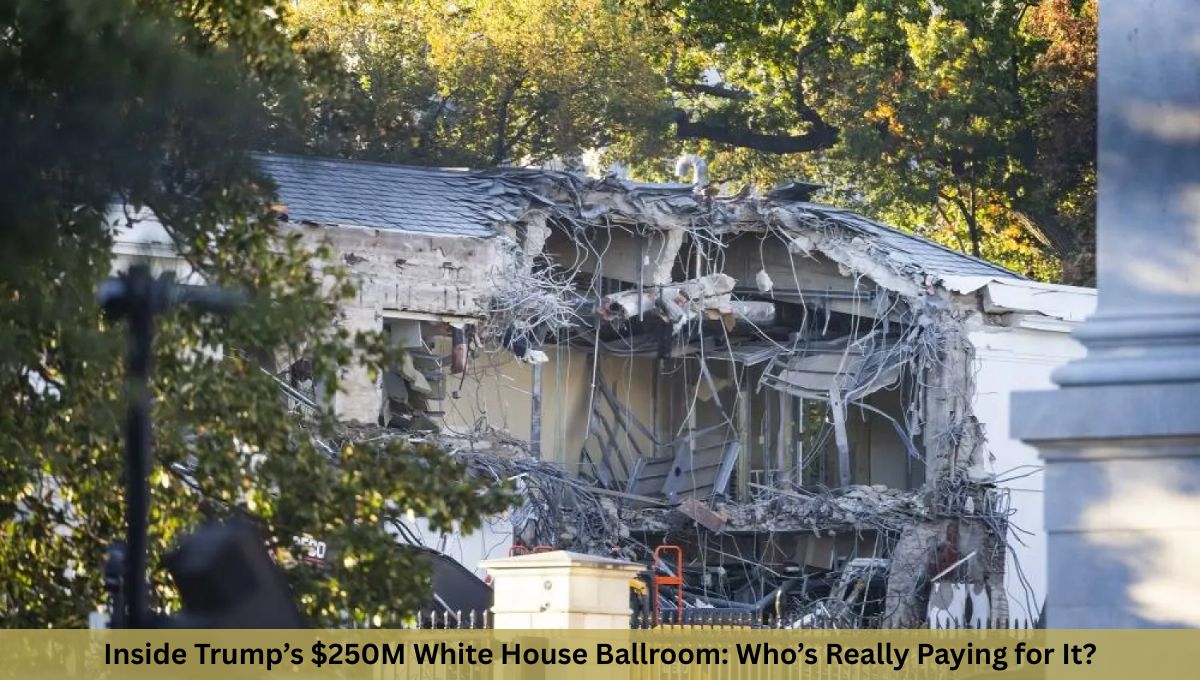
Inside Trump’s $250M White House Ballroom: Who’s Really Paying for It? – sparking controversy. Construction crews have begun tearing into the East Wing of the White House as President Donald Trump’s ambitious $250 million ballroom project gets underway. The sprawling 90,000-square-foot expansion—about the size of two football fields—will transform the presidential residence with what Trump calls “a grand and necessary addition.”
But the real question dominating Washington isn’t about the design. It’s about who is paying for it—and what they might get in return.
Inside Trump’s $250M White House Ballroom: Who’s Really Paying for It?
The Project: Trump’s “Big, Beautiful Ballroom”
Trump announced the project in July and confirmed ground-breaking in October on his social platform, Truth Social. “For more than 150 years, every president has wanted a ballroom at the White House,” Trump wrote. “I’m honored to be the first to get it done—with zero cost to the American taxpayer.”
According to the White House Press Office, the ballroom will cost between $200 million and $250 million, will seat up to 999 guests, and will serve as a permanent venue for state dinners, large receptions, and high-profile cultural events.
Trump says it’s long overdue: “The tents we’ve used for decades are embarrassing—this will be elegant, timeless, and 100% privately funded.”
The ballroom’s neoclassical design—complete with gold-leaf Corinthian columns, crystal chandeliers, and marble floors—has drawn comparisons to both Versailles and Caesars Palace, reflecting the President’s well-known taste for grandeur.
Washington-based McCrery Architects is leading the project, alongside Virginia-based Clark Construction and engineering firm AECOM of Dallas.
Architect James McCrery, known for his classical style, has designed major cathedrals and was reportedly hand-picked by Trump.
Demolition in the East Wing
To make room for the massive structure, bulldozers began tearing into parts of the East Wing, the section of the White House traditionally used by the First Lady and her staff since the Carter administration.
The demolition is controversial—not just for its symbolism, but also for its timing. The project began while the U.S. government remains in a shutdown, with thousands of federal employees furloughed. Critics call it “tone-deaf” and “unlawful.”
“It’s surreal,” said Democratic Representative Suzan DelBene, adding that Trump “cares more about his personal legacy than government workers struggling to pay their bills.”
Former Republican Congressman Joe Walsh was even harsher: “It’s an utter desecration. If I were President, I’d take a bulldozer to that ballroom myself.”
Still, the Trump administration insists the project will not cost taxpayers a dime, calling it a patriotic gift to the “People’s House.”
Who’s Paying? The Mystery Donors Revealed
Despite Trump’s repeated claims that he’s footing the bill himself, multiple reports suggest the ballroom is being bankrolled by major corporations, billionaires, and tech firms.
According to CBS News, donors have pledged nearly $200 million toward the ballroom through the Trust for the National Mall, a nonprofit that works with the National Park Service to fund White House and Mall projects. Donations are tax-deductible, offering a financial incentive to contributors.
At a private dinner held at the White House on October 15, attended by CEOs and business titans, Trump reportedly discussed contributions ranging from $5 million to $25 million.
Confirmed and Reported Donors:
- YouTube – $22 million (part of a legal settlement over Trump’s post–January 6 suspension)
- Lockheed Martin – pledged over $10 million
- Google, Palantir, Microsoft, Amazon, Blackstone, Coinbase, Booz Allen Hamilton, and NextEra Energy – reportedly donated between $5–10 million each
- Stephen Schwarzman (Blackstone CEO) – personal donor
- Woody Johnson, owner of the New York Jets – attendee at donor dinner
- Shari and Edward Glazer, owners of Manchester United and the Tampa Bay Buccaneers – attendees
A pledge form obtained by CBS indicated that donors could receive “recognition” for their contributions, possibly with names etched in the ballroom’s structure or listed on a permanent donor plaque.
“It’s an ethics nightmare,” said Richard Painter, a former chief ethics lawyer in the George W. Bush administration. “Corporations donating to build part of the White House is the very definition of pay-to-play politics.”
“I’ll Take It”: Trump’s Fundraising Pitch
During the donor dinner, Trump reportedly told guests, “Some asked me, ‘Is $25 million too much?’ I said, I’ll take it.”
Sources close to the administration say the effort is being led by Meredith O’Rourke, a longtime Trump fundraiser, in partnership with the Trust for the National Mall. Donors are invited to pay in one lump sum or in installments through 2027, according to internal documents.
A White House official said donors are eligible for “recognition associated with the White House Ballroom” but can also remain anonymous. Trump’s press secretary Karoline Leavitt emphasized that “no foreign sources” are involved.
The Legal and Ethical Storm
Ethics experts warn the project blurs the line between public service and private interest.
“This is effectively selling access to the White House,” said Painter. “These corporations all want something from the government—defense contracts, AI regulation, antitrust leniency. It’s a huge conflict of interest.”
Critics note that several of the reported donors—Lockheed Martin, Google, Microsoft, and Palantir—have active contracts or regulatory issues before federal agencies.
Proving corruption would be difficult, experts admit, since quid pro quo is hard to establish. But the appearance of influence could erode public trust.
“This is a very slippery slope,” said Kathleen Clark, a government ethics professor at Washington University. “When corporations start funding additions to the White House, democracy looks like it’s up for sale.”
The White House Defense: “It Saves Money”
Supporters of the project argue the ballroom is a practical improvement that will reduce future costs.
Former White House executive chef Martin Mongiello, who served under seven administrations, told the BBC:
“Those outdoor tents cost a million dollars or more each time. The ballroom will eventually pay for itself.”
The administration also argues that future presidents will benefit from the facility. “This is not just Trump’s ballroom—it’s America’s ballroom,” said White House Chief of Staff Susie Wiles. “It will serve generations to come.”
Historical Context: Presidents and Their Renovations
Presidential home makeovers aren’t new—but Trump’s project stands out for its scale and financing method.
Key White House Changes Over Time:
- Thomas Jefferson added the colonnades (now part of the East and West Wings).
- Teddy Roosevelt built the West Wing.
- Franklin D. Roosevelt expanded the East Wing over a secret underground bunker.
- Harry Truman gutted and rebuilt the entire interior after structural collapse.
- Jackie Kennedy refurbished interiors with antiques.
- Barack Obama modernized the Situation Room and added Wi-Fi.
- Melania Trump built a tennis pavilion and redesigned the Rose Garden.
But Trump’s ballroom marks the first exterior alteration in over 80 years, prompting the Society of Architectural Historians to warn it should only proceed “with special care to preserve the historic integrity of the building.”
Architecture and “Classical Beauty”
Trump’s ballroom reflects his long-standing preference for “classical architecture”—the same style he mandated in his 2020 executive order, “Making Federal Architecture Beautiful Again.”
Architect James McCrery is known for designs like the Cathedral of the Most Sacred Heart of Jesus in Knoxville, Tennessee, and has described the ballroom as “a reflection of American timelessness and strength.”
According to preliminary renderings, the ballroom will feature:
- White marble flooring and gilded cornices
- Arched windows overlooking the South Lawn
- 50-foot ceilings
- A presidential stage and orchestra pit
- Separate VIP galleries and press balconies
Also Read: Donald Trump’s 24-Karat Gold White House Makeover: ‘Best Oval Office Ever’ or Tone-Deaf Bling?
The Shutdown Optics: “Golden Hammers Amid Government Halts”
The timing of the demolition—during a prolonged federal shutdown—has drawn outrage.
While millions of Americans face delayed paychecks, the image of bulldozers tearing through the White House has sparked fierce backlash on social media.
“Trump’s building a palace while the government is shut down,” read one viral post.
Critics argue that even if privately funded, the project is a symbol of privilege amid dysfunction.
White House officials counter that construction had been approved months before the shutdown and that security and preservation personnel remain on duty.
The Role of the Trust for the National Mall
The Trust for the National Mall, which oversees private fundraising for national landmarks, is handling the ballroom’s donations. The nonprofit’s collaboration with Trump has raised eyebrows because it offers tax deductions for contributions tied to a presidential vanity project.
“It’s unprecedented for a sitting president to use a nonprofit intermediary to fund a personal architectural legacy,” said historian Kate Andersen Brower. “This isn’t a park bench—it’s the East Wing of the White House.”
What Donors Might Get in Return
Beyond public recognition, donors could receive:
- Invitations to inaugural events in the ballroom
- Permanent plaques or name engravings in marble or bronze
- Tax deductions through the Trust’s nonprofit status
- Exclusive access to White House functions
While the White House insists all donations comply with ethics laws, watchdog groups argue that the optics are damaging. “It’s the Lincoln Bedroom scandal on steroids,” said Painter, referring to the Clinton-era controversy over overnight stays for donors.
The Vision: A Legacy That Lasts—or a Vanity Project?
Trump sees the ballroom as part of his broader legacy-building mission, alongside his “Victory Arch” concept modeled after the Arc de Triomphe, reportedly displayed as a model in the Oval Office.
“Every great nation has monuments that celebrate its spirit,” Trump said in July. “This ballroom will celebrate American greatness.”
To his critics, however, it’s an indulgent monument to personal ego.
To his supporters, it’s a gift to history.
Timeline of the Ballroom Project
| Date | Event |
| July 2025 | Trump announces the project on Truth Social |
| August 2025 | Architectural plans finalized by McCrery Architects |
| October 2025 | Groundbreaking and demolition begin |
| 2026 (Projected) | Completion aligned with America’s 250th anniversary celebrations |
| 2027 | Final donor payments due under pledge agreements |
The Final Word
The Trump White House Ballroom stands at the intersection of power, architecture, and politics—a lavish new stage for diplomacy that may also symbolize the blurring line between public office and private wealth.
Whether it becomes a historic landmark or a monument to controversy, one thing is clear:
The ballroom will forever alter not only the East Wing but also the legacy of the Trump presidency itself. “Presidents come and go,” one senior official said, “but this ballroom will stand as long as the White House stands.”
Also Read: A ‘beautiful’ ballroom and a new Lincoln bathroom: Trump relishes remaking the White House