US President Donald Trump Fuels Third-Term Speculation for 2028, Rejects Vice Presidential Bid. US President Donald Trump on Monday dismissed suggestions that he might run for vice president in 2028, but notably refused to rule out the possibility of seeking a third term in office, reviving speculation and constitutional debate over the limits of presidential tenure in the United States.
Key Highlights
- US President Donald Trump rejected the idea of running as vice president in 2028, calling it “too cute.”
- He hinted at the possibility of a third presidential term, despite constitutional limits.
- The 22nd Amendment restricts presidents to two elected terms.
- Trump’s comments have stirred fresh speculation among allies, including Steve Bannon.
- Constitutional scholars say any path to a third term would face overwhelming legal barriers.
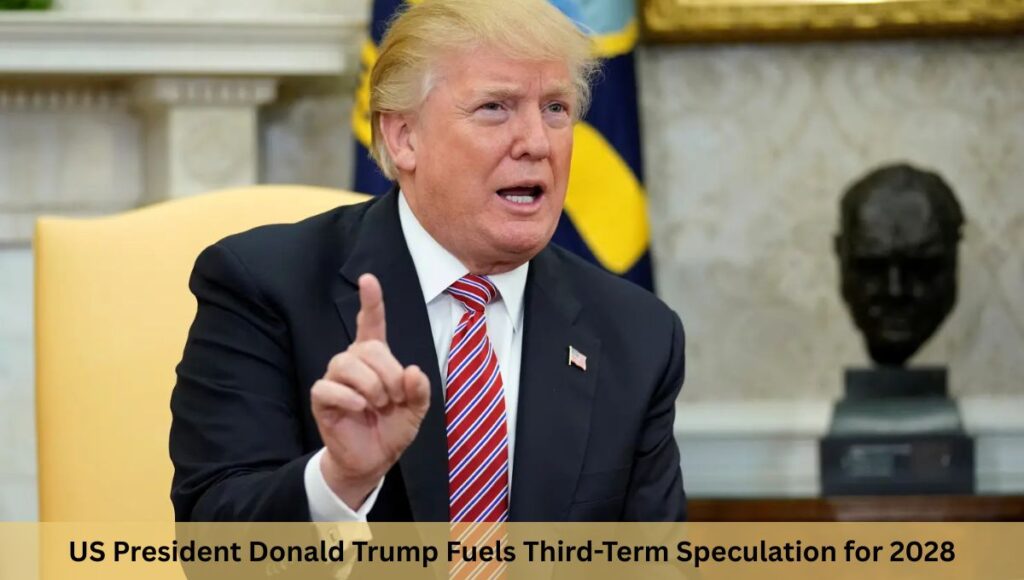
US President Donald Trump Fuels Third-Term Speculation for 2028
Trump Rules Out Vice-Presidential Run in 2028
Speaking to reporters aboard Air Force One en route from Malaysia to Tokyo, US President Donald Trump brushed off the idea of running for vice president under another Republican in 2028, describing the notion as “too cute” and “not right.”
“I’d be allowed to do that,” Trump said, referring to the possibility of serving as vice president. “But I wouldn’t. It wouldn’t be right. I think people wouldn’t like that. It’s too cute.”
The comments came after some of his supporters floated the theory that Trump could return to the presidency by running as a vice-presidential candidate, then assuming office if the president-elect resigned.
However, legal experts have widely dismissed the idea. The 12th Amendment to the US Constitution stipulates that no person ineligible for the presidency may serve as vice president. Given the 22nd Amendment’s clear limit of two elected terms, constitutional scholars say Trump cannot hold the office again through any such maneuver.
Hints of a Third Term: “I Would Love to Do It”
While rejecting the vice-presidential path, US President Donald Trump left open the possibility of seeking a third term outright.
When asked if he would consider running again in 2028, Trump replied, “I would love to do it. I have my best numbers ever.”
Pressed by reporters on whether he was formally ruling out a third term, Trump added ambiguously, “Am I not ruling it out? I mean, you’ll have to tell me.”
The 79-year-old leader, who began his second term earlier this year, went on to say he “hadn’t really thought about it,” a response that only added fuel to speculation about his future political ambitions.
Also Read: 3 Explosive Claims: Steve Bannon Says Trump Will Serve a Third Term in 2028
Constitutional Constraints and Legal Realities
The 22nd Amendment, ratified in 1951 after Franklin D. Roosevelt’s four electoral victories, bars any individual from being elected to the presidency more than twice.
It reads: “No person shall be elected to the office of the President more than twice.”
To overturn this rule, either Congress would need to pass a new amendment with two-thirds support in both chambers, or two-thirds of US states would have to call for a constitutional convention. In either scenario, three-fourths of the states—38 in total—would need to ratify the change, a process considered politically unfeasible in the current environment.
Legal scholars have emphasized that even an attempt to challenge the amendment in court would almost certainly fail.
“I would predict the Supreme Court to say ‘nope, it’s clear — two terms of four years each, and that’s it,’” said Wayne Unger, a constitutional law professor at Quinnipiac University. “Donald Trump cannot run for a third term.”
Also Read: Trump fuels third-term speculation: A look at legal hurdles and what experts have to say
Bannon’s “Plan” and Political Undercurrents
Despite the constitutional barrier, Trump’s allies have continued to hint at unconventional strategies.
Last week, former White House strategist Steve Bannon told The Economist that “a plan is in place” to secure another term for US President Donald Trump.
“Trump is going to be president in ’28, and people ought to just get accommodated with that,” Bannon said, without elaborating on what such a plan might entail.
His remarks sparked renewed interest among Trump supporters who have long viewed term limits as a political constraint rather than a hard stop.
Some Republicans in Congress have previously floated proposals to repeal the 22nd Amendment, though none have gained traction.
Trump’s Political Messaging and the 2028 Narrative
For US President Donald Trump, maintaining speculation about a third term serves several political purposes, analysts say.
By keeping 2028 discussions alive, Trump sustains his relevance beyond the conventional limits of his presidency, ensuring that his influence continues to shape the Republican Party.
Political analyst John Fortier, co-author of a Brookings Institution paper on presidential term limits, noted that presidents entering a second term often face diminishing power — a phenomenon known as “lame-duck status.”
“The Twenty-second Amendment ensures that a re-elected president becomes a lame duck, contributing to the diminution of the office in the view of other Washington institutions,” Fortier and Norman Ornstein wrote in a 2016 analysis.
Trump’s remarks about 2028 may therefore function as a political signal: that he intends to remain central to the national conversation, both within his party and beyond.
Republican Succession Talk: Vance and Rubio Named
When asked about possible Republican successors, US President Donald Trump praised Vice President JD Vance and Secretary of State Marco Rubio, calling them “great people” with strong political prospects.
“If they ever formed a group, it’d be unstoppable,” Trump said, as Rubio reportedly smiled beside him.
The comment was widely interpreted as both a nod of approval and a subtle reminder of Trump’s continued role as the arbiter of Republican politics.
Trump’s endorsement carries weight in a party where loyalty remains a key currency.
Analysts say the 2028 field could include several of Trump’s current and former allies — though his hints about another run make it difficult for others to fully position themselves.
Inside the Air Force One Remarks
The exchange took place aboard Air Force One as US President Donald Trump traveled from Malaysia to Japan following the ASEAN Summit in Kuala Lumpur.
After a stopover in Tokyo, Trump is expected to attend the Asia-Pacific Economic Cooperation (APEC) forum in South Korea later this week, where he is scheduled to meet Chinese President Xi Jinping and other world leaders.
Trump’s comment about being “allowed” to run as vice president appeared to conflate eligibility and legality, according to constitutional experts, further illustrating how his off-the-cuff remarks can blur legal boundaries.
Historical Context: Roosevelt and the Two-Term Limit
Before the 22nd Amendment, presidents were guided only by tradition, not law. George Washington voluntarily stepped down after two terms, setting a precedent that lasted more than 150 years.
It was Franklin D. Roosevelt who broke that norm, winning four consecutive elections between 1932 and 1944, leading the country through the Great Depression and World War II.
His unprecedented four terms prompted lawmakers to formalize limits on presidential tenure.
Since then, several presidents — from Ronald Reagan to Barack Obama — have joked about seeking a third term, but none have seriously attempted to challenge the restriction.
US President Donald Trump’s remarks mark one of the rare occasions when a sitting president has publicly entertained the idea of extending his time in office.
Constitutional Barriers to Repealing the 22nd Amendment
Efforts to repeal the 22nd Amendment have surfaced periodically in Congress, but they rarely advance beyond committee discussion.
Amending the Constitution requires overwhelming bipartisan support — a threshold rarely met in modern US politics.
For Trump to legally pursue a third term, he would need both chambers of Congress to initiate the amendment or two-thirds of state legislatures to call for a constitutional convention.
Afterward, 38 states would have to ratify the change — an outcome legal analysts describe as “politically implausible.”
Trump’s Age, Fitness, and Public Image
At 79, US President Donald Trump continues to project energy and vigor, often contrasting his stamina with that of his 2020 rival Joe Biden, who is 82.
Throughout his 2024 campaign, Trump frequently questioned Biden’s mental acuity and physical fitness, a theme he has maintained into his second term.
Supporters say Trump’s travel schedule — which includes consecutive international summits and nightly media engagements — underscores his vitality.
Critics, however, argue that his continued focus on the 2028 race reveals an obsession with power and public validation.
Reactions Within the Republican Party
Trump’s hints about a third term have prompted mixed reactions within Republican circles.
Some hardline loyalists have embraced the idea as a show of defiance against political norms, while establishment Republicans have quietly distanced themselves, emphasizing adherence to constitutional limits.
Former Vice President Mike Pence, who broke with Trump after the 2021 Capitol riot, said earlier this year that “no one is above the Constitution.”
Others, including Florida Governor Ron DeSantis, have declined to comment directly but continue to build national profiles that suggest interest in a post-Trump GOP future.
Democratic Response and Broader Political Implications
Democrats were quick to seize on Trump’s remarks as evidence of authoritarian leanings.
California Governor Gavin Newsom said in a television interview that Trump’s refusal to rule out a third term “shows exactly why we have term limits.”
Former Vice President Kamala Harris echoed similar sentiments, telling the BBC she may run again in 2028, adding, “The American system is built to prevent power from concentrating indefinitely.”
Political analysts suggest that Trump’s flirtation with a third term may also be aimed at energizing his base by presenting himself as a figure unfairly constrained by “the establishment.”
The Strategic Utility of Ambiguity
Observers note that Trump’s rhetorical ambiguity has long served as a political tool.
By refusing to rule out certain possibilities, he maintains suspense and media attention — strategies that have defined his public career.
In this case, keeping the 2028 question open-ended allows him to assert continued dominance over the Republican narrative, even as others begin to plan for a post-Trump era.
“Trump’s comments are not about 2028,” said political scientist Norman Ornstein. “They’re about 2025, 2026, and 2027 — ensuring that everyone remains aligned with him until the very end.”
Why Trump Keeps the 2028 Talk Alive
Analysts say that US President Donald Trump’s willingness to entertain third-term speculation reflects not only personal ambition but also a strategic understanding of political influence.
The conversation helps delay the onset of lame-duck status and signals to allies that his leadership remains central to the Republican movement.
Even if he never pursues a third term, keeping the possibility alive strengthens his hold on party donors, lawmakers, and media attention. As constitutional scholars, political operatives, and global observers debate the implications, one fact remains clear: Trump’s remarks have reignited a national conversation about presidential power — and how far it can stretch.