
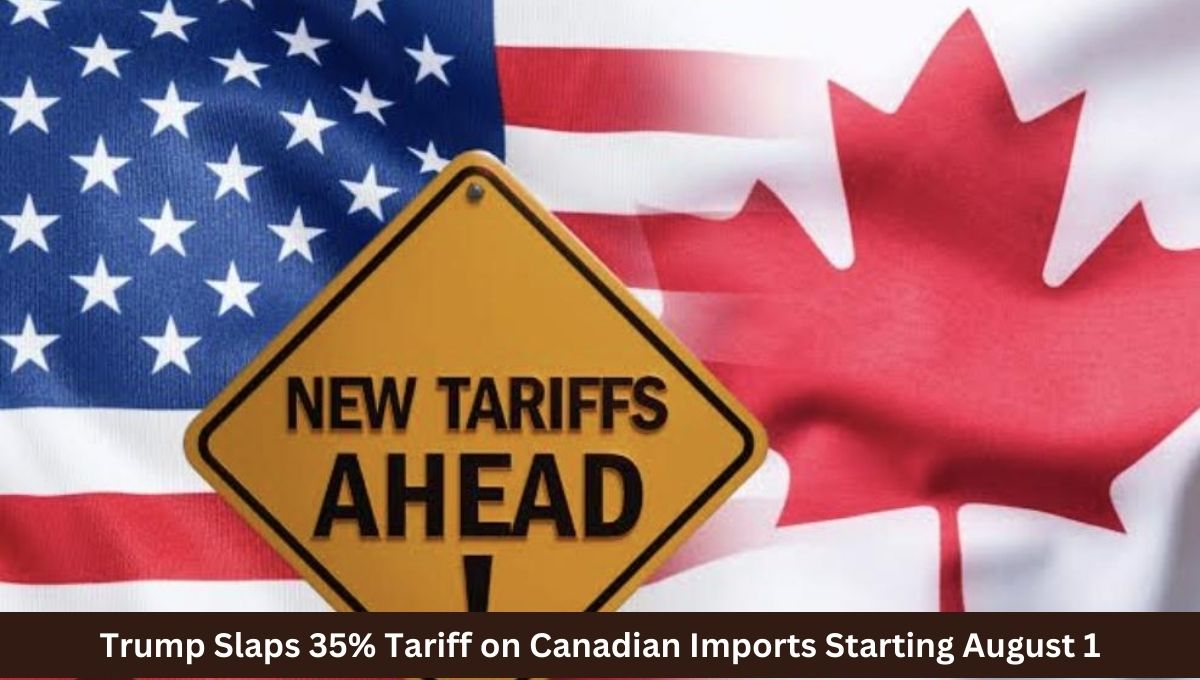
Escalating trade war, Trump Slaps 35% Tariff on Canadian Imports Starting August 1. U.S. President Donald Trump has intensified his protectionist trade policy with a sweeping 35% tariff on imports from Canada, set to go into effect on August 1, 2025. The announcement came in a formal letter addressed to Canadian Prime Minister Mark Carney, and was shared publicly on Trump’s Truth Social platform.
This move marks a sharp escalation in U.S.-Canada trade tensions and is part of Trump’s broader global strategy of what he has called “reciprocal tariffs”. Canada, one of America’s most vital trade partners, is now facing one of the steepest tariff hikes in recent history.
Trump Slaps 35% Tariff on Canadian Imports Starting August 1
Trump’s Justification: Fentanyl, Dairy, and Trade Deficits
In the letter, President Trump accused Canada of failing to cooperate with the United States in addressing several “critical” issues.
Chief among them is the flow of fentanyl into the U.S., which Trump claims is partly due to Canada’s lax border enforcement.
He also took direct aim at Canada’s dairy tariffs, which he claims reach as high as 400%, effectively locking American dairy farmers out of Canadian markets.
“Canada’s trade policies and the flow of fentanyl are among several serious issues hurting the U.S., including an unsustainable trade deficit,” Trump wrote.
“The Trade Deficit is a major threat to our Economy and, indeed, our National Security.”
A 35% Tariff and a Warning
Trump’s 35% tariff on Canadian goods is separate from existing sectoral tariffs already in place, such as those on steel, aluminum, and automobiles. The letter made clear that if Canada retaliates with its own new tariffs, Trump will increase the 35% rate by an equivalent amount.
“If for any reason you decide to raise your tariffs, then, whatever the number you choose to raise them by, will be added onto the 35% that we charge,” Trump warned. He also declared that transshipment sending goods through third countries to avoid the tariff would be met with enforcement.
Sectoral Tariffs and Their Impact on Canada
Canada is already grappling with a series of sector-specific tariffs imposed by the Trump administration over the past year, including:
- 50% tariffs on imported steel and aluminum
- 25% tariffs on most cars and trucks not built in the U.S.
These have significantly affected key Canadian export sectors, especially automotive and raw materials. With Canada shipping around 75% of its goods to the U.S., these tariffs represent a serious economic blow.
Blanket Tariffs Coming for Other U.S. Trade Partners
Trump’s Canada tariff is part of a broader strategy. In an interview with NBC News, he said his administration is preparing to impose blanket tariffs of 15% or 20% on “most remaining trade partners.”
“We’re just going to say all of the remaining countries are going to pay, whether it’s 20% or 15%. We’ll work that out now,” Trump said.
So far, Trump has issued more than 20 letters to countries including:
- Brazil (50% tariff on all imports)
- Japan and South Korea
- Sri Lanka
- The European Union (set to receive a letter this week)
He also announced a 50% tariff on copper imports, further widening the scope of the trade offensive.
U.S.-Canada Trade: A Critical Relationship at Risk
According to the U.S. Department of Commerce, Canada was the third-largest source of U.S. imports in 2024, exporting $413 billion worth of goods to the U.S. Conversely, Canada imported $349 billion worth of American products.
Disruptions in this bilateral relationship could send shockwaves through industries on both sides of the border, from agriculture and energy to manufacturing and logistics.
If enforced broadly, Trump’s 35% tariff could disrupt supply chains, raise prices for U.S. consumers, and strain diplomatic relations between the two allies.
The Road to This Tariff Decision
Trump’s animosity toward Canadian trade policies predates his current term. In November 2024, just weeks after being elected, he proposed 25% tariffs on all Canadian imports.
Though the tariffs were paused in February 2025, they were later implemented on March 6.
Since then, Canada has retaliated with tariffs on U.S.-made vehicles, appliances, whiskey, and sports equipment.
Canadian officials have also expressed growing frustration with what they see as an unpredictable and unilateral U.S. trade approach.
Trump’s past claims that Canada has been “ripping off” U.S. dairy farmers have become a central theme of his trade rhetoric.
Collapsed Trade Talks and the G7 Fallout
Earlier this year, at the G7 Summit, Prime Minister Mark Carney and President Trump agreed to work toward a new U.S.-Canada trade and security deal with a self-imposed deadline of July 21.
However, those talks broke down on June 27, when Canada announced a digital services tax targeting U.S. tech firms. Trump immediately responded by calling off negotiations and threatening new tariffs.
On June 29, in an apparent effort to salvage the situation, Canada withdrew the proposed tax. But by then, Trump had already shifted gears toward implementing the 35% import tariff.
“You will never be disappointed with The United States of America,” Trump ended the letter — a line he has repeated in every tariff-related letter this week.
Uncertainty in the Business Community
Trump’s tariff blitz has drawn concern from business leaders and investors alike. Analysts warn that rising tariffs could:
- Trigger a slowdown in cross-border trade
- Disrupt investment decisions
- Spark inflationary pressure
- Cause legal challenges in international trade forums
“This kind of uncertainty isn’t good for anybody,” said an executive from the U.S. Chamber of Commerce. “It hurts manufacturers, farmers, and consumers alike.”
Still, Trump maintains that tariffs are a necessary tool to boost American manufacturing and rebalance trade relationships.
Canada’s Options: Retaliate, Negotiate or Challenge?
With the August 1 deadline looming, Canada is now faced with difficult choices:
- Retaliate with counter-tariffs, escalating the trade war
- Re-enter negotiations under Trump’s terms
- Challenge the tariffs through legal mechanisms such as the World Trade Organization (WTO) or dispute resolution under CUSMA (Canada-United States-Mexico Agreement)
The Trump administration has not clarified whether CUSMA-compliant goods will be exempt from the new 35% tariff, creating further confusion for exporters and importers alike.
A Glimmer of Flexibility?
Despite the confrontational tone, Trump’s letter left the door open to revising or reversing the tariffs under certain conditions.
“If Canada works with me to stop the flow of fentanyl, we will, perhaps, consider an adjustment to this letter,” Trump wrote.
He also extended an olive branch to Canadian companies, suggesting they relocate to the U.S. to avoid the tariffs altogether.
“We will do everything possible to get approvals quickly, professionally, and routinely in a matter of weeks.”
What Comes Next?
As the clock ticks toward August 1, global markets, industry leaders, and policymakers are watching closely. With Trump now targeting trade relationships across Europe, Asia, and the Americas, a broader tariff era may be emerging.
The outcome of the U.S.-Canada standoff could set a precedent for how other nations respond to Trump’s “America First” trade agenda either through concessions, retaliation, or legal resistance. For now, businesses on both sides of the border are bracing for a volatile summer as a once-stable economic partnership hangs in the balance.
Also read: Tariff-free trade deal unlikely with US, says Canadian PM as deadline nears
Also Read: Trump Ends Canada Trade Talks Over Digital Services Tax on US Tech Giants
Related Posts:
- 5 Key Takeaways from Trump–Carney Meet: Trade,…
- What’s Next for Donald Trump After Court Rules His…

- U.S. and Canada Navigate Tensions as Carney, Trump…

- 9 Explosive Revelations as Trump Declares His Health…

- 7 Shocking Reasons FIFA’s Peace Prize for Trump…

- Trump’s 2025 Gaza Peace Plan Signing and Historic…
