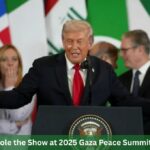
Trump’s 2025 Gaza Peace Plan Signing and Historic Global Reactions – a new chapter in Middle East diplomacy. US President Donald Trump on Monday signed what he called “a declaration for a new and beautiful day” in the Gaza Strip, marking a historic turning point in Middle East diplomacy. The event, held in Egypt’s Sharm el-Sheikh, brought together the leaders of Egypt, Qatar, and Turkey, as well as over twenty other global dignitaries.
With the words, “Now the rebuilding begins,” Trump formally launched the first phase of the Gaza peace plan, a multi-stage agreement aimed at ending years of bloodshed between Israel and Hamas. The signing followed an emotional address to the Israeli Knesset, where Trump declared that “the long and painful nightmare is finally over.”

Trump’s 2025 Gaza Peace Plan Signing and Historic Global Reaction
Trump Declares the End of Gaza’s “Nightmare”
In a jubilant ceremony, Trump hailed the agreement as “the dawn of a new Middle East,” pledging that Gaza would soon become “a symbol of faith, hope, and prosperity.”
The deal’s first phase included a dramatic exchange of prisoners and hostages:
- Israel released 250 Palestinian prisoners and 1,700 detainees held during the two-year military campaign.
- In return, Hamas agreed to release the last 20 living Israeli hostages and return the bodies of 28 deceased captives.
The moment was symbolic, signaling the first tangible peace breakthrough after two years of war that killed nearly 68,000 Palestinians and left Gaza in ruins.
Standing beside Egyptian President Abdel Fattah al-Sisi, Trump beamed as he was awarded Egypt’s Order of the Nile — the country’s highest civilian honor. “Everybody’s happy,” he quipped. “I’ve done big deals before, but this one took off like a rocket ship.”
Also Read: ‘Now the rebuilding begins,’ says Trump as he signs Gaza peace plan
A Summit of Global Leaders — But a Notable Absence
The summit saw world leaders — including Mahmoud Abbas, Recep Tayyip Erdoğan, and Qatari Emir Sheikh Tamim bin Hamad Al Thani — stand alongside Trump for a photo that symbolized global unity. But one seat remained empty: that of Indian Prime Minister Narendra Modi.
Despite a personal invitation from President al-Sisi, Modi chose not to attend the high-profile event, sending Minister of State for External Affairs Kirti Vardhan Singh as his special envoy instead. The decision sparked intense political and media debate in India.
Why Modi Skipped the Gaza Peace Summit
Diplomatic sources suggest that Modi’s absence was strategic. The most immediate reason, insiders say, was the presence of Pakistan’s Prime Minister Shehbaz Sharif at the summit.
India has been in a state of high alert with Pakistan since the April 22 Pahalgam terror attack, which killed 26 civilians and triggered Operation Sindoor, a massive retaliatory strike by Indian forces.
New Delhi reportedly did not want to risk a Modi–Sharif photo opportunity that Trump could later present as his mediation success — much like he did in other regional conflicts.
The decision also reflected India’s cautious approach toward Trump’s renewed claims of having mediated a ceasefire between India and Pakistan following Operation Sindoor — a claim India has consistently denied.
Tharoor: ‘Strategic Restraint or Missed Opportunity?’
Congress MP Shashi Tharoor openly questioned India’s diplomatic decision. “Given the galaxy of grandees present, India’s choice could be seen as signaling a preference for strategic distance,” Tharoor tweeted.
He added that while Kirti Vardhan Singh’s competence was not in doubt, India’s lower-level representation might reduce its influence on key issues like Gaza’s reconstruction and regional stability.
“For reasons of protocol access alone, India’s voice at the summit may carry less weight than it could have. In a region reshaping itself, our relative absence is puzzling,” Tharoor remarked.
MoS Kirti Vardhan Singh Meets Trump: First India–US Contact Since Operation Sindoor
Despite Modi’s absence, Minister of State Kirti Vardhan Singh became the first Indian minister to meet Donald Trump since Operation Sindoor.
Their meeting, held on the sidelines of the summit, marked a cautious thaw in New Delhi–Washington relations after months of tension over Trump’s 50% tariffs on Indian imports.
The two reportedly discussed bilateral trade, energy cooperation, and India’s humanitarian contribution to Gaza’s post-war recovery. Trump, according to sources, told Singh that “India’s role in global peace is indispensable.”
Trump’s Grand Vision: ‘A New Middle East’
In his address to the Israeli parliament, Trump proclaimed the end of “an age of terror and death,” calling the peace plan the start of “a grand concord and lasting harmony.”
“This is the start of a grand concord and lasting harmony for Israel and all the nations of what will soon be a truly magnificent region. This is the historic dawn of a new Middle East,” Trump said.
Echoing the rhetoric of his earlier Abraham Accords, Trump asserted that this new deal would reshape the geopolitical fabric of West Asia — one centered on stability, trade, and faith-based cooperation.
However, critics argue that without addressing Palestinian statehood, the deal risks being seen as merely another short-term ceasefire.
‘He’s Not the Easiest Guy’: Trump on Netanyahu
Trump’s rapport with Israeli Prime Minister Benjamin Netanyahu was on full display. Introducing Trump to the Knesset, Netanyahu called him “Israel’s greatest friend ever in the White House.”
Trump reciprocated warmly but candidly:
“He’s not the easiest guy to deal with, but that’s what makes him great.”
He revealed that he had advised Netanyahu to halt the Gaza campaign, warning that continued military action would “kill Israel’s image worldwide.”
“I said, ‘Bibi, you’re going to be remembered for peace, not for kill, kill, kill,’” Trump recounted to applause.
A Call for Netanyahu’s Pardon
In a dramatic moment, Trump called on Israeli President Isaac Herzog to pardon Netanyahu, who faces ongoing corruption trials.
“I have an idea,” Trump said, grinning. “Mr. President, why don’t you give him a pardon? Cigars and champagne — who the hell cares?”
The Knesset erupted in cheers, with lawmakers chanting “Trump! Trump! Trump!” in unison — an unprecedented show of adulation for a foreign leader.
“Peace President” and Nobel Buzz
As Trump concluded his speech, dozens of Israeli MPs stood wearing red caps that read “Trump the Peace President.” The parliament speaker told him, “There is no one more deserving of next year’s Nobel Peace Prize.”
The declaration drew laughter — but also a standing ovation. For Trump, who has long sought recognition for his global mediation efforts, the Gaza deal represents perhaps his most significant foreign policy victory since returning to office.
Also Read: Israel Awards Highest Honor to Trump in 2025 for Gaza Peace Efforts
Reactions from Regional Leaders
Egypt’s al-Sisi: “A Historic Milestone”
President al-Sisi called the signing ceremony a “historic milestone that ends an agonizing chapter.” He credited Trump’s persistence and his team’s diplomatic outreach — including Jared Kushner and Steve Witkoff — for making the breakthrough possible.
Mahmoud Abbas: “A Chance for Real Peace”
Palestinian Authority President Mahmoud Abbas, who was previously blocked from attending the UN General Assembly by the US, stood beside Trump during the photo-op. He praised the ceasefire as “a step toward a lasting peace,” but warned that “the reconstruction of Gaza must not come at the cost of Palestinian sovereignty.”
Critics Warn of Unfinished Business
Human rights advocates have raised doubts about whether the peace plan truly addresses the root causes of the conflict.
“Without dismantling the occupation and recognizing Palestinian statehood, peace will remain elusive,” said Rami Khouri, a Middle East analyst.
They also pointed out that Israel continues to expand settlements in the West Bank and conduct airstrikes in Lebanon and Syria, even after the ceasefire.
Trump’s Five Key Takeaways from His Middle East Tour
As Trump returned to Washington, his remarks throughout the trip revealed five central themes of his foreign policy revival:
1. A New Middle East Vision
Trump’s vision revolves around ending “the age of terror and death” and promoting an “era of faith and prosperity.” His language was distinctly biblical, framing peace as divine destiny.
2. Praise for Netanyahu, Despite Global Backlash
Trump reaffirmed his loyalty to Netanyahu but subtly pushed him toward moderation — signaling Washington’s shifting calculus under his leadership.
3. A Limited Message to Palestinians
Trump offered Palestinians promises of economic support but avoided references to sovereignty or statehood. His call to “turn from terror and build their people up” drew mixed reactions.
4. Mixed Signals to Iran
While boasting that US and Israeli strikes had “obliterated Iran’s nuclear program,” Trump left the door open for talks, saying, “I’d love to take the sanctions off when they’re ready to talk.”
5. A Claim to Legacy
Trump framed the Gaza peace as his crowning diplomatic achievement, adding that his next goal would be to “end the war in Ukraine.” His repeated mention of the Nobel Peace Prize underscored his desire for recognition.
India’s Strategic Distance and US Relations
The Sharm el-Sheikh summit also brought attention to the fragile state of India–US relations following Trump’s tariffs on Indian imports and sanctions threats over Russian oil purchases.
After weeks of diplomatic silence, Modi spoke with Trump on his 75th birthday, and the two leaders reportedly “reviewed progress in trade talks.”
However, Trump has continued to take credit for de-escalating India–Pakistan tensions, further irking New Delhi.
By sending Minister Kirti Vardhan Singh instead of Modi, India appeared to signal a careful recalibration — maintaining engagement with Washington without fully endorsing Trump’s peace narrative.
What Comes Next for Gaza?
The next phase of the peace plan involves creating a “Board of Peace”, chaired by Trump himself, to oversee Gaza’s reconstruction and governance transition.
According to Trump, the board will consist of representatives from Egypt, Qatar, Turkey, Israel, and the United States. The plan promises massive investments in rebuilding Gaza’s hospitals, schools, and infrastructure.
But questions remain over who will govern Gaza — the Palestinian Authority, an international coalition, or a new transitional body under US supervision.
Trump’s Peace Gamble and Global Stakes
Trump’s Gaza peace plan has reignited debates about American influence in the Middle East. Supporters hail it as a diplomatic masterstroke, while critics see it as a short-term fix that sidelines Palestinian rights.
Either way, the symbolism of Sharm el-Sheikh — the same city where world leaders once met to address global climate and security issues — may well go down in history as the birthplace of a new geopolitical order.
“It took 3,000 years to get to this point,” Trump said, smiling. “Can you believe it? And it’s going to hold up too.”
Only time will tell whether this “historic dawn” will bring lasting peace — or prove another fleeting moment in the Middle East’s long struggle for stability.
Conclusion: A Moment of Celebration and Skepticism
As the dust settles in Gaza, Trump’s triumphal diplomacy is being tested by the realities on the ground.
While world leaders applauded his peace plan, many remain wary of its sustainability. India’s cautious absence, Tharoor’s domestic critique, and Palestinian calls for sovereignty all underscore the complexity behind the celebrations.
For now, the words that echoed through the Knesset — “Now the rebuilding begins” — stand as both a promise and a challenge.