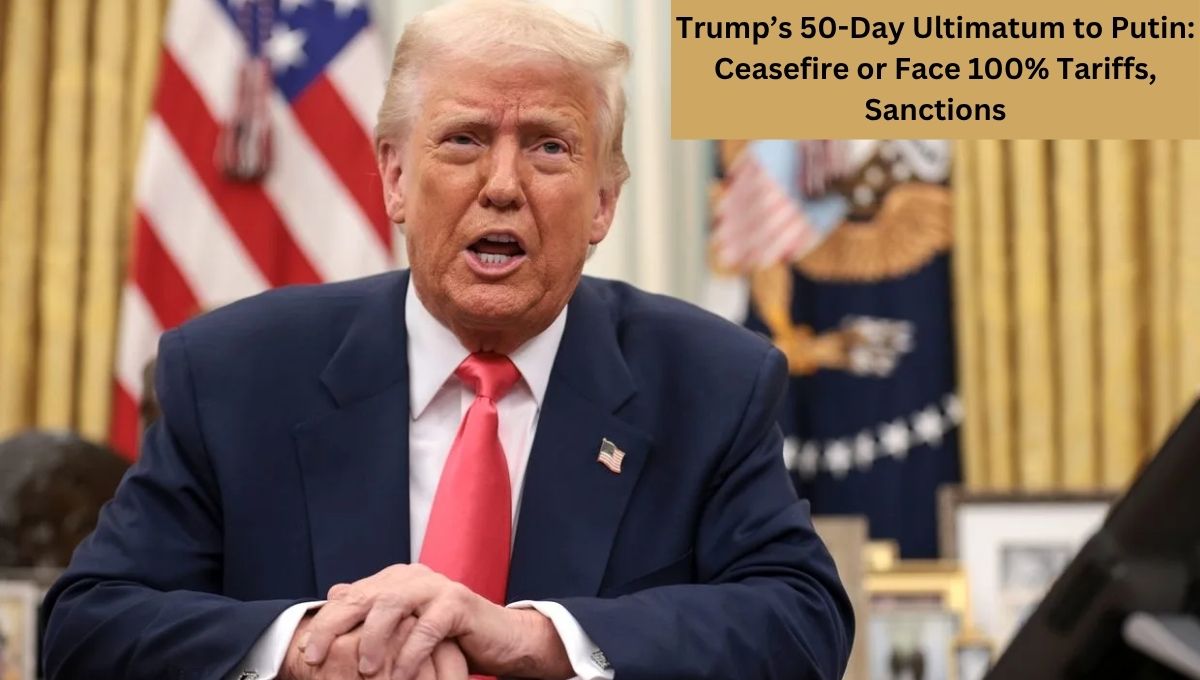
In a pivotal moment for global diplomacy, Trump’s 50-Day Ultimatum to Putin: Ceasefire or Face 100% Tariffs, Sanctions. U.S. President Donald Trump has given Russia a strict 50-day deadline to end the war in Ukraine through a ceasefire agreement or face a new wave of crippling U.S. tariffs and secondary sanctions. The announcement marks a dramatic policy shift from Trump’s earlier non-confrontational posture toward Moscow and is accompanied by renewed military support for Ukraine, including advanced Patriot missile systems.
While Kyiv welcomed the missile boost with cautious optimism, the lack of immediate financial penalties on Russia and its global energy partners China and India chief among them has sparked concern over whether the pressure on Moscow is truly enough.
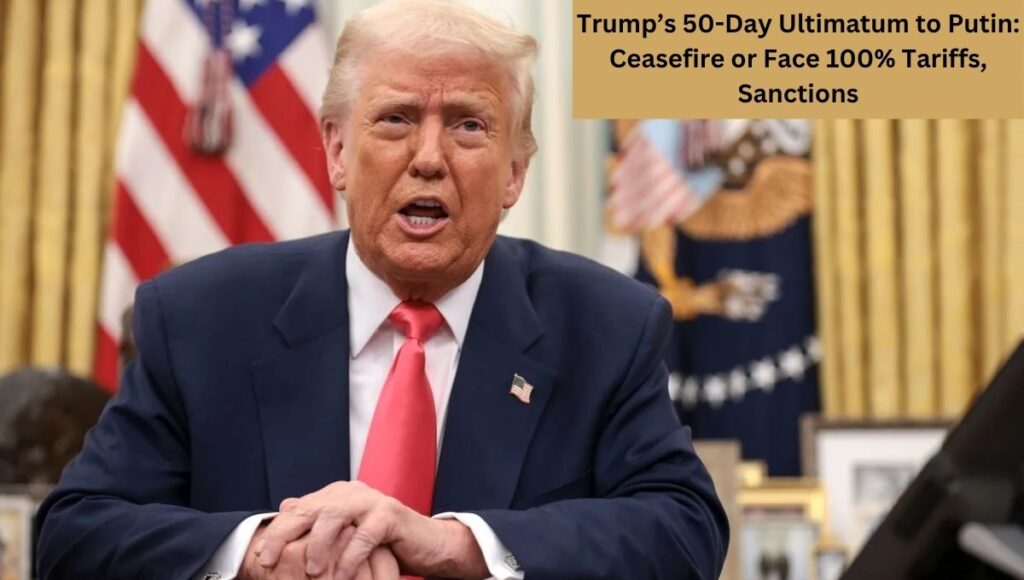
Trump’s 50-Day Ultimatum to Putin: Ceasefire or Face 100% Tariffs, Sanctions
A Shift in Trump’s Russia Strategy
Speaking at the White House alongside NATO Secretary-General Mark Rutte, President Trump declared a two-pronged approach to end the Ukraine conflict: providing military aid to Ukraine and threatening economic retaliation against Russia if no peace deal is signed within 50 days.
“If we don’t have a deal in 50 days, we’re going to be doing very severe tariffs 100% tariffs,” Trump said. “And there will be secondary sanctions.”
This represents a significant departure from Trump’s previous efforts to keep dialogue open with Russian President Vladimir Putin, avoid escalation, and minimize U.S. financial involvement in the war.
What the 100% Tariff Threat Means
The proposed 100% tariffs on Russian exports and secondary sanctions on nations that continue to trade with Russia particularly those purchasing Russian oil and gas could devastate the Kremlin’s already stressed economy.
Russia relies heavily on energy exports for government revenue, and this new threat could put immense pressure on Moscow’s wartime spending.
“Both tariffs and sanctions are tools in the president’s toolbox,” said Commerce Secretary Howard Lutnick, confirming that both could be triggered as early as September if Russia fails to agree to a ceasefire.
The potential secondary sanctions would have far-reaching global consequences, especially for China and India, two of Russia’s largest energy clients.
These nations would be forced to choose between cheap Russian energy and access to U.S. markets.
Military Aid to Ukraine: Patriot Missiles Incoming
In parallel with the economic warning, Trump confirmed the delivery of Patriot missile systems to Ukraine, paid for by NATO but manufactured by the U.S.
“We’re not buying it, but we will manufacture it,” Trump said. “They’re going to be paying for it.” Seventeen Patriot batteries are in the pipeline, some of which are expected to arrive in Ukraine “within days.”
These air defense systems are crucial to counter Russia’s relentless missile and drone strikes on Ukrainian cities.
Trump emphasized that this was not a blank check from Washington, but a shared NATO initiative, consistent with his policy of encouraging allies to shoulder more of the defense burden.
NATO Fully Backs Trump’s Tougher Posture
NATO Secretary-General Mark Rutte supported Trump’s message, stating that several key allies including Germany, Canada, the UK, Finland, and Sweden are ready to contribute to Ukraine’s defense.
“If I were Vladimir Putin today and heard what Trump just said, I’d reconsider my position,” Rutte said. “Speed is of the essence.”
The decision underscores a growing transatlantic consensus that the war must end and that only a credible deterrence will force Putin to negotiate.
Zelensky Responds: “We Thank You”
Ukrainian President Volodymyr Zelenskyy welcomed Trump’s decision, expressing appreciation for the renewed military assistance and acknowledging the role of Trump’s envoy Keith Kellogg, who visited Kyiv last week.
“We hope for the leadership of the United States,” Zelensky said. “Because it is clear that Moscow will not stop unless its ambitions are stopped by force.”
Zelensky also confirmed that Ukraine is working with Washington on joint arms production and strengthening air defense networks, calling the Patriot systems a vital upgrade.
Trump: “I’m Disappointed But Not Done With Putin”
In an exclusive BBC interview, Trump offered a rare glimpse into his personal frustrations with Putin. “I’m disappointed,” he said. “He talks so beautifully, then bombs people at night.”
He emphasized that he is “not done” trying to engage with the Russian leader but insisted that action must now follow diplomacy.
Trump referenced past negotiations where peace appeared near only to be derailed by fresh Russian missile attacks on Kyiv.
“We had four times where I thought we had a deal,” he said. “But then a building gets knocked down that night.”
From Promises to Pressure: A Clear Pivot
Trump, who famously claimed he could end the Ukraine war “in 24 hours,” had paused arms shipments to Ukraine earlier this year and even referred to Zelensky as a “dictator without elections.”
But Russia’s latest drone and missile barrages appear to have solidified a policy reversal.
The new approach combines pressure on Russia, military support for Ukraine, and the possibility of Congressional legislation that could dramatically widen America’s sanctions scope.
Sanctioning Russia Bill 2025 Gains Momentum
Bipartisan lawmakers are working to push through the Sanctioning Russia Bill 2025, which proposes tariffs up to 500% on countries that continue to purchase Russian energy.
The bill is supported by Republican Senator Lindsey Graham and Democratic Senator Richard Blumenthal, and Trump has expressed tentative support, especially for its waiver provisions.
These provisions would allow the president to grant temporary exemptions to key allies potentially shielding countries like India while applying pressure elsewhere.
India and China Brace for Impact
India, the second-largest importer of Russian fossil fuels, is especially vulnerable. In May 2025 alone, India imported over €4.2 billion in Russian energy, with crude oil comprising 72% of that amount.
Indian External Affairs Minister S. Jaishankar confirmed ongoing discussions with Senator Graham to mitigate the potential fallout. India’s strategic position tied to both the U.S. and Russia makes any sanctions decision politically delicate.
China, meanwhile, has sent mixed signals. While unwilling to abandon Russian energy, Beijing has reportedly communicated concerns to Moscow over the escalating global cost of prolonging the war.
Why Kyiv Remains Wary
Despite the immediate relief offered by the missile systems, Ukrainian officials remain concerned about the delayed sanctions.
“This is short-term relief, yes, but the long-term pressure is missing,” one Kyiv adviser said privately.
Many fear that the 50-day window gives Russia time to regroup or escalate offensives rather than de-escalate.
Without immediate economic pain, Putin may continue the war effort, betting that Trump might extend the deadline or soften sanctions later.
Russian Markets React: Relief, Not Panic
In a surprising twist, Russian financial markets rallied after Trump’s announcement. The rouble gained against the dollar and yuan, and the Moscow stock exchange rose by 2.7%.
“Trump performed below market expectations,” said analyst Artyom Nikolayev of Invest Era. “He gave 50 days for Russia to stall, and he often extends deadlines.”
This suggests investors are betting on Trump’s flexibility, not his enforcement. Whether that bet pays off will depend on what Moscow does or doesn’t do in the next few weeks.
A New Tone, Same Uncertainty
Though Trump’s rhetoric toward Russia has sharpened, critics argue that many old patterns remain:
- No new U.S. funding for Ukraine.
- Burden-sharing through NATO remains the strategy.
- Sanctions delayed, not immediate.
- Belief in a negotiated peace remains, despite Moscow’s ongoing aggression.
“Trump has moved through every season of Putin spring hope, summer diplomacy, fall disillusionment, and winter frustration,” a senior U.S. official said. “But he still hasn’t fully shut the door.”
The Countdown Begins: What to Expect in the Next 50 Days
With the September deadline looming, the world now watches for signs of a breakthrough or further escalation. Key questions include:
- Will Putin respond with genuine peace talks or intensified military action?
- Will India and China begin to decouple from Russian energy?
- Will Trump use waiver authority to soften the impact on U.S. allies?
- Will Congress pass the Sanctioning Russia Bill 2025 in time?
- Will Ukraine gain further support beyond Patriots?
Conclusion: Trump’s Gamble on the Global Stage
Trump’s 50-day ultimatum to Russia is a high-stakes gamble: He’s betting that a mix of military aid, economic pressure, and diplomatic deadlines can force Putin to the negotiating table. But if Russia calls his bluff and sanctions don’t materialize quickly the window may close without real change.
For now, Ukraine welcomes the Patriots, Washington sounds tougher, and the world waits.
Also Read: NATO Chief Warns BRICS of 100% Tariffs Over Russian Trade
Also Read: Ukrainians unimpressed by Trump’s 50-day ultimatum to Putin
Related Posts:
- Trump’s 2025 Gaza Peace Plan Signing and Historic…

- 5 Powerful Highlights as Trump Lands Second Nobel…

- 7 Powerful Measures: Trump Sanctions Russian Oil…

- Can the EU and NATO Impose Tariffs on India and…

- Dramatic Moments Behind Trump’s Gaza Peace Push and…

- Trump Sends Patriots to Ukraine, Turns on Putin in…
