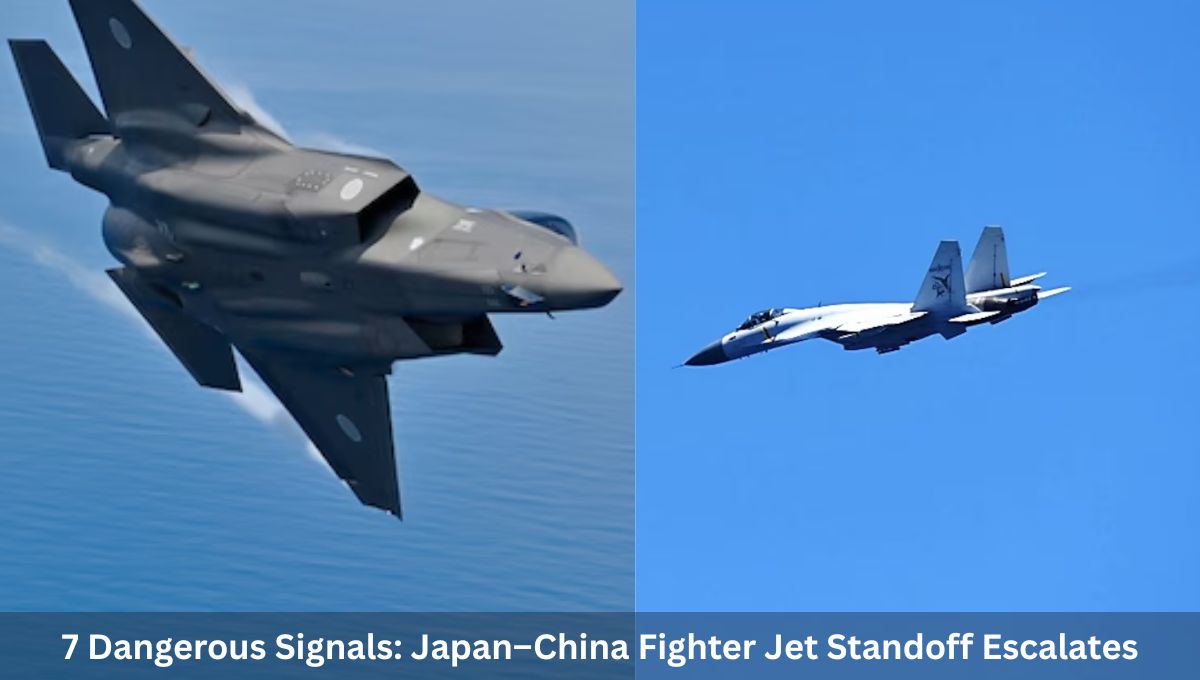
7 Dangerous Signals: Japan–China Fighter Jet Standoff Escalates, raising fears of military miscalculation in the Indo-Pacific. Japan and China are edging closer to a dangerous confrontation in the skies of the Indo-Pacific after Tokyo accused Chinese fighter jets of locking fire-control radar onto Japanese aircraft near Okinawa — one of the most aggressive aerial actions short of open combat.
The incident has pushed already strained bilateral relations to a new low, prompting Japan to summon China’s ambassador in Tokyo and igniting sharp diplomatic exchanges between the two Asian powers. The clash comes amid heightened sensitivities over Taiwan, military activity in international waters, and an expanding Chinese naval presence near Japan’s southwestern islands.

7 Dangerous Signals: Japan–China Fighter Jet Standoff Escalates
What Japan Accuses China of Doing
Japan’s Ministry of Foreign Affairs said it lodged a formal protest with Beijing after Chinese J-15 fighter jets, operating from the aircraft carrier Liaoning, allegedly twice illuminated Japanese Air Self-Defense Force F-15 jets with fire-control radar.
According to Japanese officials:
- The incidents occurred on December 6
- Both took place over international waters southeast of Okinawa
- Radar locks lasted three minutes in the afternoon and over 30 minutes in the evening
Japan described the actions as “dangerous” and “extremely regrettable,” warning that radar illumination indicates potential missile targeting and creates a serious risk of miscalculation.
Why Radar Locking Is So Serious
Illuminating a military aircraft with fire-control radar is widely viewed as one of the most threatening acts an aircraft can commit without firing a weapon.
What radar lock signals
- The target is being actively tracked
- Missile guidance systems may be engaged
- Pilots may be forced to take evasive action
Defense experts say such moves dramatically heighten the risk of accidental conflict, particularly in congested airspace where aircraft from rival militaries operate in close proximity.
Japan’s defense ministry said this was the first time it has publicly confirmed Chinese warplanes locking radar on Japanese aircraft, marking a significant escalation in bilateral military friction.
Japan Scrambled Fighters Near the Liaoning Carrier
The incident unfolded as Japan monitored the Chinese navy’s expanding carrier operations in the Western Pacific.
According to Japan:
- The Liaoning carrier strike group sailed past the Okinawa islands into the Pacific
- Approximately 100 aircraft takeoffs and landings were conducted over the weekend
- The carrier was accompanied by three guided missile destroyers
Japan scrambled multiple F-15 fighters to shadow the Chinese aircraft, maintaining what it described as a safe and professional distance. Tokyo insists no Japanese aircraft entered Chinese airspace, and no damage or injuries were reported.
Tokyo Summons China’s Ambassador
In response, Japan’s foreign ministry summoned Chinese Ambassador Wu Jianghao, formally protesting the incident and demanding measures to prevent a recurrence.
Chief Cabinet Secretary Minoru Kihara said Japan would:
- Respond “calmly but firmly”
- Closely monitor Chinese military movements
- Maintain vigilance in Japanese airspace and waters
Japan rejected China’s claims that its aircraft endangered Chinese operations, calling the accusations unfounded.
China Flatly Denies Japan’s Claims
Beijing has categorically rejected Japan’s version of events.
China’s embassy in Tokyo said:
- Chinese military activity was lawful and professional
- Japanese aircraft repeatedly approached Chinese training zones
- Japan was engaging in “slander and smearing”
China’s defense ministry accused Japan of harassing the Liaoning carrier group, claiming the Chinese navy had announced the training area in advance and acted in accordance with international law.
Chinese Military Pushback Grows Sharper
Senior Colonel Zhang Xiaogang, spokesperson for China’s Ministry of National Defense, accused Japan of:
- Deliberately intruding into Chinese military exercises
- Hyping incidents to mislead the international community
- Politicizing routine military operations
China warned it would take “necessary measures” to protect its security and sovereign interests, signaling that future confrontations could be met with a stronger response.
Taiwan at the Center of Rising Hostilities
The radar-lock incident comes against the backdrop of a deepening diplomatic rift triggered by Japanese Prime Minister Sanae Takaichi’s comments on Taiwan.
Last month, Takaichi said:
- A Chinese invasion of Taiwan could threaten Japan’s survival
- Tokyo may be justified in military intervention if Japan’s security is at stake
Beijing reacted furiously, calling the remarks an unacceptable intervention in China’s domestic affairs.
How China Responded to Takaichi’s Comments
Since the comments:
- China summoned Japan’s ambassador
- Chinese officials wrote formal complaints to the UN
- Beijing urged citizens to avoid travel to Japan
- A ban on Japanese seafood imports was reinstated
- Cultural exchanges and films involving Japan were curtailed
Chinese analysts described Takaichi’s remarks as crossing a red line on Taiwan, which Beijing considers an inseparable part of its territory.
Japan’s Constitutional Constraints — and Loopholes
Japan’s post-war constitution renounces war and prohibits the use of force to settle international disputes.
However:
- A 2015 reinterpretation allows limited collective self-defense
- Military action is permitted if an ally is attacked and Japan’s survival is threatened
Takaichi has argued that a Taiwan conflict could directly endanger Japan’s southern islands and sea lanes, making preparation unavoidable.
Regional Allies Weigh In
Japan is not alone in its concerns.
Australia backs Japan
Australian Deputy Prime Minister Richard Marles said Canberra was “deeply concerned” by China’s actions and voiced strong support for Japan.
Marles said:
- Military interactions must remain safe and professional
- Rules-based order must be upheld in the Indo-Pacific
The episode echoes similar close encounters experienced by Australian forces with Chinese aircraft in recent years.
The United States Watches Carefully
Japan hosts the largest overseas deployment of U.S. forces, including thousands of Marines based in Okinawa. Washington’s ambassador to Japan has publicly backed Tokyo’s stance, though President Donald Trump, who is expected to visit China for trade talks next year, has avoided direct comment.
U.S. strategic documents increasingly describe China as a key competitor, encouraging regional allies like Japan to play a larger role in Indo-Pacific security and Taiwan deterrence.
A Pattern of Rising Military Friction
The radar-lock incident is not an isolated event.
Past confrontations
- In 2013, a Chinese naval vessel locked radar on a Japanese destroyer
- Chinese warplanes routinely probe Japan’s Air Defense Identification Zone
- Taiwan has reported PLA simulations targeting foreign vessels
Security experts warn that each encounter increases the likelihood of miscalculation, especially as military activity intensifies across contested seas and airspace.
Why Okinawa Matters
Okinawa is strategically vital:
- Close to Taiwan and the East China Sea
- Home to major U.S. and Japanese military installations
- A key choke point for Chinese naval expansion into the Pacific
China’s carrier operations near Okinawa signal its ambition to project power farther east, while Japan sees such maneuvers as direct pressure on its national security.
ADIZ Flights and Legal Grey Zones
Japan, like many countries, maintains an Air Defense Identification Zone (ADIZ) — areas where aircraft are required to identify themselves.
However:
- ADIZs are not recognized under international law
- Flights through them are legal in international airspace
This legal ambiguity fuels disputes, as countries argue over what constitutes harassment versus lawful monitoring.
Risk of Escalation Remains High
Defense analysts warn that radar-lock incidents represent a dangerous threshold.
A misinterpreted maneuver, software error or pilot misjudgment could rapidly spiral into:
- Missile launches
- Aircraft losses
- Military confrontation between major powers
Both Tokyo and Beijing stress the need for communication channels, though it remains unclear whether emergency hotlines were used during the latest incident.
Conclusion: A Test of Restraint in the Skies
The alleged radar lock near Okinawa has become a powerful symbol of worsening Japan-China relations, military brinkmanship and the strategic shadow cast by Taiwan.
While no shots were fired, the incident underscores how fragile stability has become in the Indo-Pacific — where advanced weapons, nationalist politics and unresolved territorial disputes intersect. For now, both sides insist they will act responsibly.
But as military activity intensifies and rhetoric hardens, the margin for error continues to shrink — raising fears that the next encounter may not end as quietly.
Also Read: 7 Alarming Signals in the China–Japan Clash Over PM Takaichi’s Taiwan Remarks
Also Read: Chinese jets directed fire-control radar at Japanese aircraft in rare, highly threatening standoff