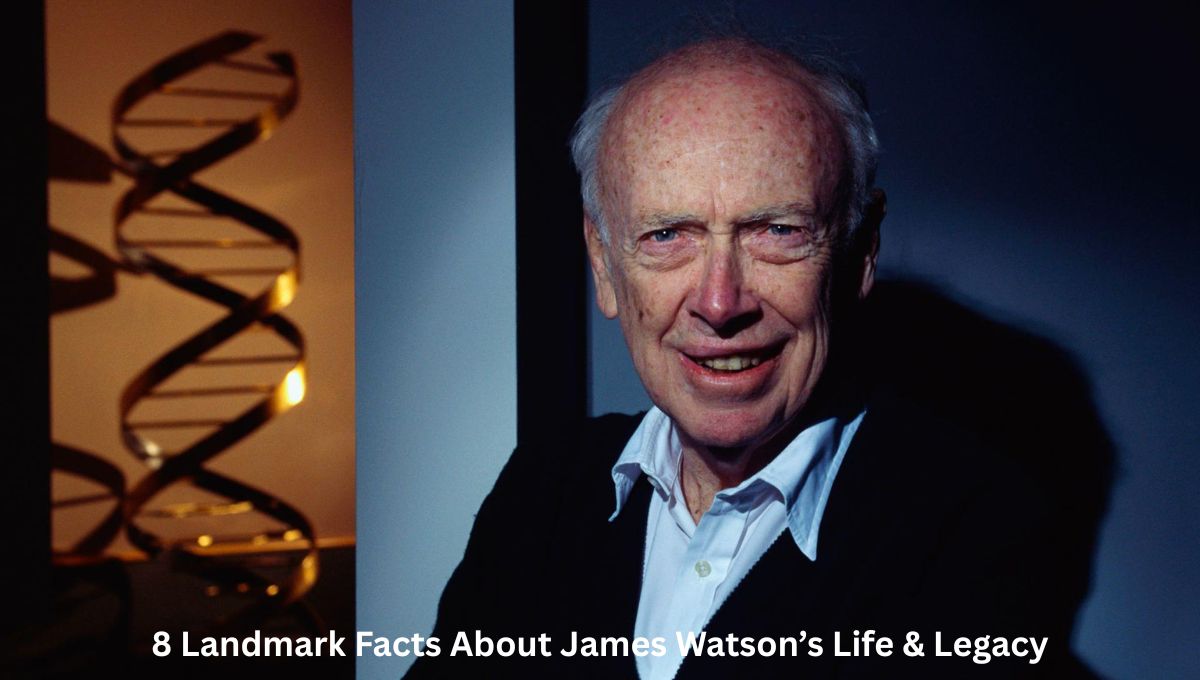
8 Landmark Facts About James Watson’s Life & Legacy — the co-discoverer of the DNA double helix has died at 97. James Dewey Watson, the American biologist best known for co-discovering the structure of DNA, passed away at the age of 97, according to a statement from Cold Spring Harbor Laboratory where he spent much of his career. His death marks the end of a life that both transformed science and generated enduring controversy.
8 Landmark Facts About James Watson’s Life & Legacy
Early Life and Education
James Watson was born on April 6, 1928, in Chicago. Raised by parents who valued “books, birds and the Democratic Party,” he developed an early interest in science and nature. His father was a bird-watcher, and Watson’s childhood explorations seeded his interest in biology.
He entered the University of Chicago at age 15, graduating in 1947 with a bachelor’s degree, and went on to earn his PhD in zoology at Indiana University in 1950.
Quest for the Structure of DNA
In 1951 Watson moved to England to join the Cavendish Laboratory at the University of Cambridge. There he met British physicist Francis Crick, and together they embarked on the quest to uncover the three-dimensional structure of DNA. Watson described the moment of the discovery as “so beautiful.”
In February 1953, Watson and Crick announced the double-helix model of deoxyribonucleic acid (DNA). Their rapid breakthrough involved model-building and interpretation of X-ray diffraction data, including data produced by Rosalind Franklin and Raymond Gosling at Kings College London.
The Breakthrough and Its Significance
The 1953 paper in Nature concluded with the classic line:
“It has not escaped our notice that the specific pairing we have postulated immediately suggests a possible copying mechanism for the genetic material.”
This insight established how DNA stores and copies hereditary information and laid the foundation for modern molecular biology and biotechnology.
The discovery is widely regarded as one of the most important scientific achievements of the 20th century and earned Watson, Crick and Maurice Wilkins the Nobel Prize in Physiology or Medicine in 1962.
Career Highlights
After the Cambridge breakthrough, Watson built a distinguished career:
- He became a professor at Harvard University in 1956.
- In 1968 he became director of Cold Spring Harbor Laboratory (CSHL) in New York, which under his leadership became a major center for molecular biology.
- In the early 1990s Watson served as the first head of the Human Genome Project effort in the U.S., aiming to map the entire human genome.
- He published The Double Helix (1968), a memoir and personal account of the discovery process, which became a landmark science-history book.
Legacy in Science
Watson’s impact in the life sciences is immense: the DNA double helix model triggered transformations in genetics, medicine, forensic science, and biotechnology.
According to CSHL’s president, Bruce Stillman, the discovery “goes down as one of the three most important discoveries in the history of biology.”
His textbooks and mentoring of young scientists influenced generations; he also made his own genome publicly available in 2007, pointing to his conviction about transparency in science.
Controversies and Professional Fallout
Watson’s legacy is deeply complicated by his persistent controversial remarks on race, gender, and intelligence. In 2007, he made comments suggesting that African-descent individuals had lower average intelligence than others, remarks that sparked global condemnation. He also made statements connecting skin colour, libido and genetics.
As a result, Watson was stripped of many honorary positions and effectively forced into emeritus status at CSHL; his reputation within the scientific community was markedly diminished. Another long-standing point of contention involves Rosalind Franklin’s role in the discovery of the DNA structure. Watson’s account in The Double Helix was criticised for down-playing her contribution.
Personal Life
Watson married Elizabeth Lewis in 1968 and had two sons. One of his sons, Rufus, suffered from schizophrenia — a personal factor that Watson later cited when supporting genomics research.
Outside of work, he remained a lifelong bird-watching enthusiast, harking back to his childhood. He also once controversially auctioned off his Nobel Prize medal in 2014 — reportedly to raise funds for scientific research.
Why His Death Matters
Watson’s death at 97 marks the passing of a figure whose scientific contributions transformed our understanding of life itself. At the same time, his career serves as a cautionary tale about how the privileges of the scientific elite do not exempt one from ethical scrutiny.
In an era where genetics and biotech raise profound ethical questions — from CRISPR gene editing and “designer babies” to societal claims about intelligence and race — Watson’s life offers both inspiration and warning.
Reflecting on the Full Picture
- Achievement: Uncovering the molecular structure of DNA, opening new science and medicine frontiers.
- Institutional impact: Building CSHL, leading human-genome efforts, influencing science policy and education.
- Controversy: Remarks that divided the scientific community and led to professional consequences.
- Ethical legacy: A man whose scientific brilliance was shadowed by public statements that many regarded as deeply irresponsible.
Conclusion
James D. Watson’s journey—from a Chicago bird-watcher’s son to one of the most recognised scientists of his generation—is a study in brilliance, ambition and complexity. His role in revealing the double helix of DNA fundamentally changed how humanity understands itself. Yet the latter chapters of his life show the cost of unchecked hubris.
For all his scientific glory, Watson leaves an unsettled legacy. His breakthroughs will endure; his missteps will not be forgotten.
Also Read: 7 Groundbreaking Insights: Nobel Prize Winners Reveal Immune System Secrets
Also Read: James Watson, who co-discovered DNA double helix, dies at 97
Related Posts:
- Trump Threatens ‘War’ on Chicago: National Guard…

- Trump Deploys 300 National Guard Troops to Chicago…

- Paul Kapur: Confirmed as US Assistant Secretary 2025

- Carlo Acutis Becomes First Millennial Saint: Vatican…

- 7 Shocking Twists in Subramanyam Vedam’s 43-Year…

- 7 Powerful Insights into Zohran Mamdani’s Historic…