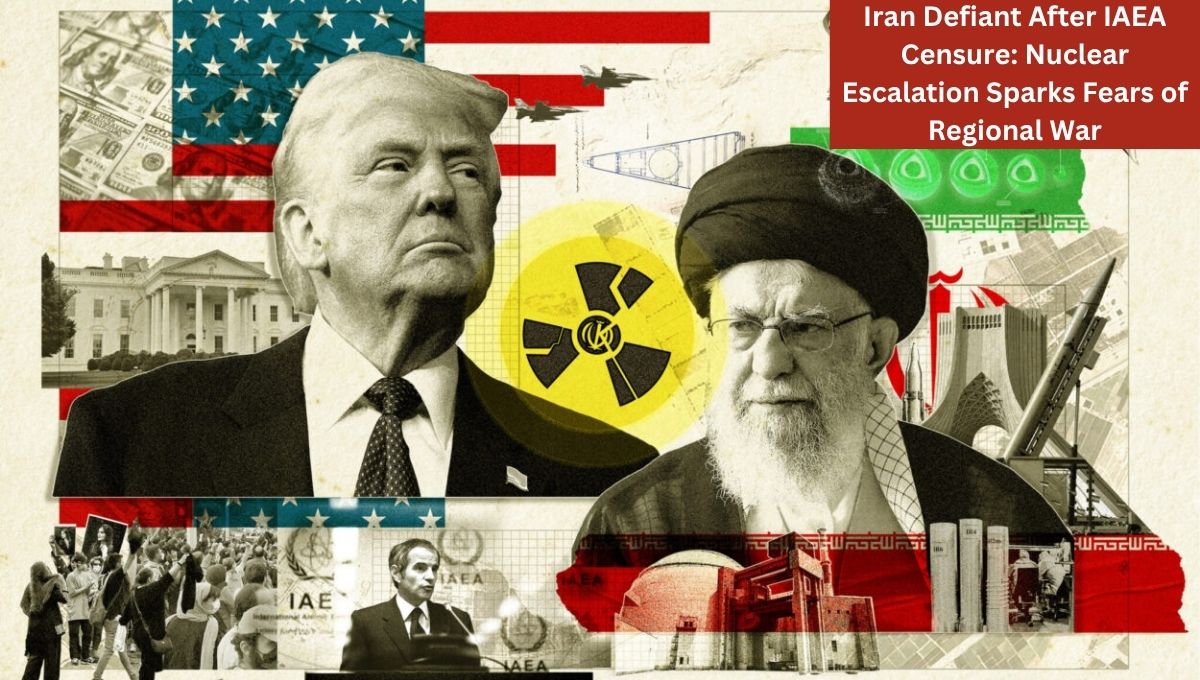
In a sharp escalation of already tense international relations, Iran Defiant After IAEA Censure: Nuclear Escalation Sparks Fears of Regional War. Iran has warned of serious retaliatory measures following a resolution passed by the International Atomic Energy Agency (IAEA).
The resolution declared the Islamic Republic in breach of its nuclear non-proliferation obligations, citing unexplained uranium traces at undeclared sites and uranium enrichment near weapons-grade levels. Tehran swiftly responded, threatening to pull out of the Non-Proliferation Treaty (NPT) and ramp up its uranium enrichment program, sparking alarm across the Middle East and beyond.
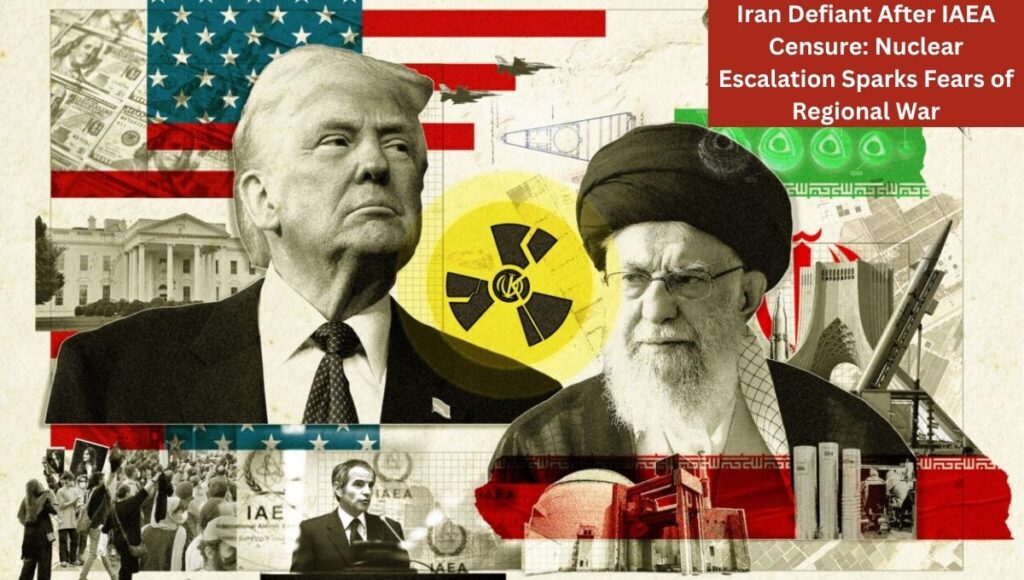
Iran Defiant After IAEA Censure: Nuclear Escalation Sparks Fears of Regional War
IAEA Declares Iran Non-Compliant
On June 6, the IAEA’s 35-member board passed the resolution with 19 votes in favor, three against (including Russia and China), and 11 abstentions.
The watchdog concluded that Iran had failed to adequately explain uranium particles found at several undeclared locations and continued to enrich uranium to 60% just shy of weapons-grade material.
Analysts warn that Iran now possesses enough highly enriched uranium to construct as many as ten nuclear weapons if it chooses to weaponize its program. While Iran maintains that its nuclear ambitions are peaceful, the IAEA says it can no longer verify the non-military nature of the program.
Iran Threatens to Quit the Non-Proliferation Treaty
Iran’s ambassador to the United Nations, Saeid Iravani, described the IAEA resolution as “politically motivated” and warned that Iran might initiate the process of withdrawing from the NPT.
Such a move would mark a dramatic shift from Tehran’s long-standing public stance of peaceful nuclear development and could pave the way for further sanctions or even military conflict.
Iran’s warning comes as the country begins to roll back cooperation with international inspectors, just as it did in 2022 following a similar censure.
New Uranium Enrichment Center and Advanced Centrifuges
In response to the IAEA resolution, Tehran announced it would begin operations at a third uranium enrichment facility at a classified secure location.
Advanced sixth-generation centrifuges will replace older machines at the Fordow underground site, joining the already operational Natanz facility.
This development significantly increases Iran’s uranium enrichment capacity, intensifying concerns in the international community, particularly in Israel and the United States.
Trump Voices Doubts, Warns of Israeli Strike
Former U.S. President Donald Trump, who withdrew the U.S. from the 2015 Iran nuclear deal (JCPOA), has added fuel to the fire.
Trump said he is “getting more and more less confident” about reaching a new deal with Iran and claimed that Israel “could very well” launch a preemptive strike if diplomacy fails.
In a sign of growing anxiety, the U.S. has begun partially evacuating non-essential staff from embassies across the region, including in Iraq and Jerusalem. Security alerts have also been issued for U.S. personnel, underscoring fears of a potential escalation.
Iran’s Military Sends a Warning to Israel and the U.S.
Responding to the increasing threats, top Iranian military commanders have issued fiery warnings. Islamic Revolutionary Guard Corps (IRGC) chief Hossein Salami declared that any Israeli attack would be met with a “history-making” retaliation.
Quds Force Commander Esmail Qaani added that Iran’s missile capabilities have improved, and allies across the region are “stronger than ever.”
Defense Minister Aziz Nasirzadeh stated that U.S. military bases in the Middle East would be legitimate targets in the event of a conflict, especially after Iran’s recent successful test of a new ballistic missile with a 2,000 kg warhead.
Iran’s Nuclear Program Sparks Nationalist Sentiment
Domestically, Iran is rallying nationalist sentiment in response to international pressure. Authorities recently installed a statue of Arash the Archer a legendary figure known for defending Iran’s borders in Tehran’s Vanak Square.
This symbolic act is seen as a bid to unify the public behind the government amid mounting external threats. President Masoud Pezeshkian referenced the Iran-Iraq war during a public speech, reinforcing the idea that Iran would not back down to U.S. or Israeli “bullying.”
Iran’s Economy Stays Resilient For Now
Despite fears of further sanctions and potential conflict, the Iranian economy remains surprisingly steady. The rial traded at 840,000 to the U.S. dollar only slightly weaker than the previous week.
Inflation, however, remains a serious concern at over 30%, largely driven by longstanding sanctions and internal economic mismanagement.
Vendors at Tehran’s Grand Bazaar report cautious optimism, saying that while people are worried, they are not panicking yet.
Talks in Oman: “Zero Enrichment” Demand Remains a Sticking Point
Diplomatic efforts are still underway, with the sixth round of U.S.-Iran nuclear talks scheduled in Muscat, Oman. However, hopes for a breakthrough remain slim.
The U.S., under Trump’s renewed influence, is demanding a total halt to uranium enrichment on Iranian soil something Tehran continues to reject.
Iran is expected to present a counterproposal, and some regional observers have floated the idea of a regional nuclear consortium, but such ideas remain theoretical and lack strong international support.
Flashbacks to 2005 and Fears of What’s Next
The current standoff is reminiscent of 2005, when Iran was last declared in non-compliance, leading to U.N. sanctions.
This time, however, the stakes are even higher due to Iran’s enhanced nuclear capabilities and regional tensions already running high from the Israel-Gaza conflict.
If Iran continues on its current path, a second IAEA resolution could push the issue to the United Nations Security Council, potentially triggering the re-imposition of multilateral sanctions.
Conclusion: A Volatile Path Ahead
Iran’s nuclear escalation following the IAEA censure has cast a dark cloud over the Middle East. The potential for regional war, especially involving Israel and U.S. military forces, has never been more real since the collapse of the JCPOA in 2018.
While diplomacy in Oman remains the last thread holding the situation back from full-scale conflict, the odds of success are dwindling. The world watches closely as Iran continues its nuclear push, while international pressure mounts and military options are openly discussed.
As one Tehran resident put it simply: “Nobody wants a war. We have enough problems already.”
Also Read: Iran to Submit Counterproposal for Nuclear Deal as Uranium Enrichment Remains Key Sticking Point
Also Read: Iran doubles down as US signals Israel could strike despite nuclear talks
Related Posts:
- UN Security Council Blocks China-Russia Resolution…
- Afghanistan–Pakistan War 2025: Inside the 48-Hour Ceasefire

- 7 Powerful Measures: Trump Sanctions Russian Oil…

- Iran Defiant on Nuclear Enrichment Despite US-Israel…
- In 8 Moves, EU Targets China-Linked Refineries and…

- Russia Hints at Missile Deployment After INF Treaty…