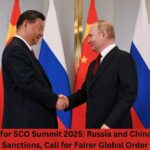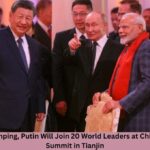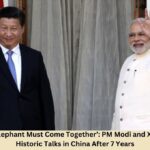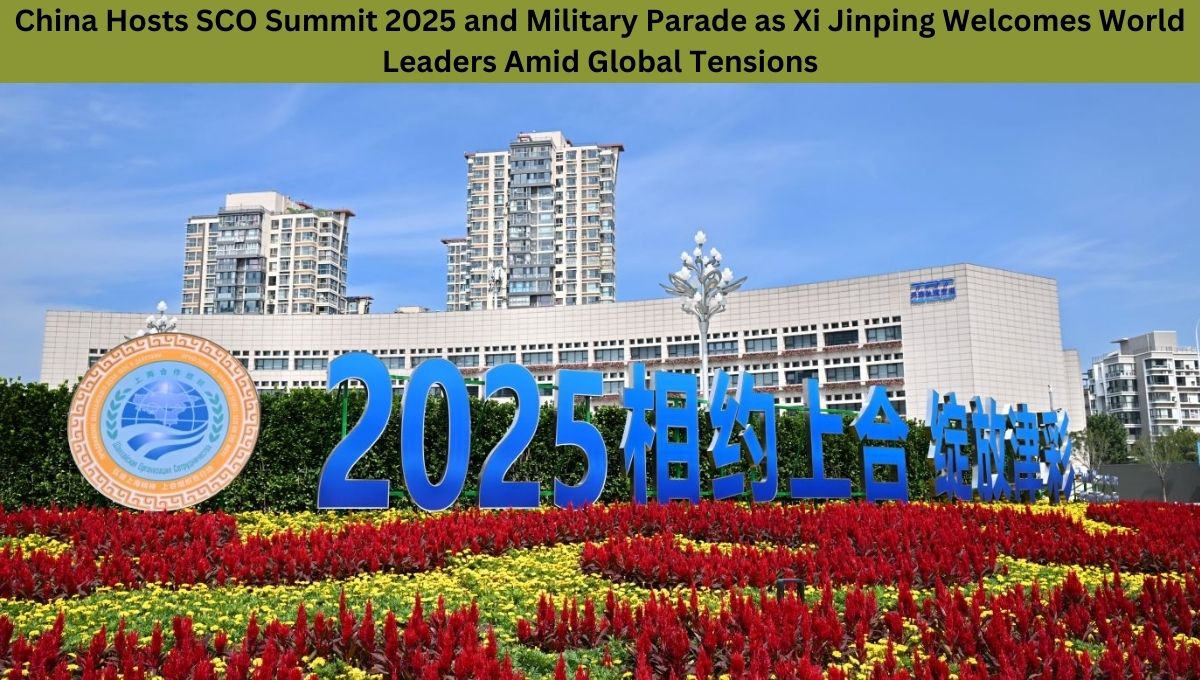
Marking the 80th anniversary of the end of World War II, China Hosts SCO Summit 2025 and Military Parade as Xi Jinping Welcomes World Leaders Amid Global Tensions. Beijing is preparing for one of the most significant diplomatic and military showcases in recent history. Under the leadership of President Xi Jinping, China will host the Shanghai Cooperation Organisation (SCO) Summit 2025 in Tianjin, followed by a grand military parade in Beijing to commemorate the 80th anniversary of the end of World War II.
The twin events reflect Beijing’s growing ambition to project itself as a central pillar of a multipolar world order, offering an alternative to the US-led system of alliances. While the SCO summit emphasizes diplomacy, consensus, and cooperation, the military parade highlights China’s strategic might and symbolic alliances. Interestingly, the guest lists for the two events differ, reflecting Beijing’s careful balancing of diplomacy, security, and symbolic power projection.
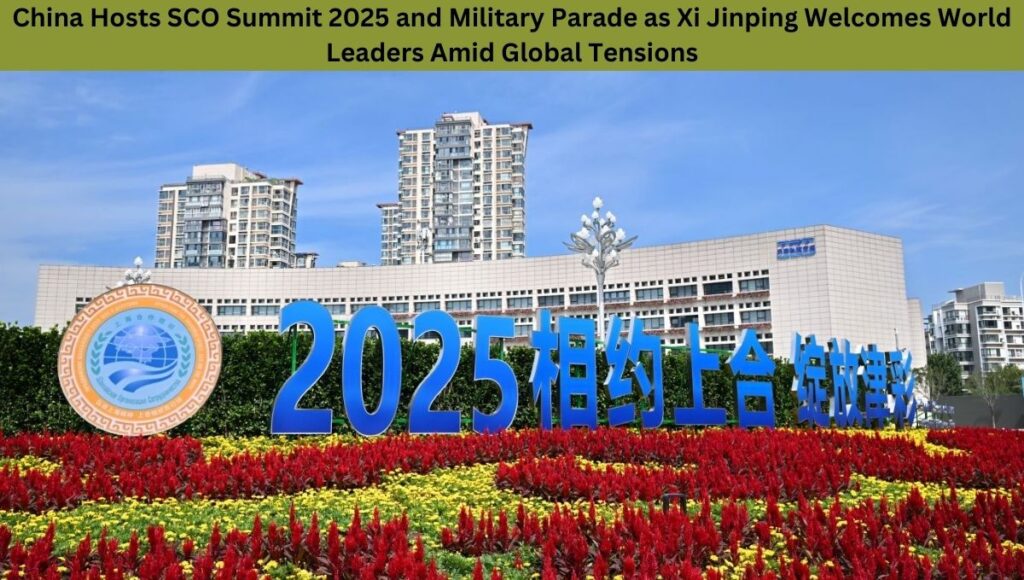
China Hosts SCO Summit 2025 and Military Parade as Xi Jinping Welcomes World Leaders Amid Global Tensions
What Is the Shanghai Cooperation Organisation (SCO)?
The Shanghai Cooperation Organisation (SCO) was founded in 2001 by China, Russia, Kazakhstan, Kyrgyzstan, and Tajikistan, with the primary focus on regional security, counterterrorism, and economic cooperation.
Over time, the SCO expanded:
- India and Pakistan joined as full members in 2017.
- Iran and Belarus recently became full members.
- Observer states include Afghanistan and Mongolia.
- Dialogue partners range from Turkey and Egypt to Southeast Asian nations.
With its expansion, the SCO now represents nearly half of the world’s population and a significant share of global GDP, making it one of the most important regional blocs in Eurasia.
The group promotes what it calls the “Shanghai Spirit”, based on mutual trust, equality, respect for civilizations, and common development, distinguishing itself from Cold War-style alliances such as NATO.
SCO Summit 2025 in Tianjin: Dates and Significance
The SCO Summit 2025 will take place on Sunday and Monday in Tianjin, a bustling port city southeast of Beijing.
The timing is critical, given the backdrop of global instability:
- Russia’s war in Ukraine continues.
- North Korea is deepening its military partnership with Moscow.
- US-China tensions over trade and technology are intensifying.
- India and China are cautiously exploring rapprochement despite lingering border disputes.
By chairing this year’s summit, Xi Jinping is positioning the SCO as a counterweight to Western-led blocs like NATO and as a platform to champion multipolarity.
High-Profile Guests at the Tianjin SCO Summit
The guest list for the SCO summit underlines Beijing’s global reach. Notable attendees include:
- Indian Prime Minister Narendra Modi
- Russian President Vladimir Putin
- Iranian President Masoud Pezeshkian
- Turkish President Recep Tayyip Erdogan
- Egyptian Prime Minister Mustafa Madbouly
Additionally, leaders from Indonesia, Laos, Malaysia, and Vietnam none of whom are SCO members will attend.
Their participation highlights China’s ambition to expand influence in Southeast Asia, especially as tensions with the United States grow.
The SCO’s inclusiveness, particularly under the SCO Plus format, allows Beijing to engage beyond its Eurasian core and court partners across Asia, the Middle East, and Africa.
Xi Jinping to Chair the SCO Summit
President Xi Jinping will chair both the 25th Meeting of the Council of Heads of State and the SCO Plus Meeting, which includes non-member states.
According to Fan Xianrong, China’s SCO coordinator, the summit is expected to produce major outcomes:
- A joint declaration by member states.
- A 10-year SCO development strategy.
- Statements on the 80th anniversary of WWII’s end and the UN’s founding.
- Agreements on security, economic cooperation, and cultural exchanges.
Xi aims to use the summit to consolidate China’s leadership role in the bloc and present the SCO as a model of peaceful coexistence and an alternative to Western dominance.
India-China Relations: Modi’s Attendance at the SCO Summit
One of the most closely watched developments is the attendance of Indian Prime Minister Narendra Modi.
This marks Modi’s first visit to China in seven years, following the deadly 2020 border clash in the Himalayas that froze bilateral ties.
Why Modi’s Visit Matters
- Optics of neutrality: India signals it is not fully aligned with Washington’s anti-China strategy.
- Trump’s tariffs: The Trump administration recently doubled tariffs on Indian exports to 50%, pushing New Delhi to explore closer ties with Beijing.
- Rare-earth diplomacy: China has promised to resume exports of rare-earth materials critical for India’s auto and electronics sectors.
For India, participation is about balancing ties with both the US and China, while ensuring strategic autonomy.
Modi-Xi Bilateral Meetings in Tianjin
Diplomatic sources confirm that Modi and Xi will hold at least one bilateral meeting during the summit.
- First meeting: Scheduled for Sunday noon.
- Possible second meeting: Before the SCO banquet that evening.
Chinese scholars describe the atmosphere as cordial and pragmatic. Zhou Rong of Renmin University noted:
“China hopes that Modi’s visit will encourage a concerted effort to make the SCO Summit successful.”
These meetings could mark the start of a reset in India-China relations, though experts caution that border disputes, Tibet, and China’s ties with Pakistan remain unresolved.
The Trump Factor: A Catalyst for Closer Ties
President Donald Trump’s tariff war has inadvertently shifted geopolitical alignments. By imposing 50% tariffs on Indian exports and simultaneously courting Pakistan, Trump has created friction with India.
This has pushed New Delhi to reassess its relationship with Beijing.
- China has defended India against US tariffs, calling Washington a “bully.”
- India, facing economic pressure, is now seeking temporary accommodation with Beijing.
- Both China and India see benefits in reducing border tensions and stabilizing trade ties.
In effect, Trump’s policies are bringing India and China closer together, at least tactically.
Rare Earths: The Hidden Battleground
Rare-earth elements critical for electric vehicles, defense systems, and high-tech industries are at the heart of China-India diplomacy.
- China controls most global rare-earth supply chains.
- Recent Chinese export restrictions hit Indian automakers like Sona Comstar, which rely on rare-earth magnets.
- During Foreign Minister Wang Yi’s visit to New Delhi, Beijing promised to resume exports, offering India a lifeline.
This move may ease tensions but also increases India’s dependency on China, creating a strategic vulnerability.
Military Parade in Beijing: Symbolism and Strategy
Three days after the SCO Summit, Beijing will host a grand military parade in Tiananmen Square on Wednesday. The event commemorates the 80th anniversary of Japan’s surrender in WWII.
The parade is expected to feature:
- Over 100 aircraft, including stealth fighters and drones.
- Cutting-edge missile systems.
- New-generation tanks and armored vehicles.
- Thousands of PLA troops marching in lockstep.
For Beijing, the parade sends a dual message:
- Domestic reassurance of China’s military strength.
- Global signaling of readiness to challenge rivals, particularly the United States.
Also Read: Xi Jinping Hosts China’s Largest-Ever Military Parade: War or Peace at Crossroads
Who Will Attend the Military Parade?
Unlike the SCO Summit, the guest list for the parade has some key differences.
Not Attending the Parade
- Narendra Modi (India)
- Recep Tayyip Erdogan (Turkey)
- Mustafa Madbouly (Egypt)
India and Turkey, in particular, avoid being associated with such overt military displays, preferring a more neutral posture.
Key Additions at the Parade
- Kim Jong Un (North Korea) – his first meeting with Xi in over six years.
- Min Aung Hlaing (Myanmar’s junta chief) underscoring China’s continued support.
- Miguel Díaz-Canel (Cuba).
- Leaders from the Democratic Republic of Congo and Zimbabwe.
- Aleksandar Vučić (Serbia) and Robert Fico (Slovakia) representing sympathetic European states.
The image of Xi, Putin, and Kim seated together in Tiananmen Square will be a powerful symbol of defiance against Western powers.
SCO 2025: Blueprint for the Future
China is using the SCO platform to chart a 10-year development strategy, focusing on:
- Enhancing security cooperation.
- Expanding economic opportunities.
- Promoting good-neighborly relations.
- Upholding fairness and justice in international affairs.
- Maintaining openness and inclusiveness.
Beijing has emphasized that the SCO is not a Cold War-style bloc, but a cooperative platform aligned with the UN Charter.
What This Means for the United States
For Washington, the optics of Xi, Putin, Modi, and Kim converging in Beijing are deeply concerning.
- The US-China rivalry is intensifying over trade, technology, and security.
- Trump’s tariff war risks pushing India closer to Beijing and Moscow.
- The SCO’s growth, along with BRICS, signals the emergence of a new global bloc challenging US influence.
As Lindsey Ford, a former US official, noted:
“India has often acted as a brake on China-Russia ambitions within BRICS. If New Delhi drifts closer to Beijing, Washington risks losing a critical counterweight in Asia.”
Conclusion: China’s Moment on the World Stage
The SCO Summit 2025 in Tianjin and the Beijing military parade together mark a turning point in global geopolitics.
China is presenting itself as:
- A diplomatic leader through the SCO.
- A military power through the Tiananmen parade.
- A champion of multipolarity in contrast to US-led dominance.
With leaders like Putin, Modi, and Kim Jong Un all engaging with Xi Jinping in different formats, the world is witnessing a reshaping of alliances. For the United States and its allies, these optics are unsettling.
But for Beijing, this is the moment to show that China stands tall on the global stage militarily, diplomatically, and strategically.
Also Read: A parade and a summit in China underscore how European security will never be the same again