9 Explosive Signals as Trump Targets Cuba’s Oil Lifeline with Tariffs amid rising regional tensions. US President Donald Trump has sharply escalated Washington’s pressure campaign against Cuba, threatening to impose new tariffs on any country that supplies oil to the Caribbean island.
The move, outlined in a newly signed executive order, marks one of the most aggressive steps taken against Havana in decades and raises the specter of a near-total energy blockade. Speaking this week, Trump claimed that Cuba is nearing collapse following the severing of its long-standing oil relationship with Venezuela.
“Cuba will be failing pretty soon,” the US president said, arguing that the island can no longer rely on fuel or financial support from Caracas after Venezuelan President Nicolás Maduro was seized by US forces earlier this month. The executive order authorizes the United States to impose tariffs on imports from countries that “directly or indirectly sell or otherwise provide any oil to Cuba.”
While no specific tariff rates or target countries were named, the broad language gives Washington sweeping discretion to penalize foreign governments and companies that continue to supply fuel to Havana.
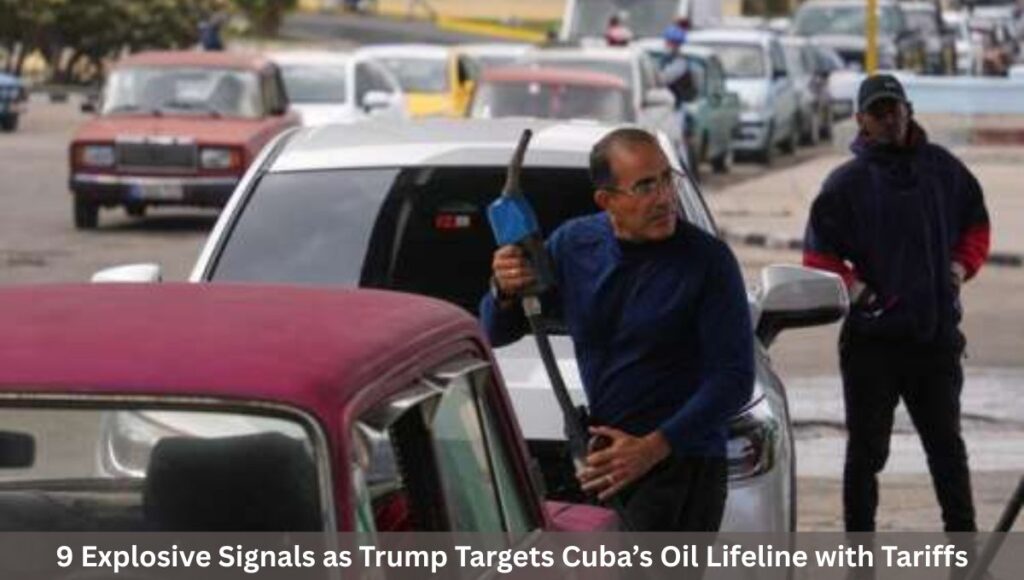
9 Explosive Signals as Trump Targets Cuba’s Oil Lifeline with Tariffs
A National Emergency Declaration
Trump’s order declares a national emergency, asserting that “the policies, practices, and actions of the Government of Cuba constitute an unusual and extraordinary threat” to US national security and foreign policy.
The declaration provides the legal foundation for imposing new tariffs and expanding economic pressure under US law.
Under the order, the Secretary of State and the Secretary of Commerce are empowered to determine which countries are supplying oil to Cuba and to recommend appropriate tariff measures.
The president also retains the authority to modify or suspend the tariffs if Cuba or affected countries take steps deemed consistent with US strategic objectives.
The White House has framed the action as part of a broader effort to hold the Cuban government accountable while supporting the “aspirations of the Cuban people.”
Critics, however, argue that the measures will overwhelmingly harm ordinary Cubans rather than the country’s leadership.
Cuba’s Furious Response: ‘Brutal Act of Aggression’
Cuba reacted swiftly and angrily to Trump’s announcement.
Foreign Minister Bruno Rodríguez denounced the tariff threat as a “brutal act of aggression” and accused Washington of attempting to impose a total fuel blockade on the island.
“We denounce to the world this brutal act of aggression against Cuba and its people,” Rodríguez said in a statement posted on social media.
He accused the United States of relying on “a long list of lies” to portray Cuba as a threat and of using “blackmail and coercion” to force other countries to comply with its policy.
Rodríguez argued that Cuba has “the absolute right to import fuel from any willing exporter without interference or subordination to the unilateral coercive measures of the United States.”
He added that the new tariff regime violates international norms of free trade and sovereignty.
Warnings of Economic and Humanitarian Collapse
Cuba’s state-run media amplified the government’s warnings, cautioning that Trump’s order could paralyze electricity generation, agricultural production, water supply, and health services.
In a dramatic statement broadcast on national television, officials asked rhetorically:
“What is the goal? A genocide of the Cuban people.”
The language underscores the severity of the crisis already gripping the island. Cuba has endured years of economic hardship, exacerbated by the COVID-19 pandemic, declining tourism, inflation, and tightening US sanctions.
Fuel shortages have triggered rolling blackouts across the country, leaving homes, hospitals, and businesses without reliable electricity.
In recent weeks, the situation has deteriorated rapidly as oil shipments from Venezuela dried up.
Long lines for gasoline stretch for hours, public transportation has been curtailed, and entire neighborhoods are plunged into darkness each night.
Venezuela’s Fall and the End of a Lifeline
For decades, Venezuela served as Cuba’s most important ally and primary energy supplier. At its peak, Caracas was believed to be sending around 35,000 barrels of oil per day to the island, often on highly favorable terms.
That relationship came to an abrupt end after a US military operation earlier this month captured Venezuelan President Nicolás Maduro and transferred him to the United States to face drug trafficking charges, which he denies.
The operation severed Cuba’s access to subsidized Venezuelan oil and removed Havana’s closest regional ally.
Analysts say the loss of Venezuelan fuel represents a devastating blow. Havana depended on Venezuela for more than one-third of its oil needs, and the sudden cutoff has left the government scrambling to secure alternative suppliers amid intensifying US pressure.
Mexico, Russia, and Other Potential Targets
With Venezuelan oil no longer flowing, Cuba has turned to a small number of remaining partners, including Mexico and Russia.
Mexico, in particular, emerged as Cuba’s top supplier after Venezuelan shipments declined last year.
However, Mexican President Claudia Sheinbaum announced this week that her government had at least temporarily halted a planned oil shipment to Cuba.
She described the move as a “sovereign decision,” while emphasizing that Mexico would continue to show solidarity with the Cuban people.
Reports suggest Washington has been quietly urging Mexico and other countries to distance themselves from Havana.
Russia and Algeria also provide limited quantities of oil to Cuba, but they too could face pressure or tariff threats under Trump’s new order.
Life on the Ground: Blackouts and Daily Struggle
The human impact of Cuba’s energy crisis is increasingly visible. In Havana, entire districts are shrouded in darkness for hours at a time.
Traffic lights frequently fail, making driving hazardous. Government-run radio and television stations in some provinces have suspended operations due to lack of electricity.
For ordinary Cubans, daily life has become a constant struggle to adapt. Families rely on charcoal grills to cook during power cuts.
Neighbors share refrigerators powered by small generators to keep food from spoiling. Internet outages disrupt work and communication, cutting off freelancers and small businesses from income.
Fuel shortages have driven up costs dramatically. At filling stations that accept US dollars, a tank of gas can cost more than the average Cuban’s monthly salary. Even at peso-based stations, waits can stretch for weeks.
Emigration and Growing Despair
The worsening crisis is accelerating emigration from the island. More than two million Cubans have left the country in recent years, seeking better opportunities abroad.
Many who remain are torn between enduring further hardship and leaving behind families, homes, and careers.
Those who stay often express a mix of resilience, frustration, and dark humor. Comparisons to the Titanic, jokes about living without electricity, and weary smiles mask deep anxiety about what lies ahead.
Doctors, teachers, and skilled professionals are among those struggling most, as shortages undermine public services and salaries fail to keep pace with rising prices.
Washington’s Strategy: Economic Strangulation
The Trump administration has made little secret of its desire to see political change in Havana.
Secretary of State Marco Rubio, a long-time critic of the Cuban government, has said openly that it would benefit the United States if Cuba were no longer governed by an autocratic regime.
Trump has repeatedly urged Cuba to “make a deal” with Washington, without specifying the terms.
One possible demand floated by US officials is the return of property confiscated from Cuban exiles after the 1959 revolution—an idea Cuban leaders have categorically rejected.
By targeting Cuba’s oil supplies, the administration appears to be betting that economic pressure will succeed where decades of sanctions have failed.
Adding to the tension are reports that the White House is considering a naval blockade to prevent oil shipments from reaching Cuba.
Such a move would be unprecedented since the 1962 Cuban Missile Crisis and would represent a dramatic escalation.
Cuban officials have condemned the idea as an act of war. “This would be a brutal assault against a peaceful nation that does not threaten the United States,” said Carlos Fernández de Cossío, Cuba’s top diplomat for US affairs.
Even the suggestion of a blockade has heightened anxiety among Cubans and raised alarms across the region.
Cuba Prepares for Confrontation
Far from signaling capitulation, the Cuban government has begun preparing its population for the possibility of confrontation.
State television has aired footage of military exercises, showing soldiers and civilians training to repel an invasion.
President Miguel Díaz-Canel has invoked the doctrine of a “war of all the people,” emphasizing that any aggression would be met with widespread resistance.
The message is clear:
Cuba intends to endure, even if the economic cost is severe.
Regional and Global Implications
Trump’s tariff threat has implications far beyond Cuba. Countries supplying oil to the island now face a stark choice between maintaining ties with Havana or risking economic retaliation from the United States.
The move also raises questions about the use of tariffs as a foreign policy weapon. Throughout his presidency, Trump has repeatedly employed tariffs to pressure allies and adversaries alike, blurring the line between trade policy and geopolitical coercion.
Critics warn that such tactics could undermine global trade norms and provoke retaliatory measures, while supporters argue they give Washington powerful leverage without resorting to military force.
Echoes of the Cold War
For many observers, the escalating standoff evokes memories of the Cold War, when Cuba stood at the center of superpower rivalry.
The island’s proximity to the United States, combined with its ties to Russia and China, continues to make it a strategic flashpoint.
Yet the context has changed. Today’s Cuba is economically fragile, demographically strained, and deeply interconnected with the global economy through migration and remittances.
Whether Trump’s strategy will hasten political change or entrench resistance remains an open question.
Can Cuba Survive Without Oil?
Energy analysts are blunt about the stakes. “No oil, no economy,” said one expert, warning that a complete cutoff would trigger imminent economic collapse.
Electricity generation, transportation, agriculture, and industry all depend on steady fuel supplies. Without them, shortages could spiral into a humanitarian emergency.
Aid organizations and international observers fear that ordinary Cubans will bear the brunt of the pain.
A Dangerous Moment
As the United States tightens the screws, the risk of miscalculation grows. Escalatory rhetoric, economic warfare, and military posturing create a volatile mix in a region with a long history of confrontation.
For now, Trump’s tariff threat stands as a stark warning to Cuba and its remaining allies. Whether it marks the beginning of the end for Havana’s government—or a new chapter of endurance and defiance—will depend on how the crisis unfolds in the months ahead.
Conclusion: Pressure, Pain, and Uncertainty
Trump’s move to target countries supplying oil to Cuba represents one of the most consequential shifts in US-Cuba relations in years. By threatening tariffs, Washington is signaling its willingness to escalate economic pressure to unprecedented levels.
Cuba, for its part, is bracing for hardship while rejecting what it sees as coercion and aggression. Caught in the middle are millions of ordinary Cubans, struggling through blackouts, shortages, and uncertainty.
As history has shown, pressure alone does not always produce the outcomes its architects expect. Whether this strategy leads to change, stalemate, or confrontation remains to be seen—but its human cost is already painfully clear.
Also Read: 13 Explosive Warnings as Trump Tells Cuba to ‘Make a Deal’ or Collapse
Also Read: Venezuela and Mexico: How Trump is trying to choke Cuba’s oil supplies
Related Posts:
- 11 Punitive Shockwaves from Trump’s Cuba Oil Tariff Threat

- 7 Explosive Moves as Trump Threatens Cuba’s Oil Lifeline
- 7 Explosive Signs Trump Is Targeting Cuba After Venezuela

- 7 Explosive Warnings: Trump Threatens Colombia as…
- 13 Explosive Warnings as Trump Tells Cuba to ‘Make a…
- “Don’t Want Them To Buy Russian Oil”: Trump Urges…