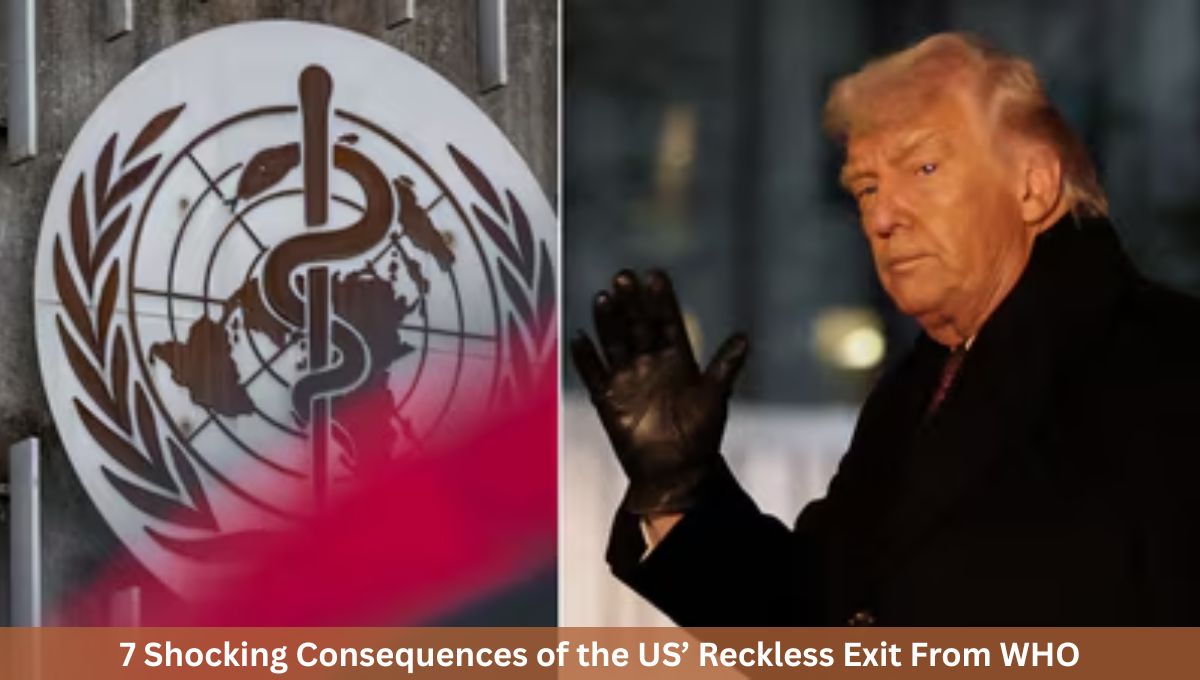
7 Shocking Consequences of the US’ Reckless Exit From WHO, leaving $260 million unpaid. The United States has formally completed its withdrawal from the World Health Organization (WHO), ending nearly eight decades of membership in the United Nations’ specialized global health agency and leaving behind an unpaid debt estimated at up to $260 million.
The move, finalized one year after President Donald Trump ordered the exit at the start of his second term, has sent shockwaves through the global health community, with experts warning it could cripple international disease surveillance, weaken pandemic preparedness, and ultimately endanger American lives.
Public health leaders, former US officials, and international health experts have described the withdrawal as “scientifically reckless,” “shortsighted,” and “ruinous,” arguing that the decision undermines not only global health security but also the United States’ own national interests.
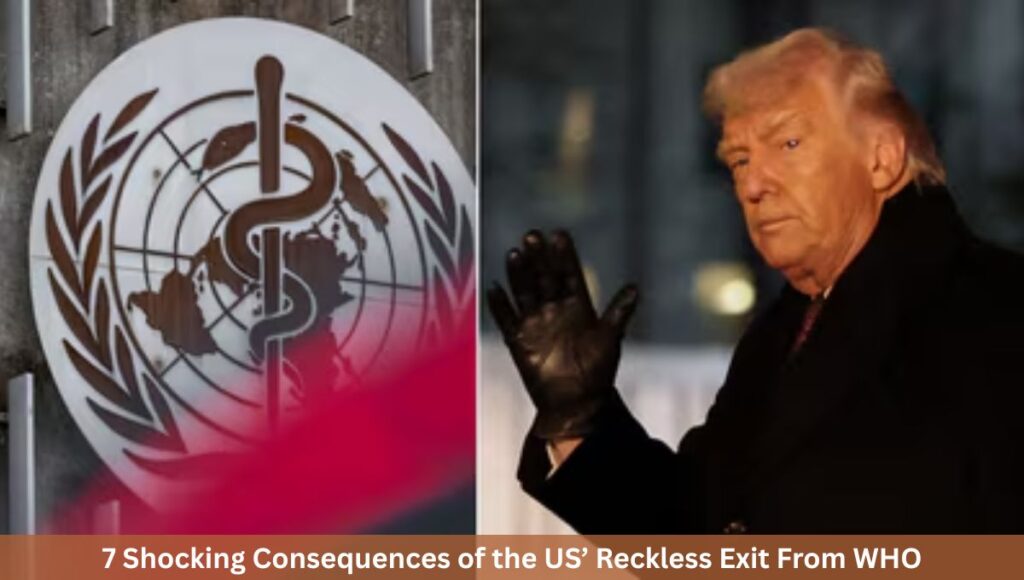
7 Shocking Consequences of the US’ Reckless Exit From WHO
US Officially Ends Nearly 80 Years of WHO Membership
The US Department of Health and Human Services (HHS) confirmed on Thursday that the United States has completed its withdrawal from the WHO, formally severing all institutional ties with the Geneva-based organization.
According to HHS, the decision brings an end to:
- All US government funding to the WHO
- Participation in WHO-sponsored leadership bodies
- Membership in technical committees and working groups
- Deployment of US personnel and contractors at WHO headquarters and field offices
“The United States is no longer participating in the work of the World Health Organization,” a senior administration official said, calling the move a fulfillment of President Trump’s long-standing campaign promise.
The withdrawal marks the first time since 1948—when the US helped found the WHO—that Washington is no longer a member.
Why the Trump Administration Withdrew From WHO
President Trump ordered the US exit through an executive order signed on January 20, 2025, the first day of his second term in office.
The administration cited multiple grievances against the WHO, most notably its handling of the COVID-19 pandemic.
Key criticisms cited by the administration include:
- WHO’s alleged delay in declaring COVID-19 a global public health emergency
- Praise of China’s early pandemic response despite later evidence of underreporting
- Failure to acknowledge airborne transmission early enough
- Downplaying asymptomatic spread of the virus
- Resistance to internal reforms
- Lack of independence from political influence
HHS said the WHO “acted contrary to US interests” and failed to adequately protect the American public during the pandemic.
“This action means our country’s health policies can no longer be constrained by unaccountable foreign bureaucrats,” a senior HHS official said.
The $260 Million Debt Controversy
One of the most contentious aspects of the withdrawal is the unpaid US debt to the WHO, estimated at roughly $260 million, covering dues for 2024 and 2025.
Conflicting figures, unresolved obligations
- WHO officials say the US owes approximately $260 million
- An Associated Press report cited a WHO official putting the figure above $130 million
- Bloomberg and Reuters consistently reported the higher estimate
Under a 1948 US Congressional resolution, the United States is required to:
- Provide one year’s notice before withdrawing
- Pay all outstanding financial obligations
However, the Trump administration disputes that payment is legally required before withdrawal.
“There is no statutory obligation to settle the debt,” a senior administration official said, adding, “The American people have paid more than enough.”
Legal Experts Say the US Is Likely to Walk Away
Global health law experts strongly disagree with the administration’s interpretation.
Dr. Lawrence Gostin, director of the WHO Collaborating Center on National and Global Health Law at Georgetown University, said the law is clear—even if unenforceable.
“As a matter of law, it is very clear that the United States cannot officially withdraw from WHO unless it pays its outstanding financial obligations,” Gostin said. “But WHO has no power to force the US to pay what it owes.”
WHO could theoretically block the withdrawal through a resolution, but experts say the organization is unlikely to escalate tensions further.
WHO Loses Its Largest Donor
The US withdrawal deprives the WHO of its single largest contributor.
Between 2022 and 2023, the United States provided nearly $1.3 billion in funding—roughly 18% of the WHO’s total budget.
As a result, the WHO has already begun:
- Slashing budgets across departments
- Halving its senior management team
- Scaling back disease programs
- Preparing to lay off nearly 25% of its workforce
WHO Director-General Dr. Tedros Adhanom Ghebreyesus previously called the withdrawal a “lose-lose” situation.
“The US loses, and the rest of the world, we know for sure, loses,” Tedros said.
7 Shocking Consequences of the US Exit From WHO
1. Weakened Global Disease Surveillance
By leaving WHO technical committees, the US loses access to real-time disease surveillance data, including information on emerging outbreaks.
Most concerning is reduced access to the Global Influenza Surveillance and Response System, which informs annual flu vaccine composition.
Without it, US vaccine development could lag behind circulating strains.
2. Slower Pandemic Response
WHO coordinates rapid-response teams for outbreaks such as:
- Ebola
- Mpox
- Dengue
- MERS
- Tuberculosis
US scientists will no longer be at the table, slowing detection and response efforts.
“When the next pandemic hits—and it will—the United States will not be prepared,” Gostin warned.
3. Loss of US Scientific Leadership
American public health experts have historically shaped global guidelines on vaccines, treatments, and disease control.
“This is a day where the world’s public health took a sad and consequential hit,” said Dr. Michael Osterholm of the University of Minnesota.
4. Increased Risk to Americans
Infectious diseases do not respect borders.
“Global cooperation is not a luxury; it is a biological necessity,” said Dr. Ronald Nahass, president of the Infectious Diseases Society of America.
Without WHO coordination, outbreaks abroad are more likely to reach US shores.
5. Fragmented Bilateral Health Strategy
The administration says the US will pursue disease surveillance through bilateral agreements and NGOs, led by the CDC’s Global Health Center.
Critics argue this will create a patchwork system incapable of replacing WHO’s global reach.
The CDC has staff in only about 60 countries, far short of WHO’s near-universal presence.
6. China Fills the Power Vacuum
At the World Health Assembly in May 2025, China pledged $500 million in new WHO funding.
With the US gone, China is poised to become the organization’s most influential national donor—reshaping global health priorities.
7. Erosion of US Soft Power
Historically, US leadership in global health—through vaccination campaigns and disease eradication—has delivered enormous diplomatic benefits.
Programs supported by USAID and WHO helped eradicate smallpox, nearly eliminate polio, and save tens of millions of lives.
That influence is now rapidly diminishing.
COVID-19: Central to the Dispute
The Trump administration has repeatedly accused the WHO of mishandling the early stages of COVID-19, particularly regarding China.
HHS claims WHO:
- Delayed emergency declarations
- Echoed Chinese government messaging
- Failed to act decisively on airborne transmission
Critics acknowledge WHO’s early missteps but argue that abandoning the institution weakens reform efforts rather than fixing them.
WHO Was Never Designed for Withdrawal
WHO’s founders did not include a withdrawal clause, believing global health required universal participation.
The US later inserted a provision allowing withdrawal—but only after:
- One year’s notice
- Full payment of financial obligations
WHO’s chief legal officer confirmed the US is in arrears for 2024 and 2025.
Will the US Ever Rejoin?
Administration officials say:
- The US has no plans to rejoin
- No observer status is being sought
- Participation will be limited solely to effecting withdrawal
However, HHS left the door open to limited technical cooperation, including possible talks over influenza vaccine composition.
Experts Warn of Long-Term Damage
Public health leaders overwhelmingly agree the decision will have lasting consequences.
“This is the most ruinous presidential decision in my lifetime,” Gostin said.
“We will not have rapid access to epidemiological data, virus samples, or genomic sequencing. That harms all Americans.”
Conclusion: A High-Stakes Gamble With Global Health
The US withdrawal from the World Health Organization represents a profound shift in how the country engages with global health threats.
Supporters argue it restores sovereignty and accountability. Critics counter that it sacrifices safety, influence, and preparedness in a world where pandemics are inevitable.
As the WHO adjusts to life without its largest donor—and as new outbreaks inevitably emerge—the true cost of this decision may not be measured in dollars, but in lives.
Also Read: 7 Explosive Signals: Netanyahu’s Stark Iran Warning as US Forces Mass
Also Read: U.S. completes withdrawal from World Health Organization, hampering global response to outbreaks
Related Posts:
- 7 Key Highlights That Will Shape the High-Stakes G20…

- 11 Powerful Shifts in New US Dietary Guidelines That…

- Trump’s 20-Point Gaza Peace Plan Gains Urgent Global…

- 9 Explosive Signals as Trump Targets Cuba’s Oil…

- 7 Groundbreaking Insights: Nobel Prize Winners…

- Trump Pushes Gaza Peace Plan: Israeli Exit, Arab…