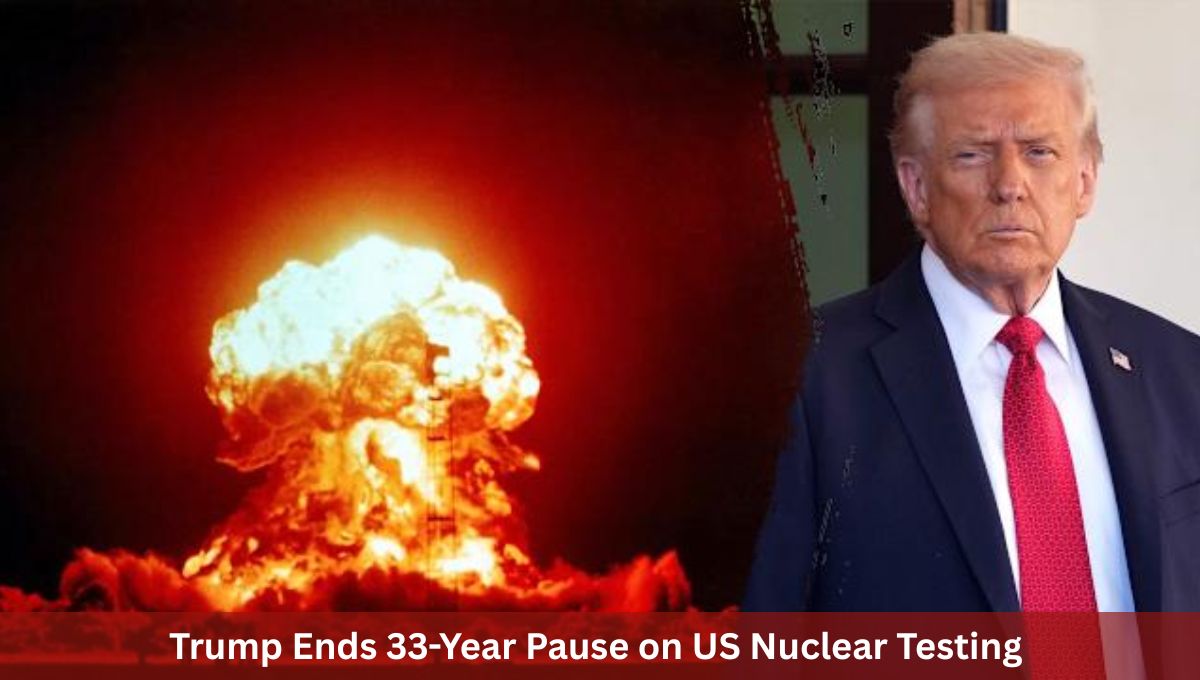
Trump Ends 33-Year Pause on US Nuclear Testing, sparks global alarm.Global criticism mounted on Friday after US President Donald Trump announced that the United States will resume nuclear weapons testing for the first time since 1992, ending a 33-year moratorium that had stood as a symbol of nuclear restraint. The announcement, made on Trump’s Truth Social platform just before his meeting with Chinese President Xi Jinping in South Korea, marks a sharp shift in US nuclear policy and has drawn concern from allies, adversaries, and disarmament advocates alike.
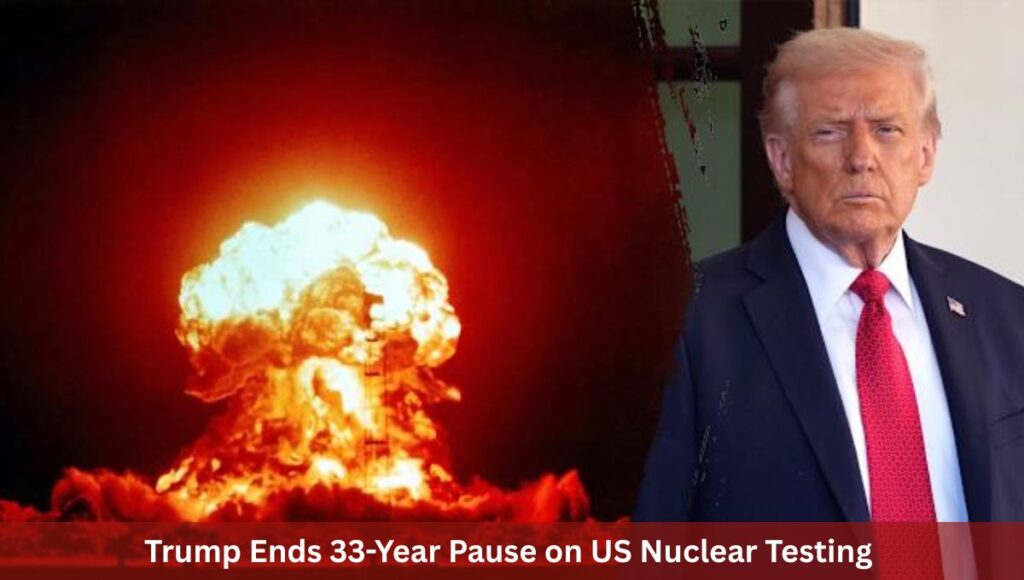
Trump Ends 33-Year Pause on US Nuclear Testing
Iran Condemns Move as “Regressive and Irresponsible”
Iranian Foreign Minister Abbas Araghchi condemned Trump’s decision, calling it a dangerous escalation and a violation of international norms.
“Having rebranded its ‘Department of Defense’ as the ‘Department of War,’ a nuclear-armed bully is resuming testing of atomic weapons,” Araghchi wrote on X (formerly Twitter).
He accused Washington of hypocrisy for “demonising Iran’s peaceful nuclear programme” while pursuing new atomic tests.
“The same bully has been threatening further strikes on our safeguarded nuclear facilities, all in blatant violation of international law,” he said.
Tehran maintains that its nuclear programme is civilian in nature and that it has never conducted a nuclear test. Experts say Iran has not produced a functional warhead nor tested a ballistic missile capable of delivering one.
Trump’s Announcement and Rationale
President Trump said he had instructed the Pentagon to “immediately” resume nuclear weapons testing to ensure US capabilities remain on par with those of Russia and China.
“Because of other countries’ testing programs, I have instructed the Department of War to start testing our nuclear weapons on an equal basis,” Trump wrote.
He said the decision was necessary to “modernize and validate” the US arsenal, claiming that China’s nuclear capacity “will be even within five years.”
Later, speaking aboard Air Force One after his meeting with Xi, Trump said potential test sites would be determined later, adding, “With others doing testing, I think it’s appropriate that we do also.”
A Historic Reversal of US Policy
The United States last conducted a nuclear test on 23 September 1992, at an underground site in Nevada, known as “Divider.” That was the 1,054th nuclear test carried out by the US since 1945.
The testing moratorium, implemented by President George H.W. Bush, coincided with the end of the Cold War and was followed by the Comprehensive Nuclear-Test-Ban Treaty (CTBT) in 1996. The US signed but never ratified the treaty, although it adhered to its principles for over three decades.
Nuclear testing is prohibited under the CTBT, which bans all explosive testing. Russia ratified the treaty but withdrew its ratification in 2023, while both the US and China have signed but not ratified it.
Russia and China Respond
The announcement prompted quick responses from Moscow and Beijing. The Kremlin said it hoped Trump’s decision was based on “accurate information” and warned that if the US abandons the moratorium, “Russia will act accordingly.”
“Regarding the tests of Poseidon and Burevestnik, we hope that the information was conveyed correctly to President Trump,” Kremlin spokesman Dmitry Peskov told reporters, referring to Russia’s recent tests of nuclear-capable weapons that did not involve detonations.
China’s Foreign Ministry urged the US to “fulfil its obligations under the CTBT and honour its commitment to suspend nuclear testing.”
Experts Warn of a New Arms Race
Nuclear policy experts say the move could ignite a global nuclear arms race at a time when tensions are already high between major powers.
Ankit Panda, a senior fellow at the Carnegie Endowment for International Peace, told Al Jazeera the decision was “likely a political response to Russian and Chinese developments, not a technical necessity.”
“There’s no military or scientific justification for the US to resume nuclear explosive testing,” said Daryl Kimball, executive director of the Arms Control Association (ACA). “It will trigger public opposition and could dismantle decades of non-proliferation progress.”
Kimball added that resuming tests would “blow apart the nuclear Non-Proliferation Treaty” and encourage adversaries to conduct their own.
Japan’s Atomic Bomb Survivors Outraged
In Japan, the decision has been met with deep emotional backlash from survivors of the Hiroshima and Nagasaki bombings, known as hibakusha.
The Japan Confederation of A- and H-Bomb Sufferers Organizations (Nihon Hidankyo), which won the 2024 Nobel Peace Prize, condemned Trump’s order as “utterly unacceptable.”
“It directly contradicts the efforts by nations striving for a peaceful world without nuclear weapons,” the group said in a letter of protest sent to the US embassy in Tokyo.
Nagasaki Mayor Shiro Suzuki called the decision an affront to decades of anti-nuclear advocacy.
“If nuclear weapons testing were to start immediately, wouldn’t that make him unworthy of the Nobel Peace Prize?” he asked, referencing Japanese Prime Minister Sanae Takaichi’s recent statement that she would nominate Trump for the award.
Two Hiroshima-based survivor groups — the Hiroshima Congress against A- and H-Bombs (Gensuikin) and the Hiroshima Prefecture Federation of A-Bomb Victims Associations — also issued statements urging Washington to reconsider.
“In a nuclear war, there are no winners or losers; all of humanity becomes the loser,” they wrote.
Inside the US: Mixed Political Reactions
While many Democratic lawmakers denounced the order, Trump’s supporters defended it as necessary for national security.
Nevada Representative Dina Titus vowed to introduce legislation to block any move to restart testing at the Nevada Test Site.
“Trump will trigger strong public opposition in Nevada, from all US allies, and it could trigger a chain reaction of nuclear testing by adversaries,” said Kimball.
However, Vice President JD Vance backed the president’s stance.
“It’s an important part of national security to ensure that our arsenal functions properly,” Vance told reporters.
Who Has the Most Nuclear Weapons?
According to the Federation of American Scientists (FAS), the world’s largest nuclear powers are:
- Russia: ~5,459 warheads
- United States: ~5,177
- China: ~600
- France: 290
- United Kingdom: 225
- India: 180
- Pakistan: 170
- Israel: 90
- North Korea: 50
Analysts at the Center for Strategic and International Studies (CSIS) say China’s arsenal has doubled in the past five years and could exceed 1,000 warheads by 2030.
A Fragile Arms Control Landscape
Trump’s announcement comes just months before the New START Treaty between the US and Russia — the last remaining nuclear arms control pact — is due to expire in February 2026.
The treaty limits both sides to 1,550 deployed nuclear warheads on intercontinental missiles, bombers, and submarines. No successor agreement has been negotiated.
“We are heading toward a world without arms control,” warned Rhys Crilley of the University of Glasgow. “If the new nuclear arms race hasn’t already begun, we are at the starting line.”
How the Nuclear Era Began
The nuclear age began with the Trinity Test on 16 July 1945 in New Mexico, under the Manhattan Project led by physicist J. Robert Oppenheimer.
Weeks later, the US dropped atomic bombs on Hiroshima and Nagasaki, killing more than 200,000 people. Those attacks remain the only use of nuclear weapons in warfare.
Between 1945 and 1992, the US conducted 1,054 nuclear tests, more than any other country. The Soviet Union carried out about 715, and China 45, according to United Nations data.
What Restarting Nuclear Tests Could Mean
Analysts warn that even underground nuclear tests carry risks. A single detonation could release radioactive materials into groundwater and violate global norms.
“There are inherent risks even with underground testing,” said Carnegie’s Jamie Kwong. “The concern is not only environmental contamination but also the message it sends — that restraint is over.”
Restarting tests could take at least 36 months, as the Nevada site requires major reactivation.
The US has relied for decades on computer simulations and sub-critical tests — experiments that validate warhead safety without causing explosions — to maintain its stockpile.
Why Resume Testing Now?
Observers suggest the decision is rooted less in technical need and more in geopolitical signaling.
Robert Peters, senior research fellow at the Heritage Foundation, said testing could serve as a “political message.”
“It may be necessary to test nuclear weapons as a demonstration of credibility,” he said.
Still, many experts argue such signaling is risky. “If the US resumes testing, others will follow,” said Darya Dolzikova of the Royal United Services Institute (RUSI). “That’s a step back toward the instability of the Cold War.”
A Precarious Global Moment
The world today faces a convergence of crises: the Ukraine war, Korean peninsula tensions, and Middle East flashpoints involving nuclear-capable states.
Russia’s President Vladimir Putin recently showcased new nuclear-capable systems — including the Poseidon underwater drone and Burevestnik missile — which he says can evade US defenses.
Meanwhile, China’s military parades in September displayed the Dongfeng-5 intercontinental ballistic missile, underscoring its rapid advances.
Even so, neither Moscow nor Beijing has conducted a live nuclear explosion in decades. North Korea remains the only country to have done so this century, with its last test in 2017.
Iran’s Civilian Nuclear Stand
Iran insists its nuclear programme remains civilian and under IAEA safeguards. The country has enriched uranium but denies any intent to produce a weapon.
“Iran has never done any nuclear tests,” said Ankit Panda. “They’re not even testing nuclear ballistic missiles. The only thing Iran has is some highly enriched uranium — that’s it.”
Trump, however, has demanded the “total dismantlement” of Iran’s programme and has coordinated airstrikes with Israel on Iranian nuclear and military sites earlier this year.
A New Era of Uncertainty
While some analysts believe the resumption of testing is unlikely to happen immediately, they warn the symbolism of Trump’s statement may be enough to destabilize decades of arms control progress.
“We’re entering an era that could very well become a three-way arms race between the US, Russia, and China,” Kimball said.
As international criticism intensifies — from Tehran to Tokyo — the world is once again grappling with a familiar question from the nuclear age:Can restraint survive in an era of renewed rivalry?
Also Read: Putin Tests ‘Burevestnik’ Nuclear Missile as Trump Calls for Renewed U.S.–Russia Arms Talks
Also Read: Is Trump launching a new nuclear arms race with first US tests in 33 years?