Maintaining a tougher stance, Trump declared, “Don’t Want Them To Buy Russian Oil”: Trump Urges NATO to Toughen Sanctions on Moscow, Threatens Tariffs on China. US President Donald Trump has once again placed Russia’s war in Ukraine at the center of his foreign policy rhetoric, urging NATO nations to stop buying Russian oil and to toughen sanctions on Moscow. Trump warned that Europe’s continued purchases of Russian crude weaken the West’s bargaining power, calling the practice “shocking.”
In a series of statements to reporters and posts on his Truth Social platform, Trump declared he is ready to impose major sanctions on Moscow but only if NATO allies commit to matching Washington’s moves. At the same time, Trump unveiled a bold new demand: NATO should impose 50% to 100% tariffs on China until the Ukraine war ends, arguing that Beijing holds “a strong grip” over Russia.
This latest escalation highlights Trump’s shifting strategy: from months of tariff battles with India to now casting China as the principal enabler of Moscow’s war machine. The pivot reflects Washington’s struggle to balance its alliances, deter Russia, and counter China’s growing influence — all while keeping India from drifting closer to Moscow and Beijing.
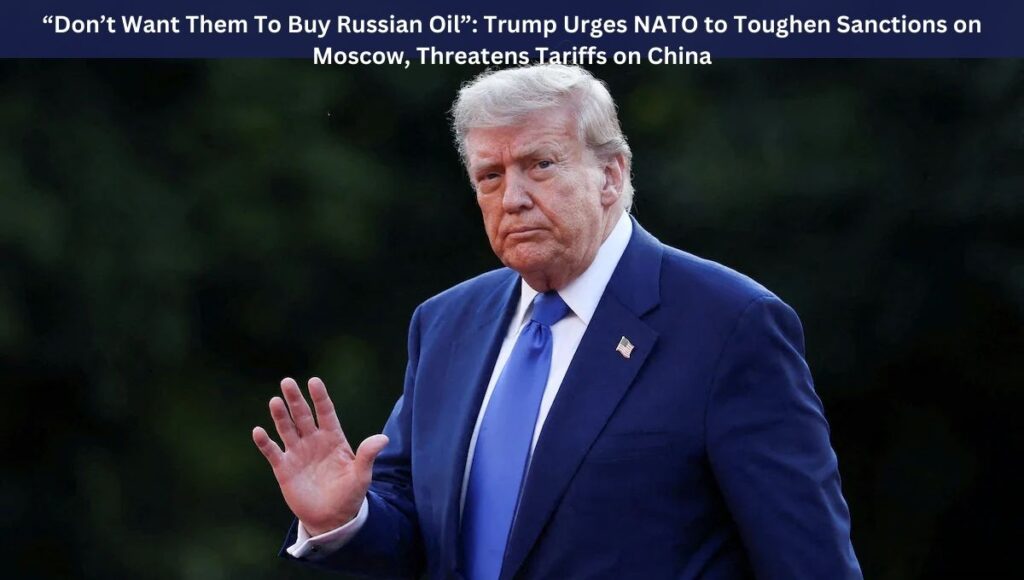
“Don’t Want Them To Buy Russian Oil”: Trump Urges NATO to Toughen Sanctions on Moscow, Threatens Tariffs on China
Trump’s Warning to NATO: “Stop Buying Russian Oil”
Criticism of Europe’s Energy Purchases
Speaking to reporters, Trump lashed out at European NATO members for continuing to import Russian energy despite pledges to reduce dependence.
“Europe is buying oil from Russia. I don’t want them to buy oil — and the sanctions that they’re putting on are not tough enough,” Trump said.
The US president stressed that while Washington had already stopped buying Russian oil, European allies were “talking, but not doing.”
He framed the issue as one of alliance credibility:
“They’re buying a lot of oil from Russia. That’s not the deal. NATO has to get together. Europe is my friend, but they’re not doing the job.”
Energy Dependence Since 2022
When Russia launched its full-scale invasion of Ukraine in 2022, Europe relied on Moscow for 45% of its gas supplies. That figure has since fallen dramatically — expected to reach around 13% this year.
But Trump’s words suggest he believes the cuts are not enough.
- Since 2022, European nations have still spent €210 billion on Russian oil and gas, according to the Centre for Research on Energy and Clean Air.
- These purchases, Trump argues, directly fund Moscow’s war machine.
Trump’s Message to NATO Leaders
In a letter to NATO nations, Trump reiterated:
“I am ready to do major sanctions on Russia when all NATO nations have agreed, and started, to do the same thing, and when all NATO nations STOP BUYING OIL FROM RUSSIA.”
He added:
“Anyway, I am ready to ‘go’ when you are. Just say when.”
The message was clear: collective action, not unilateral moves, will dictate Trump’s next steps.
Trump’s Sanction Threats on Russia
Linking Sanctions to Ukraine War Progress
Trump has repeatedly threatened new sanctions against Russia, including after Moscow launched its biggest-ever aerial assault on Ukraine earlier this month. He argues that cutting Russia’s revenue from oil sales is the most effective way to end the “ridiculous war.”
- Trump branded NATO’s slow action “frustrating” to Kyiv.
- He accused the alliance of weakening its negotiating position by continuing energy purchases.
- He vowed to escalate only when NATO commits collectively.
Meeting with Putin in Alaska
Trump’s comments also come weeks after his summit with Russian President Vladimir Putin in Alaska. While details remain scarce, Trump said he used the meeting to press Putin on the war, even as critics accused him of being too soft on Moscow.
“The purchase of Russian oil by NATO nations is shocking. It greatly weakens your bargaining power over Russia,” Trump insisted.
Also Read: Can the EU and NATO Impose Tariffs on India and China as Trump Demands to Pressure Russia?
The New Focus: Tariffs on China
Trump’s Proposal
In his strongest remarks yet on Beijing, Trump called for NATO to impose massive tariffs on China:
“I believe that this, plus NATO placing 50% to 100% tariffs on China — to be fully withdrawn after the war with Russia and Ukraine is ended — will be of great help in ending this deadly, but ridiculous, war.”
Trump argued that China has a “strong control, even grip, over Russia”, and that economic pressure on Beijing could break Moscow’s resilience.
Why China?
- China has increased its oil and gas purchases from Russia, buying $7.2 billion worth in July alone.
- Beijing has also boosted military cooperation and held a high-profile summit with Putin in Beijing.
- Trump believes tariffs will force China to loosen its support for Moscow, hastening an end to the conflict.
China’s Response
China quickly hit back. At a press conference in Ljubljana, Slovenia, Foreign Minister Wang Yi dismissed Trump’s threats:
“China does not participate in or plan wars. What China does is encourage peace talks and promote political settlement.”
Wang added that sanctions would only “complicate” conflicts and that China remained committed to multilateralism and dialogue.
He emphasized:
“China and Europe should be friends, not rivals. Cooperation, not confrontation.”
India: From Villain to Friend
Trump’s Earlier Criticism of India
Until recently, India bore the brunt of Trump’s anger over Russian oil purchases. His administration imposed:
- A 25% tariff on Indian goods, specifically penalizing Russian oil transactions.
- An additional 25% penalty, making it one of the steepest tariffs globally.
Trump branded India the “Kremlin’s laundromat” and accused Prime Minister Narendra Modi of enabling Moscow. Trade advisor Peter Navarro even made controversial remarks targeting Indian elites.
India’s Response
New Delhi rejected the criticism, calling the tariffs “unfair, unjustified, and unreasonable.”
Officials emphasized that India’s energy decisions are based on national interests and market conditions, not geopolitics.
Despite US pressure, India has:
- Continued buying discounted Russian oil.
- Deepened ties with both Moscow and Beijing through the Shanghai Cooperation Organisation (SCO) summit.
A Softer Tone from Washington
Recently, Trump has recalibrated his stance:
- Called PM Modi a “great Prime Minister” and a “dear friend.”
- Praised India as a “close friend and natural partner.”
- Expressed confidence that trade negotiations could unlock “limitless potential.”
Treasury Secretary Scott Bessent, once critical of India, now emphasizes reconciliation:
“Two great countries will get this solved.”
Why the Shift?
- Domestic pressure: Alienating Indian-Americans carries political risks.
- Strategic necessity: Washington cannot afford to push India closer to China and Russia.
- Diplomatic optics: Modi’s warm interactions with Putin and Xi at the SCO summit alarmed US officials.
By sparing India and targeting China, Trump hopes to prevent a Russia-China-India axis that could undermine US influence.
NATO’s Divided Position
Poland and Eastern Europe on Edge
The debate comes amid heightened tensions after Russian drones entered Polish airspace, sparking fears of escalation.
- Warsaw called it a deliberate act.
- Denmark, France, and Germany have deployed forces to bolster NATO’s eastern flank.
Turkey’s Dilemma
Turkey, a NATO member, remains a major buyer of Russian oil and maintains warmer ties with Moscow than most allies. Convincing Ankara to cut supplies may be one of Trump’s toughest challenges.
The Bigger Picture: Sanctions, Energy, and War
Europe’s Energy Transition
While Europe has reduced reliance on Russian energy since 2022, Trump’s insistence on a total ban raises tough questions:
- Can Europe fully replace Russian energy by 2028, as pledged?
- Will higher costs hurt European economies?
- Could divisions weaken NATO unity?
Trump’s Political Messaging
Trump has repeatedly distanced himself from responsibility for the conflict:
“This is not TRUMP’S WAR (it would never have started if I were President!). It is Biden’s and Zelenskyy’s WAR. I am only here to help stop it.”
By framing it this way, Trump seeks to both attack Biden and position himself as a peacemaker, even as his critics accuse him of escalating tensions.
Conclusion
President Donald Trump’s demand that NATO stop buying Russian oil and impose tougher sanctions highlights the deep fractures within the alliance over how to deal with Moscow. His call for massive tariffs on China signals a strategic pivot — sparing India for now, but raising the stakes with Beijing.
As the Ukraine war grinds on, Trump’s insistence on collective NATO action and his fiery rhetoric are likely to further polarize the debate. For Europe, balancing energy security with alliance unity remains a daunting challenge. For India, Trump’s softened tone reflects Washington’s recognition of its geopolitical importance.
And for China, Trump’s tariff threats could open a new front in an already tense US-China rivalry. Whether these moves bring peace closer or deepen global divisions remains uncertain. But Trump’s message is unmistakable: under his watch, the era of NATO’s “soft” approach to Russia is over.
Also Read: Trump urges NATO countries stop buying Russian oil before US sanctions