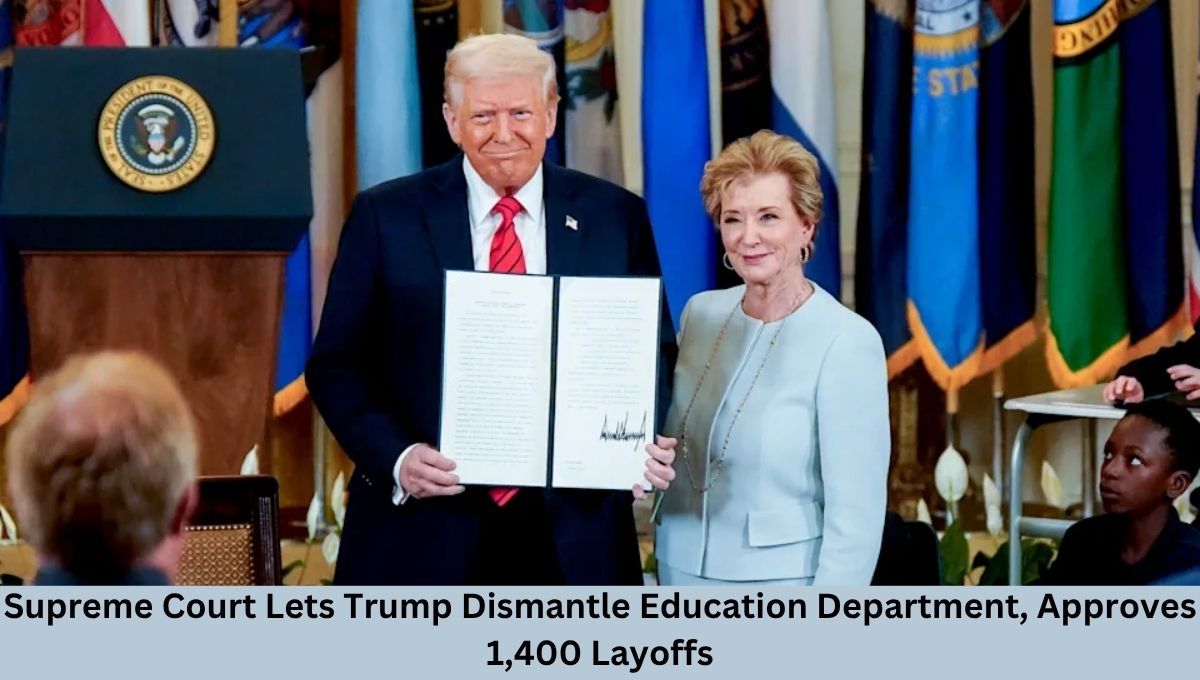
In a landmark and highly controversial ruling, Supreme Court Lets Trump Dismantle Education Department, Approves 1,400 Layoffs. The U.S. Supreme Court on Monday approved President Donald Trump’s plan to dismantle the Department of Education, allowing his administration to proceed with 1,400 employee layoffs. The 6–3 decision, delivered in an unsigned order, lifts a federal injunction that had previously blocked the cuts and marks a major turning point in the future of federal education policy in the United States.
While the legal battle over the legality of this executive action continues in lower courts, this ruling enables the Trump administration to move forward with what critics call a de facto shutdown of the Department of Education an agency created by Congress in 1979.
Supreme Court Lets Trump Dismantle Education Department, Approves 1,400 Layoffs
Trump’s Bold Push to Close the Department of Education
The current battle began in March 2025, when Trump issued an executive order directing Education Secretary Linda McMahon to close the Department of Education “to the maximum extent permitted by law.”
Within weeks, the department announced a massive Reduction in Force (RIF) targeting over half of its workforce.
Supporters of the move, including Trump and McMahon, argue that the Department of Education has “failed parents and students” and that its responsibilities are better managed at the state level.
However, education unions, school districts, and Democratic-led states immediately challenged the decision, filing lawsuits that claimed the plan violates federal law by undermining the department’s legal mandates.
Supreme Court Ruling Greenlights Layoffs
The Supreme Court’s 6–3 ruling reversed lower court decisions that had blocked the layoffs. U.S. District Judge Myong Joun in Boston had ruled in May that the plan would “likely cripple” the department and violate Congressional intent.
The First Circuit Court of Appeals upheld that ruling in June.
But Monday’s decision by the high court overrules those lower courts at least temporarily allowing the Trump administration to finalize layoffs and continue restructuring the agency.
Affected employees, many of whom had been on paid leave since March, began receiving termination notices within hours of the decision. Layoffs are scheduled to be completed by August 1.
Emails reviewed by major news outlets described the move as “structural realignment,” and noted that the terminations were not performance-related.
Trump Declares “Major Victory for Parents and Students”
On Truth Social, Trump celebrated the decision, declaring:
“Now, with this GREAT Supreme Court Decision, our Secretary of Education, Linda McMahon, may begin this very important process… America’s Students will be the best, brightest, and most Highly Educated anywhere in the World.”
Trump emphasized his long-standing goal of returning educational authority to the states and criticized the federal government’s role in education.
Secretary McMahon echoed the president’s statements, calling the ruling: “A win for efficiency, accountability, and for families who deserve better than bureaucratic waste.
We will carry out the reduction in force to ensure resources are directed where they matter most to students, parents, and teachers.”
Liberal Justices Issue Blistering Dissent
The court’s three liberal justices Sonia Sotomayor, Elena Kagan, and Ketanji Brown Jackson issued a strongly worded dissent, warning that the decision undermines constitutional checks and balances.
Writing for the dissent, Justice Sotomayor stated:
“The majority is either willfully blind to the implications of its ruling or naive, but either way the threat to our Constitution’s separation of powers is grave.”
She accused the Trump administration of using layoffs as a loophole to dismantle a federal agency without Congressional approval, which she called “executive lawlessness.”
“When the Executive publicly announces its intent to break the law, and then executes on that promise, it is the Judiciary’s duty to check that lawlessness, not expedite it.”
The dissent also emphasized the vital role the Department of Education plays in enforcing civil rights, distributing student financial aid, and supporting disadvantaged students.
Layoffs Begin Despite Legal Uncertainty
Although the Supreme Court’s order is not a final ruling, it immediately lifted a block on the layoffs, allowing the Trump administration to proceed while the full case continues in appeals.
According to union representatives, affected employees were in the process of being reintegrated when the order came down.
Now, instead of returning to work, they are being let go. The administration insists that the Department will continue to operate, albeit in a smaller capacity.
Opposition Mounts as States File New Lawsuits
In addition to the ongoing lawsuits over the department’s dismantling, more than 20 states filed a separate lawsuit on Monday against the Trump administration, alleging that it is withholding billions in federal education funding.
These funds were earmarked for after-school programs, summer learning, and support for students with disabilities.
State attorneys general claim that the administration is using the funds to leverage compliance from universities and schools on issues like pro-Palestinian student activism and curriculum control.
The Department of Education: Why It Matters
Founded in 1979, the U.S. Department of Education is tasked with:
- Enforcing civil rights in schools
- Administering student loans and grants
- Supporting special education and disadvantaged students
- Gathering and publishing national education data
While states oversee day-to-day classroom policy, the federal department ensures equitable access, funding distribution, and compliance with federal laws especially those protecting vulnerable students.
“Congress created the department to safeguard education for all,” said Skye Perryman, president of Democracy Forward, which is representing educators in court.
“This ruling undermines that mission and deals a devastating blow to public education.”
Critics Say Trump Is Using Layoffs to Abolish Agencies
Opponents argue that Trump’s strategy dismantling agencies by firing staff rather than passing legislation is part of a broader effort to reduce the size and scope of the federal government.
Legal experts warn that similar moves could soon target other agencies, such as:
- Consumer Financial Protection Bureau (CFPB)
- Environmental Protection Agency (EPA)
- U.S. Agency for International Development (USAID)
- U.S. Institute of Peace
“This is not just about education,” said constitutional law scholar Prof. Rachel Sandler. “It’s about executive overreach and setting dangerous precedents that could gut government accountability.”
Broader Trend: Supreme Court Sides with Trump on Executive Power
The ruling is part of a recent string of Supreme Court victories for Trump, which have emboldened his administration to expand presidential power over federal agencies.
Just last month, the court limited lower courts’ ability to issue nationwide injunctions against presidential actions, further tilting the balance of power toward the executive branch.
Analysts say this is part of a systemic shift toward an “imperial presidency”, with the current Supreme Court majority often siding with executive authority.
What Happens Next?
The legal process is far from over. While the Supreme Court has allowed the layoffs to proceed, full arguments are still pending before the appellate courts.
A future ruling could still determine whether Trump’s executive order violates federal law or the Constitution’s separation of powers.
But in the meantime, the administration is expected to continue its course, moving more responsibilities to state governments and cutting federal education functions significantly.
Final Thoughts: A Defining Moment in U.S. Education Policy
The Supreme Court’s decision marks one of the most consequential developments in U.S. education policy in decades. For supporters, it’s a return to state sovereignty and reduced federal control. For critics, it’s the dismantling of public education infrastructure and an assault on civil rights enforcement.
With the 2026 midterm elections approaching and the battle over federal power intensifying, the fate of the Department of Education could emerge as a defining issue for voters across the nation.
Also Read: Rubio Orders Visa Scrutiny for Harvard Visitors Amid Trump Crackdown on Higher Education
Also Read: Mass. schools react to Supreme Court loss over Education Department layoffs
Related Posts:
- Trump’s 2025 Gaza Peace Plan Signing and Historic…

- What’s Next for Donald Trump After Court Rules His…
- Judge Blocks Trump’s Birthright Citizenship Order…

- 9 Explosive Revelations as Trump Declares His Health…

- 5 Powerful Highlights as Trump Lands Second Nobel…

- Trump’s State Department Layoffs Reshape U.S.…
