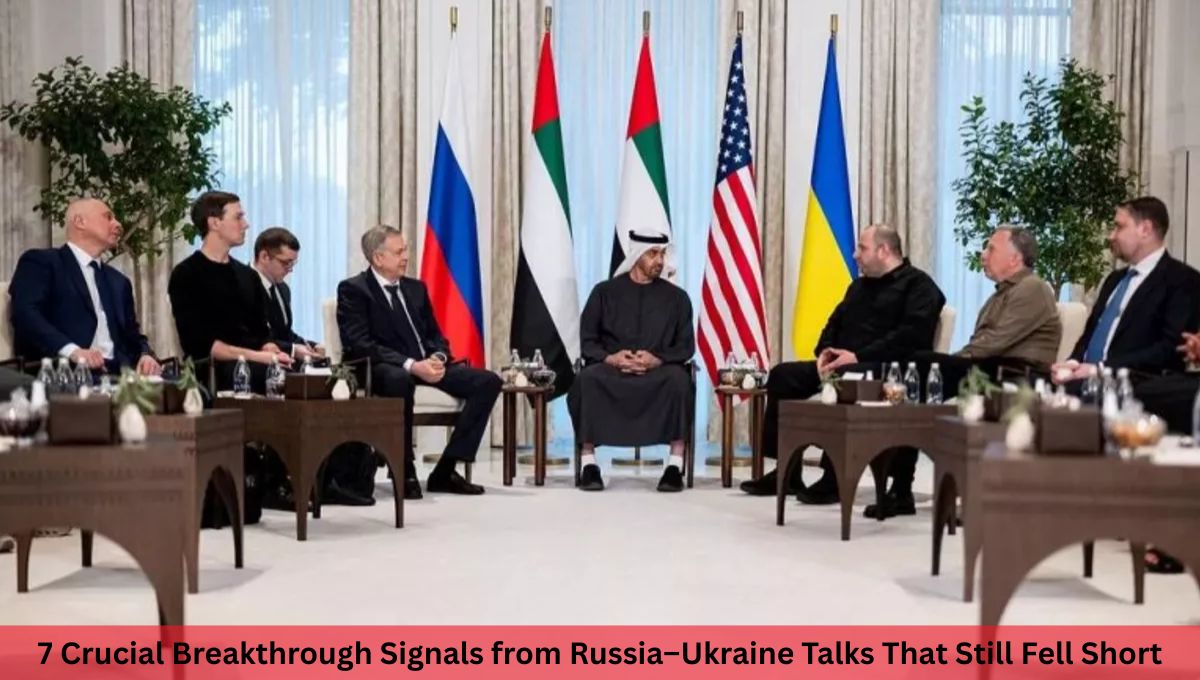
7 Crucial Breakthrough Signals from Russia–Ukraine Talks That Still Fell Short but delivered a major POW exchange. Russia and Ukraine have concluded a second round of United States-brokered peace talks in Abu Dhabi without achieving a decisive breakthrough toward ending Europe’s largest conflict since World War Two.
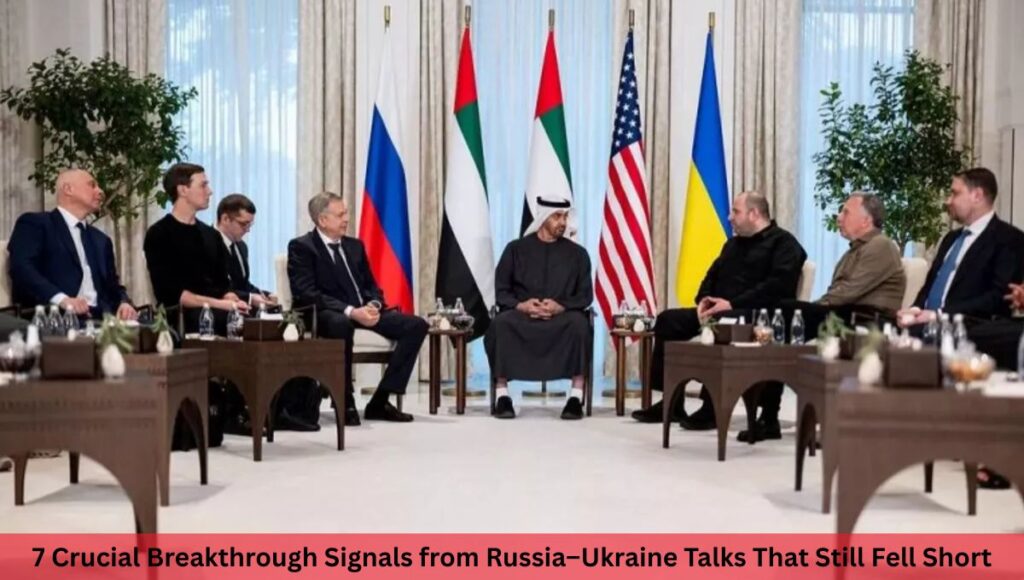
While the negotiations failed to resolve core political and territorial disputes, they produced tangible outcomes, most notably a large-scale prisoner exchange and agreement to continue talks in the coming weeks. The discussions brought together delegations from Kyiv, Moscow, and Washington under the mediation of the United States, with the United Arab Emirates acting as host.
Against the backdrop of continued fighting and mounting casualties, the talks underscored both the difficulty of ending the nearly four-year war and the growing pressure on all sides to explore diplomatic pathways.
7 Crucial Breakthrough Signals from Russia–Ukraine Talks That Still Fell Short
A Major Prisoner Exchange Offers Rare Common Ground
The most concrete result of the Abu Dhabi talks was a significant prisoner-of-war exchange. Russia and Ukraine each released 157 prisoners, making it the largest swap between the two sides in five months and the first such exchange since October.
Russian state media and the defence ministry confirmed that 157 Ukrainian servicemen were handed over, while 157 Russian soldiers were returned home.
In addition, three Russian civilians from the Kursk region were released by Ukraine.
Ukrainian officials said the exchange included soldiers and civilians who had been held for extended periods.
President Volodymyr Zelenskyy noted that some of the freed Ukrainians had been in captivity for nearly four years, dating back to the early months of Russia’s 2022 invasion.
Images released by Zelenskyy showed newly freed prisoners stepping off buses in snowy conditions, many wrapped in Ukrainian flags, some embracing one another and speaking tearfully to relatives by phone.
Several appeared visibly weakened, with shaved heads reflecting months or years in detention.
Ukrainian human rights officials said that among those released were civilians and individuals who had been unlawfully convicted by Russian courts, including some sentenced to life imprisonment.
US Mediation and the Role of Steve Witkoff
The Abu Dhabi talks were led on the American side by US special envoy Steve Witkoff, a key figure in President Donald Trump’s renewed push to broker an end to the war.
Witkoff described the discussions as “constructive” and said they focused on building conditions for a durable peace.
According to Witkoff, the successful prisoner swap demonstrated that sustained diplomatic engagement can deliver tangible results even when broader peace remains elusive.
He added that significant work still lies ahead, particularly on ceasefire mechanisms, security guarantees, and territorial disputes.
The talks marked another step in Washington’s strategy of applying pressure on both Kyiv and Moscow to explore compromise, while keeping open the option of further sanctions or incentives depending on how negotiations evolve.
Military-to-Military Dialogue Set to Resume
Beyond the prisoner exchange, the talks produced an important though less publicised outcome:
agreement to re-establish high-level military-to-military dialogue between the United States and Russia.
According to the US European Command, the channel will provide consistent communication between senior military officials as negotiations continue.
Such contacts have largely been frozen since 2021 and were completely overshadowed by the outbreak of war in 2022.
US officials said the renewed dialogue is intended to reduce risks of miscalculation, manage escalation, and support broader diplomatic efforts.
While it does not signal an improvement in overall US-Russia relations, it reflects recognition that military communication is essential amid ongoing hostilities.
Russia Signals Optimism, Criticises Europe
Russia’s chief negotiator, Kirill Dmitriev, struck an optimistic tone after the talks, telling state media that discussions were moving forward in a “positive direction.”
He also said work was under way to restore aspects of Russia’s relationship with the United States, including through a bilateral working group on economic issues.
At the same time, Dmitriev accused European countries of attempting to disrupt or meddle in the peace process.
Moscow has repeatedly criticised European governments for continued military support to Ukraine, arguing that such assistance undermines diplomatic efforts.
The comments highlighted a growing divide between Washington and some European capitals over the pace, scope, and conditions of any potential settlement.
Zelenskyy Cautious, Presses for Security Guarantees
Ukrainian President Volodymyr Zelenskyy adopted a more cautious stance, acknowledging progress on humanitarian issues while stressing that the overall peace process remains difficult.
Speaking at a news conference in Kyiv alongside Polish Prime Minister Donald Tusk, Zelenskyy said Ukraine would remain as constructive as possible but wants faster and more meaningful results.
He reiterated that any agreement must include robust security guarantees to prevent future Russian aggression.
Zelenskyy has consistently argued that without binding guarantees from Western partners, including the United States, any ceasefire risks becoming a temporary pause rather than a lasting peace.
In his nightly address, he said Ukraine is open to any diplomatic format that can realistically bring peace closer, provided it deprives Russia of the incentive to resume fighting.
Core Disputes Remain Unresolved
Despite the positive optics around the prisoner exchange, the talks failed to make progress on the most contentious issues, particularly territory.
Russia continues to demand that Ukraine cede control of the entire Donetsk region, including areas still held by Ukrainian forces. Moscow also seeks international recognition of its claims over parts of eastern Ukraine and Crimea.
Kyiv has firmly rejected these demands, insisting that Ukrainian forces will not withdraw unilaterally from fortified positions and that any settlement must respect Ukraine’s sovereignty and territorial integrity.
Ukraine has proposed freezing the conflict along current front lines while negotiations continue, a suggestion Russia has so far resisted.
Zaporizhzhia Nuclear Plant: A Strategic Flashpoint
Another unresolved issue is the fate of the Zaporizhzhia nuclear power plant, Europe’s largest, which remains under Russian control.
Ukraine wants the facility returned to its control, citing safety risks and international law. Russia, meanwhile, has said it is open to international cooperation, including with the United States, but insists the plant must remain Russian.
The issue adds another layer of complexity to talks already burdened by deep mistrust and competing strategic interests.
War Continues Despite Diplomacy
Even as diplomats negotiated in Abu Dhabi, fighting continued along the roughly 1,200-kilometre front line.
In Kyiv, Russian drone and missile attacks damaged residential buildings, offices, and a kindergarten, injuring civilians and knocking out energy supplies during one of the coldest periods of winter.
Ukrainian officials said repairs to critical infrastructure could take months.
Ukraine’s air force reported intercepting most of the drones launched overnight, but acknowledged that repeated strikes are taking a heavy toll on energy systems and civilian morale.
In eastern Ukraine, Russian shelling of the city of Druzhkivka killed at least seven people at a crowded market, with officials saying cluster munitions were used.
Casualties Mount as Fourth Anniversary Nears
As the war approaches its fourth anniversary on February 24, both sides face staggering human losses.
Zelenskyy recently estimated that around 55,000 Ukrainian soldiers have been killed since 2022, with thousands more wounded or missing. Independent analysts estimate Russian casualties at nearly 1.2 million, figures Moscow disputes.
The sheer scale of the losses has increased domestic and international pressure on leaders to seek an end to the conflict, even as battlefield realities make compromise politically risky.
Pressure From the Trump Administration
The talks reflect renewed pressure from the Trump administration to push both sides toward a negotiated outcome.
US officials have indicated that future sanctions on Russia, as well as continued support for Ukraine, could depend on how talks progress.
Treasury Secretary Scott Bessent has reiterated Washington’s view that Russia’s invasion was illegal and that accountability for war crimes remains a core concern, even as diplomacy advances.
What Comes Next?
According to Ukrainian negotiator Rustem Umerov, trilateral talks are expected to continue in the coming weeks, with the next round likely to be held in the United States.
While expectations remain modest, the Abu Dhabi talks suggest that limited cooperation is possible, particularly on humanitarian issues. Whether this momentum can translate into a ceasefire or broader settlement remains uncertain.
For now, the prisoner exchange stands as a rare moment of progress in a conflict defined by entrenched positions and ongoing violence.
For global audiences watching closely, it is a reminder that even amid war, diplomacy remains a critical, if fragile, pathway toward peace.
Also Read: Putin–Zelensky Summit: Where Could Peace Talks Happen?
Also Read: US and Russia agree to re-establish military dialogue after Ukraine peace talks in Abu Dhabi
Related Posts:
- Russia and Ukraine Agree on Major POW Swap, But…

- 7 Critical Reasons the Donbas Is the Most Explosive…
- Trump’s 20-Point Gaza Peace Plan Gains Urgent Global…

- 7 Crucial Developments as Zelenskyy Says US Security…

- 7 Powerful Measures: Trump Sanctions Russian Oil…

- In 8 Moves, EU Targets China-Linked Refineries and…
