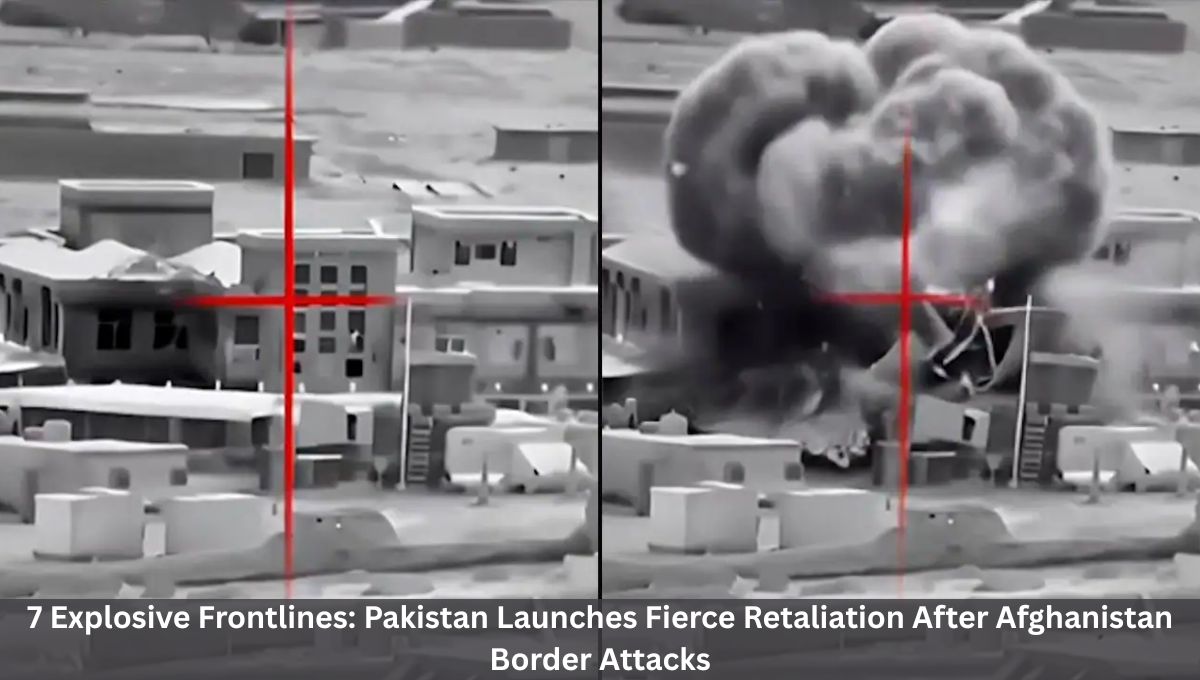
7 Explosive Frontlines: Pakistan Launches Fierce Retaliation After Afghanistan Border Attacks that have raised alarms of a wider conflict. Tensions between Pakistan and Afghanistan have erupted into one of the most serious military escalations in years, as both sides traded heavy fire along the disputed Durand Line, triggering fears of a broader regional confrontation.
What began as cross-border airstrikes quickly spiraled into coordinated ground assaults, artillery fire, and claims of captured military outposts.
While both governments insist they are acting defensively, the scale, intensity, and rhetoric surrounding the clashes point to a rapidly deteriorating security situation in South Asia.
7 Explosive Frontlines: Pakistan Launches Fierce Retaliation After Afghanistan Border Attacks
Afghanistan Confirms Cross-Border Offensive
Afghanistan’s Taliban-led authorities confirmed that their forces launched what they described as large-scale offensive operations against Pakistani military positions along the border, citing retaliation for earlier Pakistani airstrikes in eastern Afghanistan.
Taliban spokesperson Zabihullah Mujahid said the attacks were carried out in response to “repeated provocations and violations” by Pakistani forces in provinces including Nangarhar and Paktia.
According to Taliban statements, fighting erupted late Thursday night and continued for several hours across multiple border sectors.
Afghan officials claimed heavy clashes resulted in significant Pakistani casualties and the capture of several military outposts — assertions Islamabad has strongly denied.
Pakistan’s ‘Immediate and Effective Response’
Pakistan’s Ministry of Information and Broadcasting said Afghan forces had opened unprovoked fire across several sectors in Khyber Pakhtunkhwa province, prompting an “immediate and effective response” by Pakistani troops.
The ministry stated that Pakistani forces targeted Taliban positions in Chitral, Khyber, Mohmand, Kurram, and Bajaur, reporting heavy casualties on the Afghan side along with destroyed posts and military equipment.
Prime Minister Shehbaz Sharif’s spokesperson rejected Afghan claims outright, saying no Pakistani posts were captured and insisting that Pakistan had inflicted “heavy losses” in response to what it called Taliban aggression.
Conflicting Casualty Claims Deepen Uncertainty
One of the most striking aspects of the confrontation is the vastly different casualty figures reported by each side.
Afghan Claims
Afghan military officials claimed:
- Dozens of Pakistani soldiers were killed
- Multiple Pakistani outposts were captured
- Several Pakistani soldiers were taken alive
- Heavy weapons and equipment were seized
Pakistani Claims
Pakistan countered with sharply lower figures, stating:
- Only two Pakistani soldiers were killed
- Afghan casualties exceeded 130 fighters killed
- More than 200 Taliban members were wounded
- Multiple Afghan military posts were destroyed
Independent verification remains impossible, underscoring the fog of war and the risk of misinformation driving escalation.
Explosions Reported in Kabul
As the border fighting intensified, residents in Kabul reported loud explosions and the sound of aircraft overhead, marking a dramatic expansion of hostilities beyond the frontier.
Taliban officials accused Pakistan of conducting airstrikes in Kabul, Kandahar, and Paktia, though they said no casualties were immediately reported.
Pakistani officials have neither confirmed nor denied strikes inside the Afghan capital.
The presence of air operations over Kabul has heightened fears that the conflict could spiral into a wider confrontation affecting civilian populations.
Operation Ghazab Lil Haq: Pakistan Escalates
Pakistan formally acknowledged launching Operation Ghazab Lil Haq, a major military response framed as a defensive campaign against Taliban aggression.
Defense Minister Khawaja Asif said Pakistan’s armed forces were delivering a “crushing response” and warned that continued attacks would be met with decisive force.
Officials emphasized that the operation targets militant infrastructure and border positions rather than civilians, though Afghan authorities dispute that characterization.
The Durand Line: A Border That Never Healed
At the heart of the crisis lies the Durand Line, a 2,611-kilometer border that Afghanistan has never formally recognized.
The boundary has long been a source of friction, cutting through tribal regions where communities, trade routes, and militant networks overlap.
Over the years, both sides have accused each other of violations, unauthorized fencing, and harboring hostile actors.
Recent months have seen repeated closures of key border crossings, severely disrupting trade, humanitarian flows, and civilian movement.
Militant Groups and the TTP Factor
Security analysts point to the presence of Tehrik-e-Taliban Pakistan (TTP) as a central driver of tensions.
Pakistan accuses Afghanistan of allowing the TTP to operate from Afghan territory, launching attacks inside Pakistan before retreating across the border. Kabul denies these allegations.
According to analysts at Armed Conflict Location & Event Data, the porous nature of the border enables militant mobility, complicating counterterrorism efforts on both sides.
Islamic State Khorasan Complicates the Battlefield
The security environment is further complicated by Islamic State Khorasan Province, which has carried out deadly attacks in both Pakistan and Afghanistan.
Analysts suggest that the Taliban’s reluctance to aggressively confront the TTP stems partly from fears that fighters could defect to Islamic State factions, creating a more volatile and unpredictable threat.
Civilian Impact and Refugee Displacement
As fighting spread, civilians on both sides of the border were caught in the crossfire.
- Afghan authorities reported civilian casualties, including women and children, from Pakistani strikes
- Refugee camps near the Torkham crossing were evacuated
- Pakistani border villages reported mortar fire and civilian displacement
Humanitarian agencies warn that continued fighting could trigger a new wave of displacement in an already fragile region.
International Reactions and Calls for Restraint
The United Nations urged both sides to protect civilians and resolve disputes through diplomacy, stressing obligations under international humanitarian law.
Previous ceasefires brokered by regional mediators, including Qatar and Turkey, have failed to hold amid repeated violations.
Global powers are closely monitoring the situation, concerned that prolonged fighting could destabilize South Asia and disrupt regional security corridors.
Information Warfare and Propaganda Risks
Both sides have used social media platforms to shape narratives, announce casualty figures, and release battlefield footage — much of which remains unverifiable.
Pakistan accused Afghanistan of spreading “false and baseless propaganda,” while Taliban officials accused Islamabad of targeting civilian areas.
Experts warn that information warfare can inflame nationalist sentiment, making de-escalation politically difficult.
Why This Escalation Is Different
Several factors distinguish the current crisis from past flare-ups:
- Simultaneous ground and air operations
- Direct strikes reported near capital cities
- Public declarations of large-scale operations
- Intensified rhetoric suggesting prolonged confrontation
Analysts say these elements increase the risk of miscalculation and unintended escalation.
What Comes Next?
Despite the intensity of the clashes, both sides insist they are not seeking full-scale war. However, continued retaliatory cycles could quickly undermine those claims.
Key variables to watch include:
- Whether airstrikes continue beyond border regions
- Diplomatic intervention by regional or global powers
- Movement or redeployment of heavy military assets
- Civilian casualty trends
Without credible dialogue mechanisms, observers warn that further escalation may be inevitable.
Conclusion: A Region on Edge
The Pakistan-Afghanistan confrontation highlights how unresolved borders, militant networks, and mutual distrust continue to destabilize South Asia.
As both sides trade fire and accusations, civilians remain the most vulnerable victims of a conflict shaped by history, ideology, and security fears.
Whether diplomacy can reassert itself before the violence deepens will determine not only the fate of the Durand Line, but the broader stability of the region.
Also Read: Trump’s Bold Claim: ‘Easy’ to Solve Pakistan–Afghanistan Conflict 2025
Related Posts:
- Afghanistan–Pakistan War 2025: Inside the 48-Hour Ceasefire

- Afghanistan–Pakistan Border Clashes 2025: Key Facts…

- Pakistan–Afghanistan Border Conflict 2025: Ceasefire…

- 3 Afghan Cricketers Killed in Pakistan Airstrikes:…

- Pakistan–Afghanistan Ceasefire 2025: What to Know…

- Rising Tensions Between India and Pakistan: Strikes,…