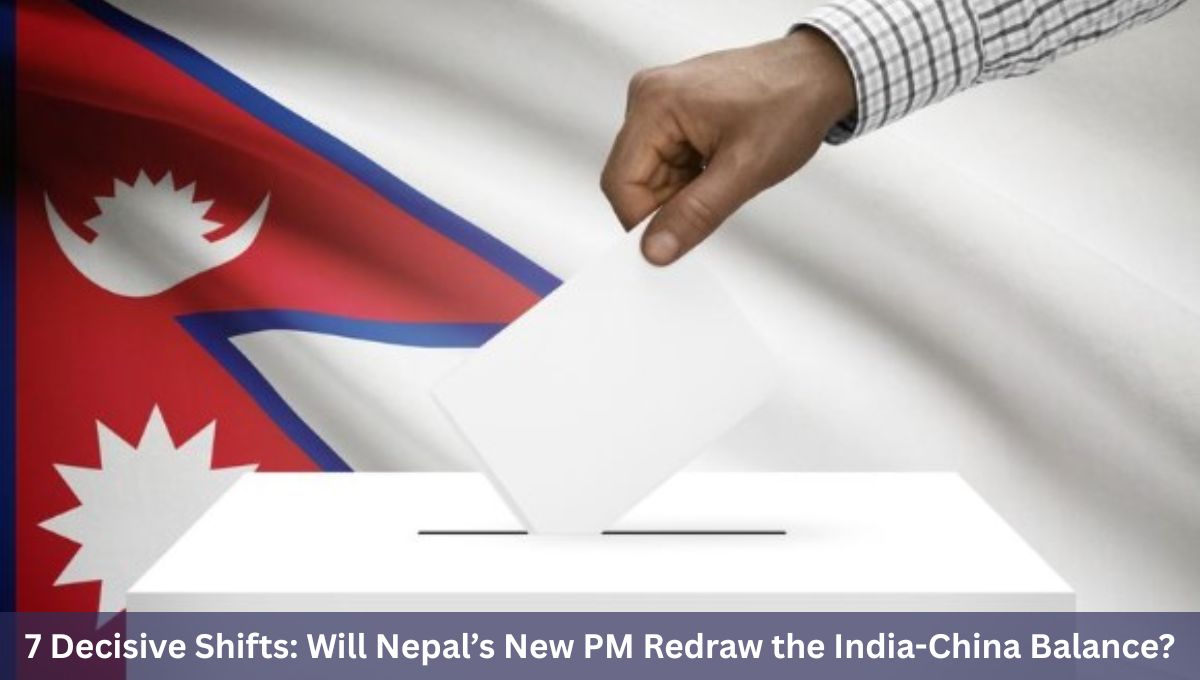
7 Decisive Shifts: Will Nepal’s New PM Redraw the India-China Balance? — The world watches. Nepal goes to the polls on March 5 in its most consequential election in two decades, six months after a youth-led uprising killed 77 people, burned parliament buildings, and forced the resignation of Prime Minister K. P. Sharma Oli.
At first glance, the election appears to be about domestic accountability—corruption, unemployment, economic stagnation, and generational change.
But beneath the surface lies a deeper geopolitical question with global implications:
Will Nepal’s next prime minister disrupt the country’s delicate diplomatic balance between India and China?
Analysts largely agree on one point:
while faces may change dramatically, Nepal’s core foreign policy doctrine—careful hedging between its two giant neighbours—will likely endure.
Yet the political forces unleashed by the Gen Z uprising have introduced unprecedented uncertainty into how that balance will be managed.
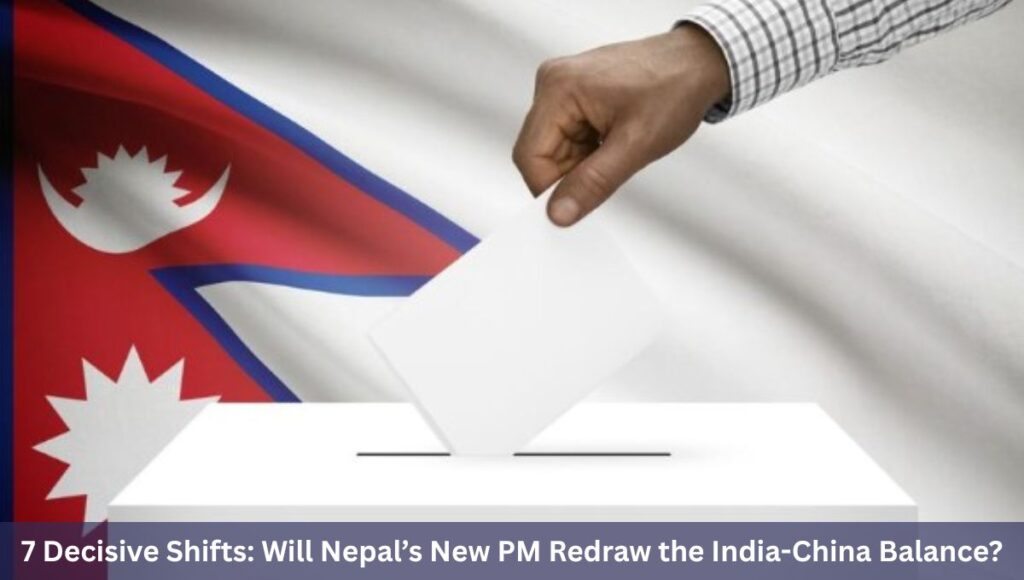
7 Decisive Shifts: Will Nepal’s New PM Redraw the India-China Balance?
1. A Nation at a Turning Point
From Stability to Shock
For nearly two decades after the end of Nepal’s civil war in 2006, power rotated among a small group of veteran leaders.
Coalition governments rose and fell, but foreign policy remained strikingly consistent. That equilibrium collapsed in September 2025.
What began as protests against a short-lived social media ban exploded into a nationwide revolt against corruption, unemployment, and political stagnation.
Security forces opened fire. Dozens died. Hundreds of buildings burned. The government fell.
The interim administration under former chief justice Sushila Karki called early elections, setting the stage for a political reset.
2. Nepal’s Enduring Balancing Act
Between Two Giants
Nepal is a landlocked Himalayan state of roughly 30 million people, wedged between the world’s two most populous nations:
India to the south and China to the north.
Its survival strategy has long been pragmatic nonalignment.
- India remains Nepal’s largest trading partner, accounting for 63% of imports
- China follows with 13%, but is rapidly expanding infrastructure investment
- Nepal depends on India for trade access and energy export
- It relies on China for connectivity diversification and strategic leverage
This balancing act is not improvisational. It is constitutionally embedded.
Article 51 of Nepal’s Constitution anchors foreign policy in nonalignment, sovereign equality, and the Panchsheel principles, transforming hedging into a legal commitment rather than a tactical choice.
3. What Experts Say: Continuity Over Rupture
Nepali journalist Sudheer Sharma believes any dramatic shift is unlikely.
“It will be very difficult for any single party to secure a majority,” Sharma said. “Nepal’s relations with India or China depend on coalition dynamics. The fundamentals will not change—only the approaches might.”
That view is echoed internationally. South Asia analyst Michael Kugelman argues that even generational turnover will not upend Nepal’s geopolitical instincts.
“Nepal’s leadership, even if inclined to lean one way or another, ultimately aims to balance ties with India and China,” Kugelman said. “It’s hard to imagine that changing.”
4. India’s Stakes: Stability Over Alignment
Why New Delhi Cares
India has historically viewed Nepal as a close cultural and strategic partner:
- Open borders enable free movement of people
- Hydropower trade integrates both economies
- Shared religion and history reinforce ties
Retired Indian diplomat Rakesh Sood describes bilateral relations as “extensive,” spanning trade, tourism, and energy. Yet relations have not always been smooth.
Oli’s previous terms were marked by friction with New Delhi, including his decision to visit Beijing first after taking office—breaking a long-standing diplomatic custom.
For India, the priority now is predictability, not preference. Political instability in Kathmandu directly affects India’s border security, migration flows, and domestic politics in Bihar and Uttar Pradesh.
5. China’s Approach: Flexible, Strategic, Patient
Beijing’s Nepal policy under Xi Jinping has become broader and more institutionalised.
Chinese engagement now spans:
- Infrastructure and airport construction
- Rail and road connectivity via Tibet
- Political party exchanges
- Media and business outreach
China is less concerned about who governs Nepal than how open Kathmandu remains.
As Kugelman notes, Beijing is “comfortable with any political dynamic” so long as it preserves access and influence.
Fragmentation in Nepal does not weaken China’s position—it multiplies entry points.
6. The Gen Z Factor: Disruption Without Realignment
Youth Revolt, Old Constraints
The September uprising was driven by young Nepalis frustrated by:
- Youth unemployment above 20%
- Corruption and patronage politics
- Forced labour migration
- A sense of generational exclusion
Yet despite its revolutionary energy, the movement was not ideological in foreign policy terms. Nepali youth are not anti-China, but they are sceptical of opaque mega-projects.
They are not anti-India, but they reject perceived interference. Their defining demand is transparency, not alignment.
7. The Rise of Balendra Shah
A Populist Disruptor
The most dramatic wildcard is Balendra Shah, popularly known as Balen.
A rapper-turned-engineer who became Kathmandu’s mayor in 2022, Shah has emerged as the leading prime ministerial contender according to analysts and local media.
His party, the Rastriya Swatantra Party, pledges “balanced foreign relations” and economic reform.
Shah’s appeal lies in:
- Direct communication via social media
- Visible urban governance reforms
- Anti-elite rhetoric
But analysts warn charisma alone cannot govern a fragmented parliament.
8. Coalition Politics and Foreign Policy Risk
Nepal is almost certain to produce a hung parliament.
Coalition dependence creates vulnerabilities:
- Infrastructure financing becomes politicised
- External actors gain leverage
- Policy coherence weakens
Historically, elite continuity mitigated these risks. That continuity is now gone. The risk is not abandonment of nonalignment—but incoherent execution.
9. The Economic Paradox Behind the Uprising
Macroeconomically, Nepal is stable:
- Record foreign reserves
- Remittances up over 30%
- Graduation from Least Developed Country status imminent
Yet the uprising was driven by aspirational frustration, not collapse. Remittances—nearly a quarter of GDP—acted as a pressure valve.
For Gen Z, migration is no longer opportunity but obligation. This disconnect between stability and opportunity is politically explosive.
10. Digital Elections and a New Political Arena
Nepal’s election campaign has gone hybrid:
- Door-to-door mobilisation continues
- But social media dominates outreach
The Election Commission has partnered with Meta and TikTok to track spending and misinformation.
Digital campaigning lowers entry barriers—but also accelerates populism, polarisation, and perception-driven politics.
11. Security on a Knife Edge
Authorities have deployed over 338,000 security personnel nationwide. More than 3,680 polling stations are classified as highly sensitive.
The memory of September’s bloodshed looms large. A peaceful election is not just a procedural necessity—it is a legitimacy test.
12. What Happens After March 5?
Three Likely Scenarios
- Fragmented Coalition, Policy Continuity
Most likely. Hedging survives, governance remains slow. - Youth-Led Reform Coalition
Domestic reform accelerates, foreign policy cautious but inexperienced. - Old Guard Resurgence
Familiar stability returns—but legitimacy erodes further.
In all scenarios, Nepal continues balancing India and China—but under greater strain.
Conclusion: Hedging Survives, But the Margin Narrows
Nepal’s March 5 election will not overturn its nonaligned foreign policy. But it will test whether that strategy can survive political fragmentation, generational upheaval, and rising geopolitical pressure.
Strong institutions enable balanced diplomacy. Weak legitimacy turns states into arenas of competition. The Gen Z uprising shattered complacency.
The election will determine whether Nepal converts rupture into renewal—or drifts into deeper vulnerability. The world should pay attention.
Also Read: Post-uprising polls won’t shake Nepal’s delicate India-China balance
Related Posts:
- Nepal’s Gen Z Protests Push Sushila Karki and Kulman…

- Nepal Gen Z Protests Escalate: 112 Indian Tourists…

- Sushila Karki Sworn In as Nepal’s First Woman Prime…

- Kathmandu Airport Reopens after Nepal Gen Z Protests…

- Worried Migrants Head Home from India as Nepal’s Gen…
- Indian Tourist’s Desperate Appeal Amid Nepal Gen Z…
