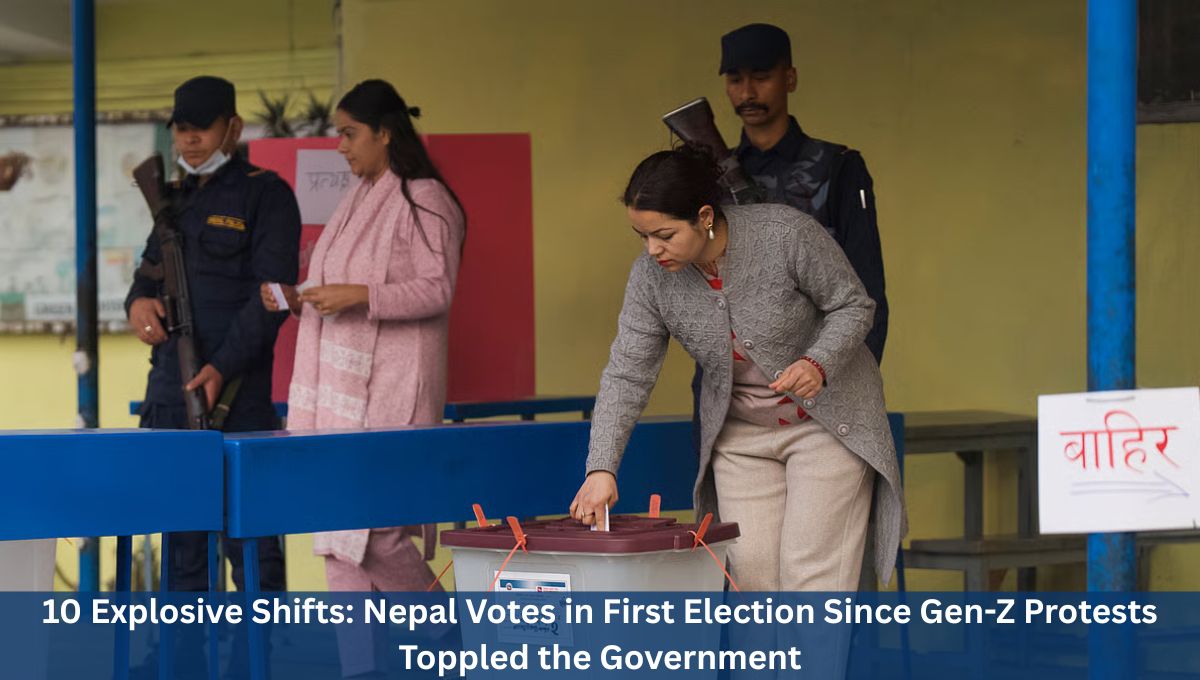
10 Explosive Shifts: Nepal Votes in First Election Since Gen-Z Protests Toppled the Government amid political instability. Nepal is voting today in what is widely seen as one of the most consequential elections in its recent history. The nationwide polls come nearly six months after massive youth-led protests shook the Himalayan nation, forced the resignation of Prime Minister KP Sharma Oli, and resulted in the deaths of more than 70 people.
The election marks the first national vote since the unrest that exposed deep frustration among younger citizens toward Nepal’s traditional political establishment.
With nearly 19 million voters eligible to cast ballots for a new parliament, the outcome could reshape the country’s political landscape and determine whether Nepal continues under its long-dominant leaders or moves toward a generational shift.
The vote will replace the interim administration led by Sushila Karki, a former chief justice who stepped in as Nepal’s first female prime minister after the protests triggered a political collapse in September 2025.
For many observers, the election is not merely about forming a government but about defining the future direction of a nation that has struggled with instability since the abolition of its monarchy in 2008.
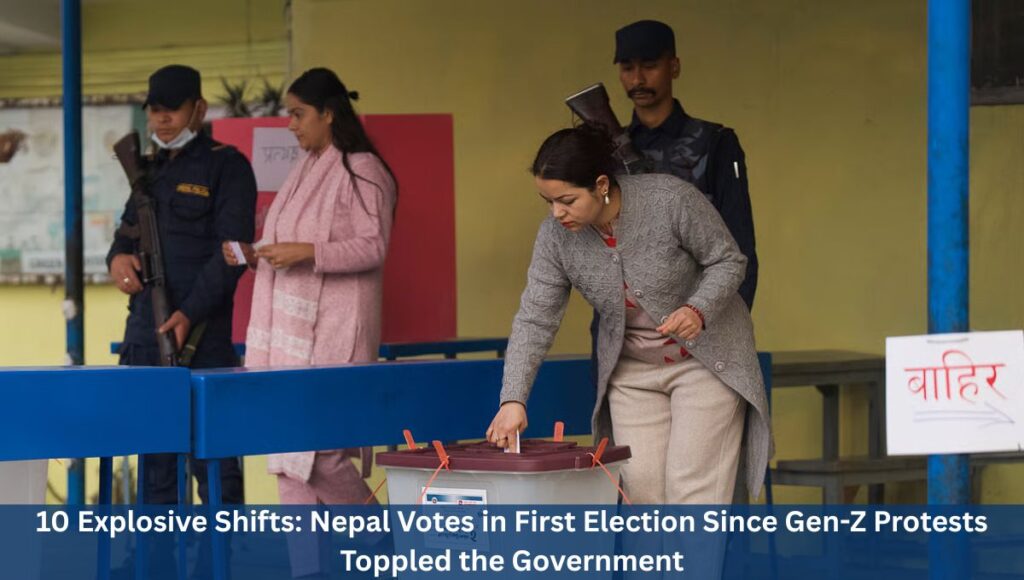
10 Explosive Shifts: Nepal Votes in First Election Since Gen-Z Protests Toppled the Government
A Test for Nepal’s Old Political Guard
At the center of the election are some of the most familiar names in Nepali politics.
Veteran leaders such as Sher Bahadur Deuba of the Nepali Congress, KP Sharma Oli of the Communist Party of Nepal–Unified Marxist Leninist (CPN-UML), and Pushpa Kamal Dahal, also known as Prachanda, of the Communist Party of Nepal (Maoist Centre) remain prominent contenders.
These leaders have dominated Nepal’s politics for decades, guiding governments through periods of civil conflict, constitutional transitions, and shifting alliances. However, this election is widely being seen as a referendum on their leadership.
The protests last year revealed widespread public dissatisfaction with what many citizens describe as entrenched political elites, persistent corruption, and a failure to address economic problems, especially unemployment among young people.
Analysts say that if traditional leaders fail to deliver strong results in the polls, it could signal the beginning of a dramatic transformation in Nepal’s political structure.
Young Leaders Enter the Fray
The biggest challenge to Nepal’s old guard comes from a new generation of politicians who have captured the attention of younger voters.
Among them is Rabi Lamichhane of the Rastriya Swatantra Party (RSP), a former media personality who rose to prominence by campaigning against corruption and political patronage.
But perhaps the most prominent new face in the election is Balendra Shah, widely known as “Balen.”
A rapper-turned-politician and former mayor of Kathmandu, Shah has become a symbol of youth-driven change in the country.
At just 35 years old, he represents a stark contrast to Nepal’s traditional leaders, many of whom are in their seventies.
Shah’s campaign has focused heavily on transparency, governance reforms, and job creation — issues that resonated strongly with the young protesters who led last year’s demonstrations.
His rise has energized Nepal’s political discourse and introduced a level of unpredictability rarely seen in past elections.
A High-Profile Showdown in Jhapa
One of the most closely watched contests in the election is unfolding in Jhapa-5, a constituency in eastern Nepal near the border with India.
Here, Balendra Shah has taken on veteran leader KP Sharma Oli in a direct political showdown.
Oli, 74, is defending the seat that has anchored his national political career for decades. Having served multiple terms as prime minister, he remains one of the most influential figures in Nepali politics.
Yet this election may be the toughest challenge of his five-decade career. For Shah, the contest represents more than just a parliamentary seat.
It is an opportunity to demonstrate that Nepal’s younger generation is ready to challenge the political establishment and potentially reshape the country’s leadership.
The race has become symbolic of the broader generational divide now shaping Nepali politics.
Gagan Thapa and the Reformist Push
Another significant figure in the election is Gagan Thapa, the newly elected head of the Nepali Congress, Nepal’s oldest political party.
At 49, Thapa represents a younger face within the party compared with its long-standing leadership.
He is contesting from Sarlahi-4 in southern Nepal and has positioned himself as a reformist voice seeking to modernize governance and address public dissatisfaction.
Thapa’s campaign has focused on improving government accountability, strengthening democratic institutions, and creating economic opportunities for the country’s youth.
His leadership within the Nepali Congress also reflects internal pressure within traditional parties to embrace generational change.
Interim Leader Urges Peaceful Voting
Ahead of the vote, interim Prime Minister Sushila Karki urged citizens to participate in the election without fear.
Karki, who assumed office after the violent protests last year, has repeatedly emphasized that her government’s primary mission is to ensure a free and fair election that restores political stability.
Speaking in a public broadcast earlier this week, she told voters that their participation would shape the nation’s future.
“Voting is not just about sending someone to victory,” she said. “It is a decision you make about your future and that of your children.”
Her interim administration has overseen extensive preparations for the election, including the deployment of more than 300,000 security personnel across the country.
Massive Logistics in a Mountain Nation
Organizing elections in Nepal presents unique logistical challenges due to its rugged terrain.
The country is home to eight of the world’s ten highest mountains, including Mount Everest, and many communities are located in remote areas that are difficult to access.
To ensure every eligible voter has the opportunity to participate, election officials have transported voting materials by helicopter and even on foot to isolated regions.
More than 23,000 polling stations have been established across the country, with voting scheduled to take place between 7 a.m. and 5 p.m.
Officials say the counting process will begin soon after polling closes, though final results may take several days.
How Nepal’s Electoral System Works
The election will determine the composition of Nepal’s House of Representatives, the lower chamber of parliament.
The chamber consists of 275 members elected through a mixed electoral system. Of these seats, 165 are chosen through direct first-past-the-post contests in individual constituencies.
The remaining 110 seats are allocated through proportional representation, allowing parties to nominate lawmakers based on their share of the national vote.
This system is designed to balance local representation with proportional party influence, but it often results in coalition governments.
Negotiations among parties after the vote could take days or even weeks before a new government is formed.
The Gen-Z Protests That Changed Nepal
The election follows one of the most dramatic political upheavals in Nepal’s recent history.
In September 2025, protests erupted across the country after the government imposed a ban on 26 social media platforms, including Instagram, Facebook, YouTube, WhatsApp, and X.
The decision triggered anger among young Nepalis, many of whom rely on social media for communication, activism, and employment opportunities.
But the protests quickly expanded beyond the digital ban. Thousands of demonstrators took to the streets to express frustration over corruption, economic inequality, and political favoritism.
Clashes between protesters and security forces turned deadly, with more than 70 people killed and thousands injured.
Government buildings, including parliament and the prime minister’s residence, were attacked during the unrest. Amid mounting pressure, Prime Minister KP Sharma Oli resigned.
The Rise of Sushila Karki
Following the crisis, former chief justice Sushila Karki was appointed interim prime minister.
At 73, she became the first woman to hold the office in Nepal’s history. Karki was widely seen as a neutral figure with a reputation for integrity.
Her government focused on restoring order, launching investigations into the protest violence, and preparing the country for new elections.
She repeatedly emphasized that her administration would remain strictly transitional and would step down once a democratically elected government was formed.
Economic Frustrations Driving the Vote
Underlying the political turmoil are deep economic challenges. Nepal’s largely agrarian economy has struggled to create sufficient employment opportunities, particularly for young people.
Youth unemployment remains high, and many citizens seek work abroad. Government estimates suggest that thousands of Nepalis leave the country each day to pursue employment opportunities overseas.
This migration has become one of the defining social trends in modern Nepal. Many voters say they hope the election will produce leaders capable of addressing these long-standing economic problems.
Voters Seek Change
Across the country, voters have been lining up at polling stations, some arriving early in the morning to cast their ballots.
For many, the vote represents an opportunity to demand better governance and economic prospects.
Issues such as job creation, corruption, and political accountability have dominated campaign discussions.
Analysts say the outcome of the election will reveal whether Nepal’s electorate is ready to move away from its traditional leadership or whether experienced political figures will continue to dominate the country’s governance.
Coalition Negotiations Could Decide the Outcome
Even after votes are counted, Nepal’s political future may remain uncertain. Because of the country’s fragmented party system, no single party is likely to secure a clear majority.
As a result, coalition negotiations are expected to play a crucial role in determining who forms the next government.
Nepal has experienced frequent government changes over the past two decades, and coalition bargaining has often produced unstable administrations.
Whether the next government can provide lasting stability remains one of the biggest questions facing the country.
A Defining Moment for Nepal’s Democracy
As Nepal’s citizens head to the polls, the election represents more than a routine political event.
It is a defining moment for a country still navigating the transition from monarchy to republic and grappling with the demands of a younger, more politically engaged generation.
The outcome will determine whether Nepal’s political establishment adapts to the call for change or whether the familiar faces of its old guard continue to dominate the national stage.
For millions of voters, the choice they make today could shape the future of the Himalayan nation for years to come.
Also Read: Nepal: Voting underway in first polls since ‘Gen Z’ protests toppled Oli government
Related Posts:
- Nepal Gen Z Protests Escalate: 112 Indian Tourists…

- Nepal’s Gen Z Protests Push Sushila Karki and Kulman…

- Sushila Karki Sworn In as Nepal’s First Woman Prime…

- Kathmandu Airport Reopens after Nepal Gen Z Protests…

- Indian Tourist’s Desperate Appeal Amid Nepal Gen Z…

- 7 Decisive Shifts: Will Nepal’s New PM Redraw the…