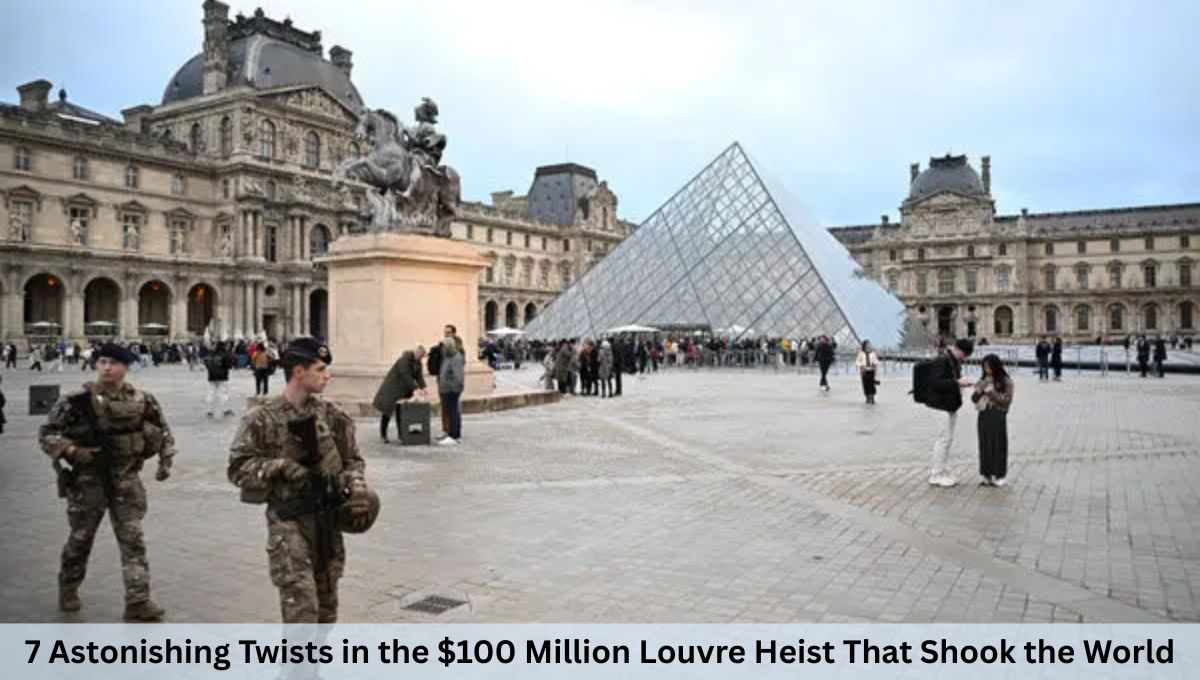
7 Astonishing Twists in the $100 Million Louvre Heist That Shook the World: exposing security flaws. The world’s most famous museum, the Louvre in Paris, has once again captured global headlines — not for its priceless art, but for a $100 million heist that could rival a Bollywood thriller.
An AI-generated video dramatizing the theft in cinematic style has gone viral, with millions of viewers comparing the high-speed robbery to Dhoom 2, the 2006 Bollywood blockbuster featuring a Louvre-set heist by Hrithik Roshan’s character Aryan. But beneath the memes and viral clips lies a story of shocking security lapses, clever criminals, a stolen German truck, and one “cursed” Indian diamond that ties the modern crime to a 17th-century legend.
7 Astonishing Twists in the $100 Million Louvre Heist That Shook the World
1. The Daring Daylight Heist: How the Robbery Unfolded
On a quiet Sunday morning, as Paris prepared for another day of tourists, a gang of four men disguised as renovation workers arrived at the Louvre.
They parked a Boecker furniture hoist truck outside the museum’s Apollo Gallery — the section that houses France’s historic royal jewels, including Napoleon’s gifts to Empress Eugénie.
Within minutes, they raised the mechanical ladder to the first-floor balcony, smashed a window, and slipped inside.
Eyewitnesses told French media they saw the men “get on the hoist, break the window, and enter” within seconds. The thieves were inside for less than four minutes, but they left chaos behind.
Using disc cutters, they sliced open glass cases and made off with eight priceless pieces of jewelry, including a diamond-and-emerald necklace once gifted by Emperor Napoleon.
They escaped the same way they came — down the hoist, onto two Yamaha TMax scooters, and vanished into the Paris streets, just a few hundred meters from the Mona Lisa gallery and the city’s police headquarters.
As they fled, they dropped a 19th-century diamond crown, which was later found damaged, likely crushed during the getaway. The entire operation took just seven minutes — an audacious feat that stunned France and the world.
2. The AI Video That Made the Heist Go Viral
Within 48 hours of the robbery, social media exploded with an AI-generated video recreating the heist in cinematic fashion.
Shared widely on X (formerly Twitter), the clip showed a dramatized version of the Louvre theft — complete with music, slow-motion shots, and slick camera angles reminiscent of Bollywood’s Dhoom 2.
One user joked, “There’s a theft at the Louvre Museum, but the contents are all from Dhoom 2.”
Another quipped, “If Aryan from Dhoom 2 were real, he’d 100% rob the Louvre just for the thrill.”
Within hours, the hashtag #LouvreHeist began trending, blending real crime and reel fiction into one surreal narrative. The AI video, intended as satire, became a viral phenomenon — a modern echo of how art, technology, and crime have merged in the digital era.
3. Security Lapses Exposed: The Louvre’s “Aging Eyes”
As the memes trended online, inside the Louvre, officials were reeling from a massive security failure.
Louvre Director Laurence des Cars, in a candid address to French senators, admitted the museum had “failed these jewels.”
The investigation revealed shocking details:
- The only exterior CCTV camera near the Apollo Gallery was pointing the wrong way.
- The thieves’ truck and ladder were never spotted as they arrived.
- The Louvre’s surveillance system was “aging and unsatisfactory.”
Des Cars confessed that some of the infrastructure dated back decades and could not support modern digital surveillance.
“I was warned about how obsolete the equipment was,” she told senators. “We did not spot the arrival of the thieves early enough… our perimeter protection is weak.”
Despite 8.7 million annual visitors, investment in security had lagged, and staffing cuts over the past decade made the museum increasingly vulnerable. In an emotional admission, she said she had even offered her resignation, but it was refused.
“We’ve had a terrible failure at the Louvre. I take responsibility for it,” des Cars said.
4. The German Company’s Unlikely Marketing Win
While French officials faced criticism, one German company found itself unexpectedly in the spotlight — and seized it. The Boecker company, whose lifting hoist was used in the robbery, turned the incident into marketing gold.
Posting an image of the truck outside the Louvre, Boecker joked on social media:
“When you need to get going again quickly.”
The caption noted that their hoist could lift up to 400 kilograms and was “as quiet as a whisper.” Incredibly, Boecker revealed that the thieves had stolen the machine during a demonstration just nine days before the robbery.
“They removed the customer’s labeling and replaced the license plates,” said Alexander Boecke, the company’s managing director.
Once the photos of the heist emerged, Boecke immediately recognized the truck. “When we realized no one had been hurt, we took it with a touch of humor,” he said, admitting the company used the global attention to boost brand awareness.
The irony wasn’t lost on the public — the same equipment designed for construction had become an accessory in one of the world’s most cinematic crimes.
5. The Hunt for the Louvre Thieves
Authorities believe the robbers were working for a criminal syndicate, possibly from Eastern Europe. French Interior Minister Laurent Nuñez told Europe1 Radio that he had “every confidence” the thieves would be caught.
CCTV from surrounding streets shows the gang switching vehicles twice, suggesting a well-planned escape route. Interpol has been alerted, and European border agencies are monitoring for attempts to sell the jewels on the black market.
As of now, the eight stolen pieces remain missing, and investigators have described the suspects as “experienced professionals.”
6. From Golconda to Paris: The Regent Diamond’s Dark Legacy
Amid all the chaos, one priceless jewel stayed safely behind — the Regent Diamond. Known as the “cursed gem of Golconda,” its story stretches back more than three centuries, to the Kollur mines of India.
The Discovery
In 1687, during the Golconda siege by Emperor Aurangzeb, a slave miner unearthed a 426-carat diamond. He hid it in a wound on his leg, hoping to escape. But legend says he was betrayed and murdered by an English sea captain, who sold the gem to an Indian merchant named Jamchand.
The Pitt Years
In 1701, the diamond was bought by Thomas Pitt, the British governor of Madras, for 48,000 pagodas. Pitt secretly shipped it to London, where it was cut into a 141-carat cushion brilliant — one of the purest diamonds ever crafted.
The gem’s tainted history led satirist Alexander Pope to immortalize it in verse:
“An honest agent stole a gem away;
He pawned it to the Knight, the Knight had sense,
So retained the diamond, and the thief was bit.”
A French Crown Jewel
In 1717, the diamond was sold to Philippe II, Duke of Orléans, and renamed Le Régent.
It adorned the crowns of Louis XV, Louis XVI, and Charles X, and even Marie Antoinette’s hat.
During the French Revolution, it was stolen, recovered, and later mounted in Napoleon Bonaparte’s sword. Today, it rests once more in the Louvre — a 141-carat symbol of power, betrayal, and empire, valued at over $60 million.
7. A Museum Under Pressure: The Future of the Louvre
Following the heist, France’s culture ministry has launched a full security overhaul at the Louvre.
Des Cars has proposed doubling the number of CCTV cameras and modernizing the building’s infrastructure by 2026.
But the challenge is immense — the Louvre is a centuries-old royal palace, not built for 21st-century threats. Despite the embarrassment, the museum reopened quickly, though the Apollo Gallery remains sealed as investigators comb through evidence.
For millions of visitors, the Louvre remains a sanctuary of art and history — but the heist has left an indelible mark on its legacy.
The Art of the Heist: Where Reality Meets Fiction
The $100 million Louvre heist is more than a crime story — it’s a cultural moment.
In a single week, it has:
- Exposed gaping holes in museum security,
- Sparked a global social media frenzy,
- Boosted a German company’s marketing, and
- Rekindled fascination with a centuries-old Indian diamond.
It’s a tale where technology, history, and human ambition collide — a real-life Dhoom 2 with global consequences.
As one viral comment summed it up:
“Movies aren’t fiction anymore — they’re blueprints.”
Also Read: 8 Crown Jewels Stolen in a Shocking $102 Million Louvre Heist
Conclusion: A Heist for the Ages
The Louvre robbery will go down as one of the boldest and most cinematic heists in modern history.
From the AI video’s viral fame to the museum director’s tearful confession, from the Boecker truck’s twist to the Regent Diamond’s cursed past, every layer of this saga feels scripted — yet terrifyingly real.
As France tightens its defenses and the world watches, one question lingers:
If even the world’s most guarded museum can fall in seven minutes, what does that say about the art of crime in the age of AI?
Quick Facts: The $100 Million Louvre Heist
- Date: Sunday, October 19, 2025
- Location: Apollo Gallery, Louvre Museum, Paris
- Duration: 7 minutes
- Loot: 8 royal jewel pieces worth ~$100 million
- Getaway Vehicles: Boecker hoist truck, 2 Yamaha TMax scooters
- Inspiration: Similar to Dhoom 2 heist scene
- Suspects: 4 men linked to an organized crime group
- Recovered: One damaged diamond crown
- Viral Impact: AI video with millions of views on X
Related Posts:
- $102-Million Louvre Heist: 7 Key Twists from Arrests…

- 8 Crown Jewels Stolen in a Shocking $102 Million…

- 7 Shocking Facts: 600+ Artefacts Stolen in UK Museum Heist

- 5 Alarming Failures: Water Leak Hits Louvre Weeks…

- 9 Shocking Facts Behind Germany’s €30 Million…

- Donald Trump Imposes 100% Tariff on Foreign-Made…