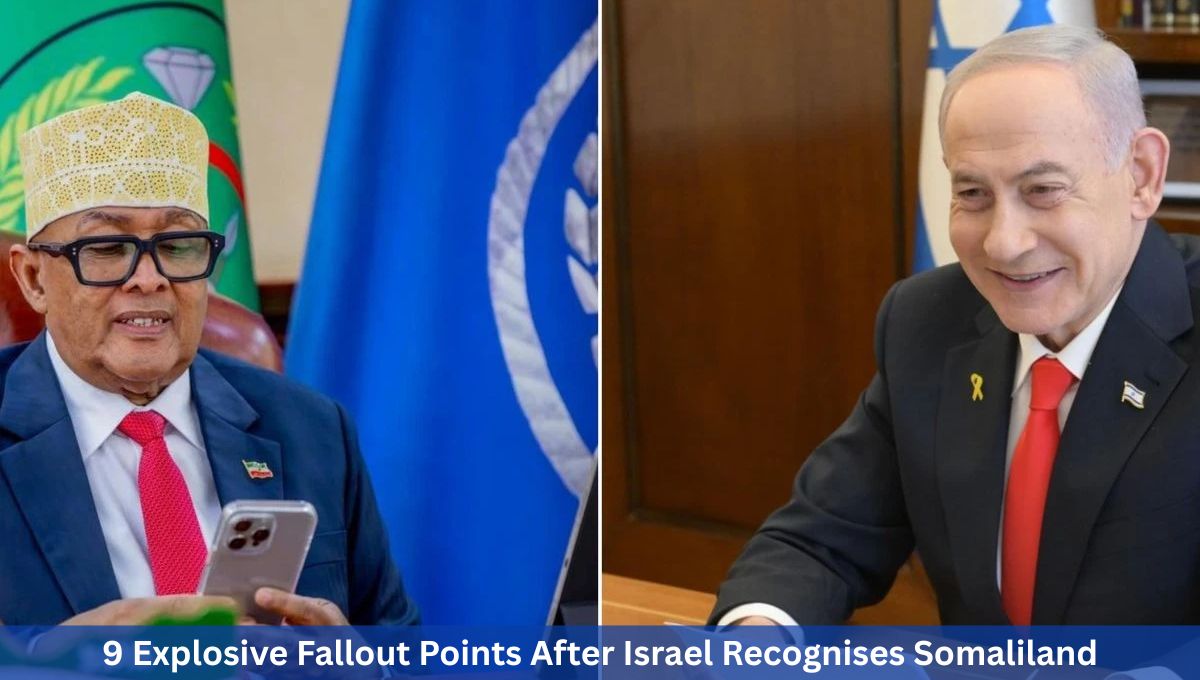
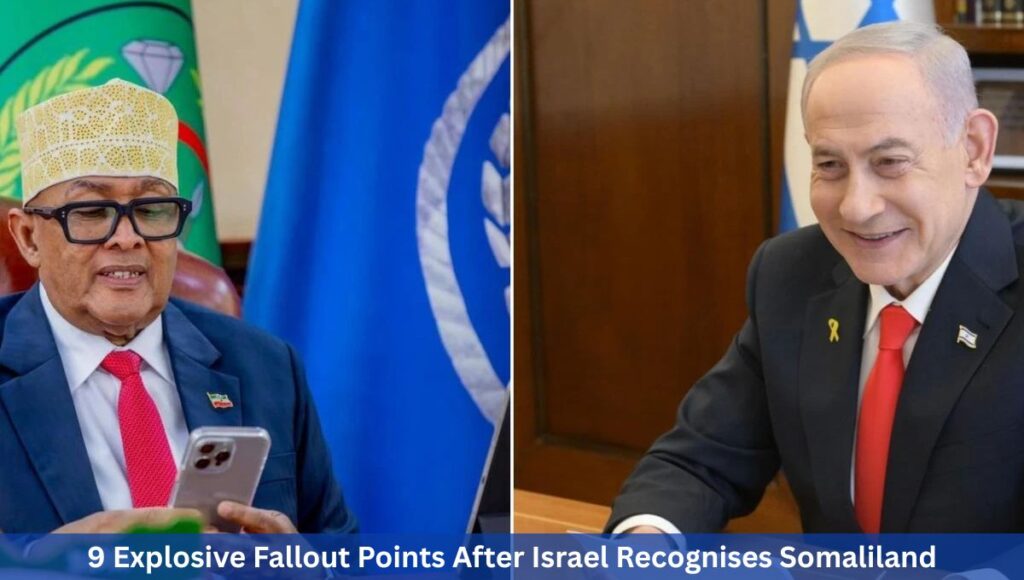
9 Explosive Fallout Points After Israel Recognises Somaliland, sparking fears of instability in the horn of Africa.Israel’s decision to formally recognise Somaliland as an independent and sovereign state has sent shockwaves across Africa, the Middle East and the Red Sea region, triggering fierce condemnation from Somalia and an unusually broad international backlash.
The announcement, made on Friday by Israeli Prime Minister Benjamin Netanyahu, marked the first time a United Nations member state has recognised the self-declared Republic of Somaliland, which broke away from Somalia in 1991 but has never secured international recognition.
Somalia’s president, Hassan Sheikh Mohamud, described the move as a “threat to the security and stability of the world and the region,” accusing Israel of committing a blatant act of aggression against Somalia’s sovereignty.
Emergency parliamentary sessions were convened in Mogadishu, while warnings of military, diplomatic and legal consequences followed swiftly.
From the African Union to the Arab League, from Yemen’s Houthi rebels to European capitals, Israel’s move has been widely criticised as a dangerous precedent that could destabilise one of the world’s most fragile regions.
Below are the key developments, reactions and implications from one of the most controversial diplomatic decisions in the Horn of Africa in decades.
9 Explosive Fallout Points After Israel Recognises Somaliland
1. Israel Breaks a 30-Year Diplomatic Taboo
Israel’s recognition of Somaliland is unprecedented.
Since Somaliland unilaterally declared independence from Somalia in 1991 following the collapse of the Siad Barre regime, no country had been willing to formally recognise it, largely due to concerns about encouraging secessionist movements across Africa.
Netanyahu framed the decision as historic and strategic. In his announcement, he congratulated Somaliland President Abdirahman Mohamed Abdullahi, praised his leadership and invited him to visit Israel.
He said Israel would immediately pursue cooperation with Somaliland in agriculture, health, technology and economic development.
According to Israeli officials, Netanyahu, Foreign Minister Gideon Saar and Abdullahi signed a joint declaration of mutual recognition, formally establishing diplomatic relations.
Netanyahu explicitly linked the move to the Abraham Accords, calling it part of the broader effort initiated during US President Donald Trump’s first term to reshape regional diplomacy.
2. Somaliland Celebrates a Diplomatic Breakthrough
In Hargeisa, Somaliland’s capital, celebrations erupted as news of Israel’s recognition spread.
President Abdullahi hailed the move as a “historic moment” and declared Somaliland would join the Abraham Accords. He described recognition as a step toward regional and global peace, saying his government was committed to partnerships that promote stability across Africa and the Middle East.
For Somaliland, which has its own currency, passport, military and functioning government, recognition by Israel is seen as validation of more than three decades of de facto independence.
Officials hope Israel’s move will encourage other countries to follow suit, breaking Somaliland’s long-standing diplomatic isolation and opening access to international markets and institutions.
3. Somalia Condemns the Move as ‘Naked Aggression’
Somalia’s reaction was immediate and furious. Addressing an emergency joint session of parliament, President Hassan Sheikh Mohamud called Israel’s decision the “greatest abuse” of Somalia’s sovereignty in the nation’s history.
“This is a naked invasion,” Mohamud said, warning that Somalia would not allow its territory to be used as a base for Israel’s regional conflicts.
Lawmakers unanimously passed a resolution declaring Israel’s recognition “null and void,” despite the largely symbolic nature of the measure.
The resolution warned of legal consequences for individuals or institutions violating Somalia’s sovereignty and instructed the government to raise the issue at the United Nations, African Union, Arab League and other international bodies.
Somalia’s prime minister’s office described the recognition as an “unlawful step” and a “deliberate attack” on Somalia’s territorial integrity.
4. African Union and Arab World Unite in Opposition
The backlash extended far beyond Mogadishu. The African Union rejected Israel’s recognition outright, reaffirming its “unwavering commitment” to Somalia’s unity and territorial integrity.
AU Commission Chair Mahmoud Ali Youssouf warned the move sets a “dangerous precedent” that could undermine peace and stability across the continent. Arab and Islamic institutions echoed that view.
The Arab League, the Gulf Cooperation Council and the Organisation of Islamic Cooperation all condemned Israel’s decision as a grave violation of international law and the UN Charter. A joint statement by 21 Arab and African countries described the recognition as reckless and destabilising.
Egypt, Turkiye, Saudi Arabia, Iran, Pakistan, China and Nigeria were among the states that publicly rejected Israel’s move, warning it could inflame tensions in the Horn of Africa and the Red Sea.
5. Houthis Warn Israeli Presence Would Be a ‘Military Target’
The sharpest warning came from Yemen’s Houthi movement.
Abdel-Malik al-Houthi, the group’s leader, said any Israeli presence in Somaliland would be considered a legitimate military target.
“We consider any Israeli presence in Somaliland a military target for our armed forces,” he said, calling the move aggression against Somalia, Yemen and the wider region.
Analysts say Israel’s recognition of Somaliland could give it greater strategic access to the Gulf of Aden and the Red Sea — areas critical to global shipping and already tense due to Houthi attacks linked to the Gaza war.
The Houthis have previously launched missiles and drones at Israel, claiming solidarity with Palestinians. Although attacks have paused following a fragile Gaza truce, Israel’s Somaliland move has reignited regional fears.
6. Red Sea and Horn of Africa Security at Stake
Somaliland’s strategic location has long drawn international attention.
Situated along the Gulf of Aden near one of the world’s busiest maritime corridors, the territory offers proximity to Yemen, the Red Sea and East Africa.
Regional analysts warn that Israeli recognition could militarise Somaliland’s diplomacy, turning it into a new arena for Middle Eastern rivalries.
Somalia has accused Israel of attempting to “import Middle Eastern conflicts” into the Horn of Africa, while regional leaders fear the move could embolden extremist groups such as al-Shabab, which has already vowed to fight any Israeli involvement in Somaliland.
7. Trump Distances the US from Israel’s Decision
Despite Netanyahu framing the recognition as aligned with the Abraham Accords, the United States has declined to follow Israel’s lead.
US President Donald Trump said Washington would not recognise Somaliland, telling the New York Post: “No. Does anyone know what Somaliland is, really?”
Trump’s refusal was welcomed by Somali officials, who thanked him for supporting Somalia’s territorial integrity.
The US has historically backed Somalia’s unity, even while expressing frustration over security failures and governance issues in Mogadishu.
Washington’s stance suggests Israel may struggle to rally Western support for Somaliland’s recognition in the near future.
8. Allegations of Gaza Displacement Fuel Anger
The controversy has been intensified by allegations linking Somaliland recognition to plans for relocating Palestinians from Gaza.
Earlier this year, reports suggested Israel and US officials had explored Somaliland as a potential destination for displaced Palestinians — claims denied by both Somalia and Somaliland at the time.
Somali officials now accuse Israel of reviving those ambitions, calling forced displacement a “red line.”
The Palestinian Authority and Hamas both condemned Israel’s move, while the OIC explicitly rejected any link between Somaliland recognition and attempts to expel Palestinians from their land.
9. A Precedent with Global Implications
Beyond Somalia and Somaliland, the decision raises broader questions about international norms.
Africa has long upheld the principle of respecting colonial-era borders to prevent fragmentation. Israel’s recognition challenges that doctrine and could embolden other separatist movements on the continent.
European Union officials stopped short of outright condemnation but urged respect for Somalia’s sovereignty and called for dialogue between Mogadishu and Hargeisa.
Meanwhile, the UN Security Council is expected to discuss the issue, as Somalia seeks international backing to reverse Israel’s move.
Conclusion: A Diplomatic Earthquake in the Horn of Africa
Israel’s recognition of Somaliland has opened a new and volatile chapter in Horn of Africa geopolitics. For Somaliland, it is a long-awaited breakthrough after decades of diplomatic isolation.
For Somalia, it is an existential threat to national unity. For the wider region, it risks entangling Africa in Middle Eastern conflicts at a time of heightened instability.
Whether Israel’s move sparks a wave of recognitions — or remains an isolated gamble — will depend on how global powers respond in the weeks ahead. What is clear is that the decision has already redrawn diplomatic fault lines and injected new uncertainty into one of the world’s most fragile regions.
Also Read: Israel Awards Highest Honor to Trump in 2025 for Gaza Peace Efforts
Also Read: Israel’s recognition of Somaliland: a strategic calculus or regional gamble?
Related Posts:
- France Formally Recognises Palestine, Joins Wave of…
- Belgium to Recognise Palestine at UN General…
- Trump’s 20-Point Gaza Peace Plan Gains Urgent Global…

- 7 Alarming Twists in the Sheikh Hasina–Tulip Siddiq…

- 9 Explosive Revelations Behind Yemen’s Separatist…

- 7 Critical Reasons the Donbas Is the Most Explosive…