
Who is the Indian-American engineer who designed the B-2 bomber’s stealth system and How B-2 Bomber Secrets Were Sold to China: The Spy Story of Noshir Gowadia. Noshir Sheriarji Gowadia, an Indian-born aerospace engineer, was once hailed as a visionary within U.S. defense circles. Born in Mumbai in 1944 and naturalized as a U.S. citizen in 1969, he went on to play a crucial role in the development of the B-2 Spirit stealth bomber, one of the most classified and cutting-edge aircraft in American military history.
Working at Northrop Corporation (now Northrop Grumman), Gowadia was central to the design of the B-2’s low-observable propulsion system. Known by the code name “Blueberry Milkshake”, he helped develop the aircraft’s exhaust system, enabling the B-2 to evade both radar and infrared detection a vital advantage in modern warfare.
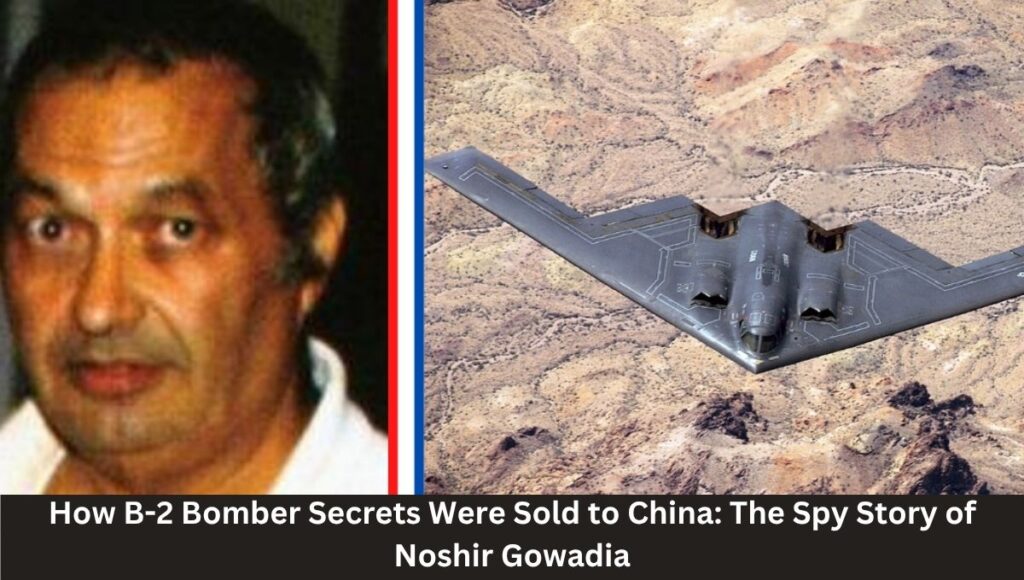
How B-2 Bomber Secrets Were Sold to China: The Spy Story of Noshir Gowadia
From Engineering Genius to Accused Traitor
Despite his accomplishments, Gowadia’s career took a dark and destructive turn. After leaving Northrop in 1986 due to a health condition, he started a defense consulting firm.
Over time, dissatisfaction, financial pressures, and a deep sense of underappreciation began to mount.
In the early 2000s, the FBI began monitoring Gowadia after discovering classified stealth-related documents inside a container shipped to him in Hawaii.
That discovery led to a more extensive investigation, revealing a betrayal that stunned the intelligence community.
The Espionage: Selling Secrets to China
Between 2003 and 2005, Gowadia traveled multiple times to Shenzhen and Chengdu, China centers of the country’s military aircraft development.
There, he reportedly met with Chinese defense officials and shared details of radar-evading propulsion systems, infrared suppression techniques, and stealth nozzle engineering.
Court records revealed that he delivered PowerPoint presentations and technical breakdowns of how to suppress exhaust heat and make aircraft nearly invisible to modern detection systems.
In exchange, Gowadia was paid over $110,000, laundered through offshore accounts and even a fake charity in Liechtenstein.
These were not generic technical suggestions; they were critical B-2 secrets, foundational to the very systems that gave the U.S. its stealth advantage.
The FBI Raid and Arrest in Paradise
On October 13, 2005, Gowadia was arrested after 15 federal agents raided his $3.5 million oceanfront home in Maui, Hawaii.
The lavish property concealed 500 pounds of evidence: classified documents, schematics, hard drives, and incriminating communications with Chinese operatives.
Agents found him calmly gardening when they approached. Inside the home, they uncovered proof of an espionage operation stretching years and continents.
The Confession That Changed Everything
After days of questioning under FBI custody, Gowadia made a damning confession: “On reflection, what I did was wrong to help the PRC make a cruise missile. What I did was espionage and treason.”
His admission, along with troves of digital and paper evidence, sealed the case against him.
The Trial: Espionage Meets Psychology
In 2010, Gowadia was convicted on 14 of 17 counts under the Espionage Act and Arms Export Control Act.
His defense team argued that he suffered from narcissistic personality disorder, leading to poor judgment and a need for external validation.
They claimed he only shared declassified material and that his confession was coerced.
But the prosecution presented overwhelming evidence financial transactions, travel records, communications with Chinese handlers, and technical details that went far beyond public knowledge.
On January 24, 2011, U.S. District Judge Susan Oki Mollway sentenced him to 32 years in prison, stating that Gowadia had “marketed valuable technology to foreign countries for personal gain.”
He currently serves his sentence at ADX Florence, America’s highest-security prison, alongside some of the most dangerous criminals in modern history.
China’s Rapid Rise in Stealth Technology
The implications of Gowadia’s betrayal became even more apparent in May 2025. Satellite images from The War Zone revealed a stealth drone at Malan air base in Xinjiang, China, with an uncanny resemblance to the B-2 Spirit.
With a flying-wing design, no vertical stabilizers, and radar-evading exhaust systems, the drone is believed to be part of China’s H-20 bomber program or a testbed for advanced HALE (High-Altitude Long-Endurance) stealth UAVs.
Experts suggest that this aircraft could eventually carry nuclear or precision-guided payloads across intercontinental ranges potentially rivaling the B-2 in both form and function.
How Much Did Gowadia Help China?
While many of China’s technological leaps are attributed to indigenous R&D, Gowadia’s leaks undoubtedly accelerated Beijing’s progress. He provided:
- Infrared suppression technology to hide heat signatures
- Radar-deflecting nozzle geometry
- Lock-on range calculations for missile systems
- Tactical insights into making cruise missiles stealthier
These were not hypotheticals they were actionable, implementable components. And just years after his betrayal, China unveiled stealth platforms with suspiciously similar characteristics.
Operation Midnight Hammer and Strategic Timing
The timing of China’s stealth emergence adds urgency to the U.S. response. On June 22, 2025, the United States deployed B-2 bombers in Operation Midnight Hammer, targeting Iranian nuclear facilities. Just days later, satellite photos exposed China’s B-2-like stealth drone.
The symbolism is hard to ignore: America’s premier stealth weapon was being mirrored, perhaps even rivaled, by the very nation to which Gowadia sold its secrets.
Motivations: Recognition, Resentment, and Risk
Gowadia’s own words reveal that his betrayal was not solely about money. He often lamented being unappreciated in the U.S. despite his contributions.
He once wrote: “There are people who believe the B-2 would not have happened without me.” That wounded ego, combined with the allure of money and foreign admiration, proved devastating.
Intelligence analysts note that China expertly exploited these emotional weaknesses, offering the praise and validation Gowadia craved.
Fallout and Reforms
Gowadia’s case led to sweeping changes within the U.S. defense and intelligence community. Security clearance procedures were tightened, and monitoring of retired scientists and contractors became more stringent.
His betrayal is now taught at intelligence training schools as a case study in insider threat prevention, alongside infamous spies like Aldrich Ames and Robert Hanssen.
Conclusion: A Legacy of Innovation and Infamy
Noshir Gowadia’s life is a paradox. He was one of the minds behind America’s stealth dominance, yet also one of the individuals most responsible for eroding that dominance.
His decision to sell secrets to China had real-world consequences, visible today on satellite images of a Chinese stealth drone that looks hauntingly familiar.
While the B-2 Spirit bomber continues to serve as a pillar of U.S. power projection, its once-unique advantages are now being challenged.
The price of betrayal, as Gowadia learned, is not just prison but the permanent loss of trust, legacy, and the very technology he once proudly built.
Final Thought:
As espionage evolves and technological theft becomes a new front in global power struggles, the case of Noshir Gowadia remains a powerful reminder that insider threats are often the most dangerous of all.
Also Read: Inside the B-2 Stealth Bombers That Struck Iran’s Nuclear Sites
Also Read: Why the US used B-2 stealth bombers, costing $2.1 billion each, to strike Iran’s nuclear sites
Related Posts:
- Inside the B-2 Stealth Bombers That Struck Iran’s…
- 14 Explosive Charges: How 3 Silicon Valley Engineers…
- Anna Chapman — Putin’s Glamorous 43-Year-Old Spy Returns

- In 8 Moves, EU Targets China-Linked Refineries and…

- Afghanistan–Pakistan War 2025: Inside the 48-Hour Ceasefire

- 7 Powerful Measures: Trump Sanctions Russian Oil…
