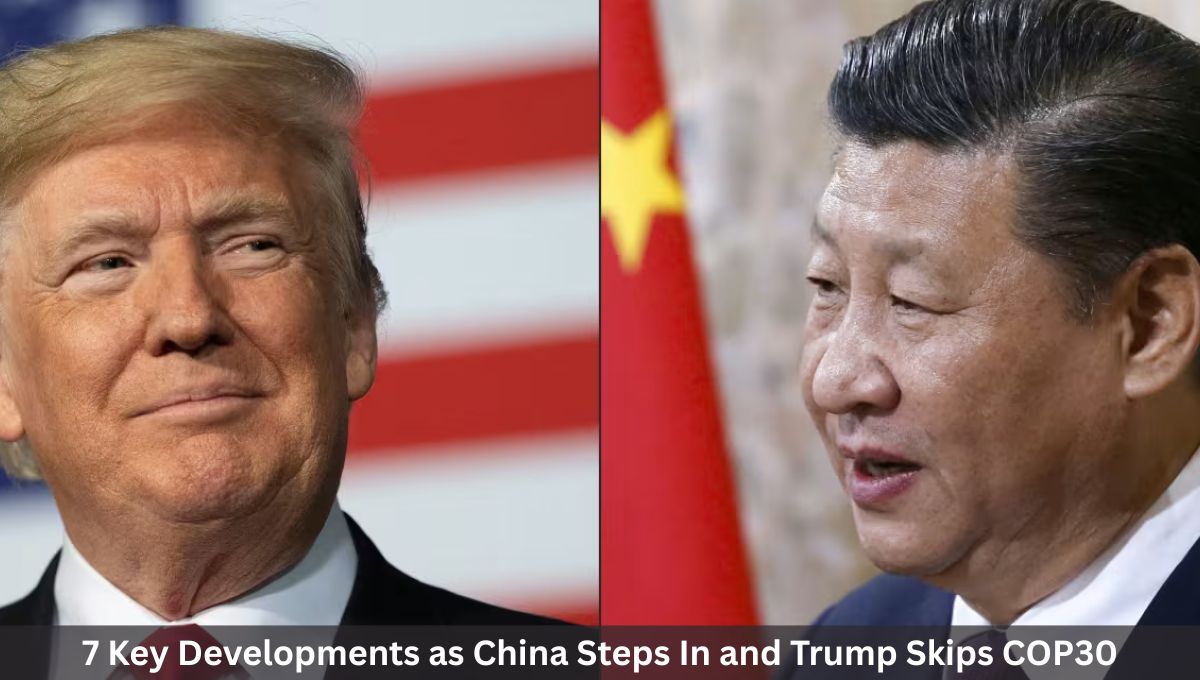
7 Key Developments as China Steps In and Trump Skips COP30: Can global climate talks survive? China emerged as a central player at the COP30 climate summit in Belém, Brazil, as U.S. President Donald Trump’s absence cast a long shadow over global negotiations.
With Washington retreating from multilateral commitments, Beijing positioned itself as a leader of the developing world’s climate agenda, pledging deeper South-South cooperation and renewed investment in renewable energy.
The shift underscored mounting questions about whether the international community can sustain collective climate action without the participation of the world’s second-largest historical emitter.
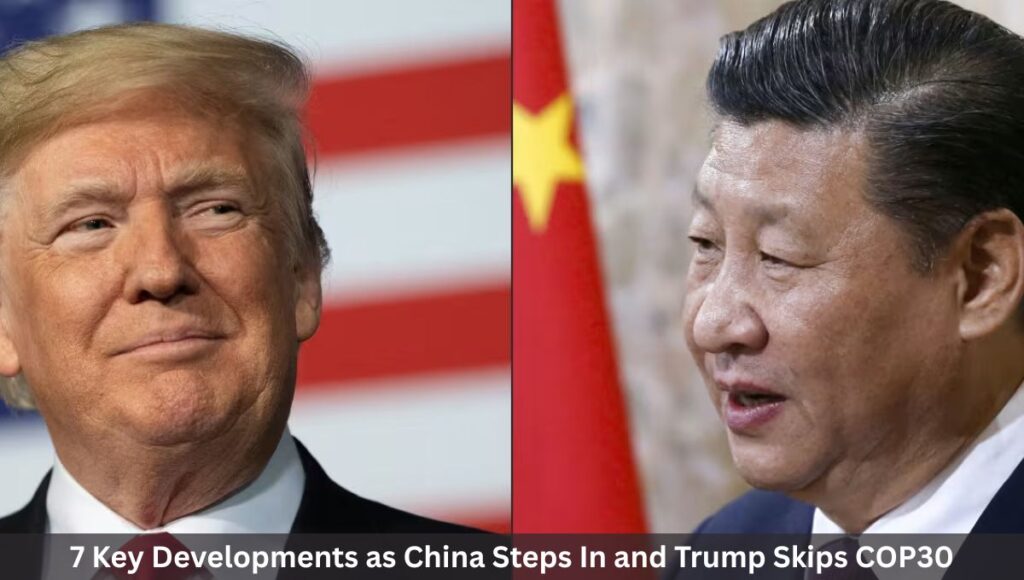
7 Key Developments as China Steps In and Trump Skips COP30
1. U.S. Absence at COP30
Empty chair and missing delegation
At COP30 in Belém, Brazil, the United States sent no senior government officials, leaving an “empty chair” symbolising the country’s absence. The summit convened delegates from more than 190 countries, but the lack of U.S. attendance drew widespread notice.
What it signals
Analysts say the absence reflects the U.S. administration’s shift away from multilateral climate cooperation. At the opening, the U.N. climate chief urged unity, adding the situation “threatens a fracturing international consensus.”
Also Read: Countries are gathering for climate negotiations. Here’s where the U.S. stands
2. China’s Increased Visibility
Delegation and representation
Although China’s president did not attend, the country dispatched a large delegation to COP30, raising its diplomatic profile. China’s updated climate plans contributed to a revised global emissions-reduction estimate ahead of the summit.
Leadership vacuum filled?
With the U.S. largely absent, observers say China has more room to shape negotiations and agendas. For example, media noted the absence of the major emitters leaves “Europe to pick up the climate tab”.
One former U.S. negotiator said: “It is a much more aggressive administration now… if you allow yourself to be intimidated … they will seize all the ground that you cede them.”
3. Host Country Brazil’s Agenda
Opening message
Brazilian President Luiz Inácio Lula da Silva declared COP30 would be “the COP of truth” in an era of “fake news and misrepresentation”. Indigenous delegates from the Guajajara group performed a welcome song and dance at the venue in the Amazon region.
Strategic priorities
Brazil emphasises forest protection and climate justice, proposing its “Tropical Forest Forever Fund” as a centrepiece initiative. The fund aims to raise some US $125 billion globally. The host country also sought to steer negotiations away from deadlock, beginning with acceptance of the summit agenda.
4. Multilateral Negotiation Challenges
Agreement uncertainty
It remained unclear if COP30 would yield a final global agreement. The U.N. report indicated emissions will drop 12 % by 2035 under current pledges — far short of the ~60 % needed for 1.5 °C.
With major emitters missing or sending lower-level delegates, the negotiation dynamics shifted.
Competition and fragmentation
Media coverage described the U.S. absence as potentially better than having a disruptive presence. One diplomat said: “If the choice is no US or a US that is there as a spoiler … then I think most countries would prefer there to be no US.” Still, developing countries voiced concern that the absence of major emitters could undermine momentum.
5. Climate Finance in the Spotlight
Funding gap and demands
Negotiations centre on scaling climate finance, with proposals pointing to about US $1.3 trillion by 2035. Developing countries, including Brazilian hosts, are pushing for predictable and sufficient finance for adaptation and mitigation.
Burden shifting
With the U.S. and China’s limited engagement, questions arise whether other actors — notably Europe — will bear a disproportionate share of financing. Observers noted that major emitter absences complicate collective funding commitments.
6. Emissions Pathways and Targets
New baseline estimates
Ahead of the summit, a U.N. analysis revised global emissions-cutting plans downward: a 12 % reduction by 2035 from 2019 levels was projected, yet still insufficient to meet the 1.5 °C goal.
China’s recent pledges contributed to improvement in the projection, but not enough to close the gap.
Strategic focus shift
Brazil and other host-country officials signalled a shift from broad targets to smaller, actionable initiatives such as deforestation and clean-energy transitions.
“Your job here is not to fight one another — your job here is to fight this climate crisis, together,” U.N. climate chief Simon Stiell said.
The absence of key emitters makes the emphasis on implementation rather than negotiation especially crucial.
7. Implications for Global Climate Diplomacy
Geopolitical realignment
The U.S. absence and China’s increased visibility mark a potential shift in climate governance. Some analysts argue the “centre of gravity” of climate negotiations may move towards the Global South and emerging economies. Brazil’s presidency of COP30 in the Amazon adds symbolic weight to this shift.
Can multilateralism survive?
Observers question whether COP30 can maintain the relevance of the annual summit format amid waning participation by major emitters.
Some suggest refocusing the process on targeted implementation forums rather than wide-ranging global agreements.
One commentator flagged that “it isn’t just the US’s absence, but also China’s own variety of climate initiatives” underscoring a changing global climate-governance architecture.
Conclusion
COP30 in Brazil opens against a backdrop of geopolitical shifts and institutional strain. The United States’ decision to skip major participation has left a clear gap that China and Brazil are moving to fill.
The summit’s agenda spans climate finance, emissions pathways and governance reform — all while the world watches whether the annual climate-talks format can adapt to a changing global order.
With major emitters opting out or reducing their engagement, the future of the multilateral climate-system may depend less on large-scale agreements and more on regional leadership and smaller-scale implementation.
The outcomes at COP30 will be closely watched as an indicator of whether global climate diplomacy retains its relevance in a fractured world.
Also Read: Over 20% of the Ocean Is Darkening: A Growing Threat to Marine Life and Climate Health
Related Posts:
- 7 Alarming Forces Driving the COP30 Climate Summit…
- 7 Shocking Moments from the COP30 Brazil Fire Chaos

- 7 Key Highlights That Will Shape the High-Stakes G20…

- 7 Crucial Insights Into Trump and Xi’s High-Stakes…
- Lula Slams Trump’s 50% Tariff as “Unacceptable…

- Can the EU and NATO Impose Tariffs on India and…
