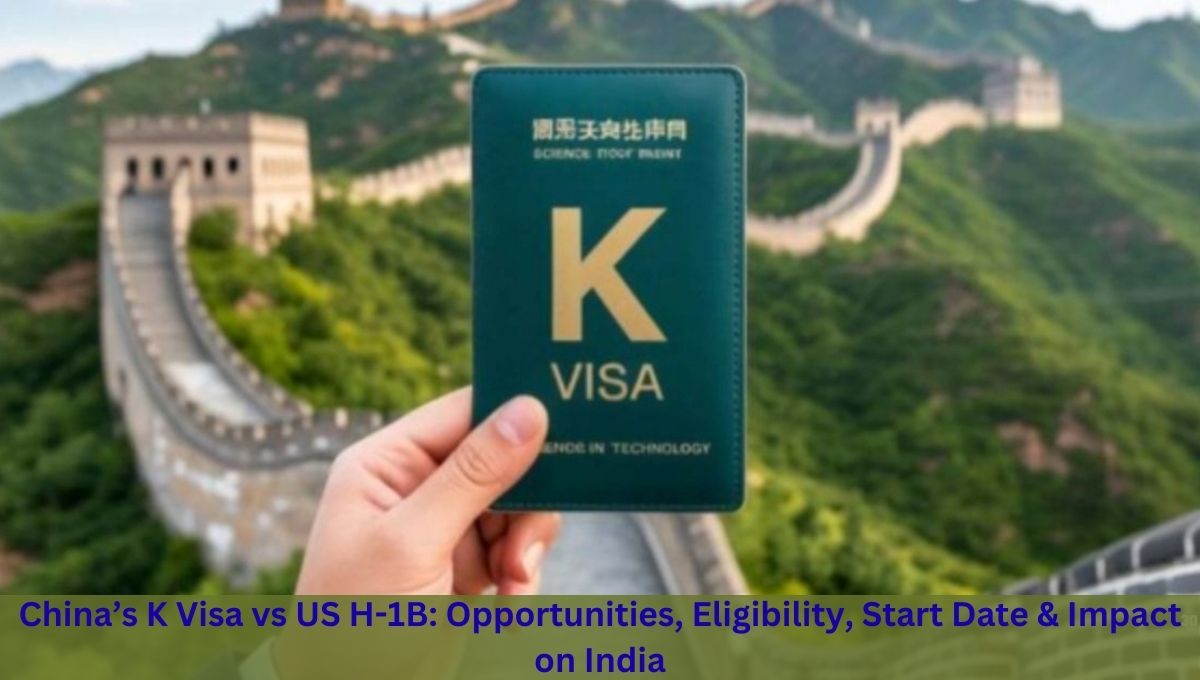
China’s K Visa vs US H-1B: Opportunities, Eligibility, Start Date & Impact on India – A complete guide for Indian professionals. As the United States tightens its visa regime under President Donald Trump, India’s tech workforce—heavily dependent on H-1B visas—is grappling with uncertainty.
Adding to the turmoil, Washington recently announced a $100,000 fee on new H-1B visa applications, sparking panic among Indian IT professionals and service firms that dominate the program. Amid this upheaval, China has stepped forward with a countermove: the introduction of a new “K visa” aimed at attracting young STEM professionals, researchers, and educators.
Scheduled to take effect on October 1, 2025, the K visa is being positioned as a flexible, streamlined alternative to the increasingly restrictive American H-1B. This article breaks down everything you need to know about the K visa launch, eligibility, advantages, risks, and its implications for India’s IT sector and global talent mobility.
China’s K Visa vs US H-1B: Opportunities, Eligibility, Start Date & Impact on India
Why China’s K Visa Matters
The K visa marks one of the most significant reforms in China’s immigration framework in recent years. Approved by the State Council in August 2025 and signed into law by Premier Li Qiang, the K visa will be available from October 1, 2025.
The program complements China’s R visa (introduced in 2013 for high-level talent) but takes a broader approach by specifically targeting young professionals in science, technology, engineering, and mathematics (STEM).
Unlike most existing visa categories, the K visa does not require sponsorship from a Chinese employer or entity, making it a rare “open door” opportunity for global professionals seeking to enter China.
Observers are calling it China’s answer to the H-1B visa, rolled out at a time when the US is raising barriers to skilled mobility.
When Will the K Visa Start?
- Start Date: October 1, 2025
- Authority: Introduced by the State Council, signed into law by Premier Li Qiang
- Legal Basis: Part of amendments to China’s entry and exit regulations
This rollout coincides with the US visa shake-up, signaling Beijing’s attempt to position itself as a welcoming hub for international STEM talent.
China’s Existing Visa Categories
Before the launch of the K visa, China had 12 ordinary visa categories including student visas (X), tourist visas (L), work visas (Z), and family reunion visas (Q).
The K visa adds a 13th category that specifically addresses the demand for scientific and technological exchanges and entrepreneurial flexibility.
In parallel, China has also expanded its visa-free policies:
- Over 40 countries now enjoy visa-free tourist entry for short stays.
- 55 countries benefit from 240-hour (10-day) visa-free transit.
- Reciprocal arrangements exist with 75 nations worldwide.
The K visa fits neatly into this broader strategy of opening up and internationalizing China’s labor market.
Also Read: China’s jobless youth aren’t happy with a plan to attract foreign professionals with a new ‘K-visa’
Who Can Apply for China’s K Visa?
Eligibility Criteria
According to the Chinese Ministry of Justice, applicants must fall into the category of young STEM professionals or graduates.
- Graduates with a bachelor’s degree or higher from reputed universities or research institutions in China or abroad
- Young professionals engaged in teaching or research in STEM fields
- Applicants must meet age, educational background, and work experience requirements (specific details expected to be published by embassies/consulates)
Key Advantage
Unlike the US H-1B visa, applicants do not require a sponsoring employer. Instead, they can apply independently, provided they meet the qualifications.
Application Documents
Applicants must provide:
- Proof of educational qualifications
- Evidence of professional or research engagement
- Supporting documents as prescribed by the Ministry of Justice
For best results, experts advise applicants to engage a qualified immigration adviser to navigate the rules and ensure compliance.
What Does the K Visa Offer?
The K visa introduces several advantages over China’s existing visas and even offers flexibility not seen in the US H-1B program.
Key Features of the K Visa
- Multiple entries permitted
- Longer validity compared to ordinary visas
- Extended stay durations allowed
- No local employer invitation required
- Participation in a wide range of activities:
- Academic exchanges
- Research collaborations
- Cultural programs
- Scientific and technological projects
- Entrepreneurial and business activities
This flexibility makes the K visa ideal for early-career professionals seeking to build networks, conduct research, or explore entrepreneurial ventures in China.
How Is the K Visa Different From Other Chinese Visas?
| Visa Type | Target Group | Employer Sponsorship | Flexibility | Duration/Validity |
| Z Visa | Foreign employees with a job in China | Required | Limited | Job-dependent |
| R Visa | High-level talent | Sometimes required | High | Long validity |
| K Visa | Young STEM talent | Not required | Very high | Multiple entry, extended stay |
The K visa clearly stands out as China’s most flexible work-oriented visa, designed to lower bureaucratic barriers and attract a new generation of talent.
Why Now? The US H-1B Fee Hike
On September 21, 2025, President Donald Trump announced a $100,000 fee for all new H-1B petitions, effective immediately.
- The proclamation framed the fee as a measure to protect American jobs.
- A new “Trump Gold Card” visa program was also announced, allowing US residency for $1 million investment.
- The White House later clarified that the $100,000 fee applies only to new applicants, not renewals.
Still, the impact has been significant:
- Indian professionals—who account for 71% of all H-1B approvals—have expressed panic over affordability.
- Indian IT firms, heavily reliant on the US market (57% of sector revenue), face pressure to rethink global strategies.
This development gave China a perfect opening to launch the K visa as a competitive alternative.
Implications for Indian Professionals
For Indian engineers, researchers, and IT workers, the K visa introduces a new career pathway.
- Lower upfront costs: Unlike the six-figure US visa fee, China’s K visa costs are expected to be modest.
- No employer dependency: Applicants can enter China without a binding job contract.
- New markets: China’s growing digital economy and regional tech hubs offer alternative opportunities.
However, questions remain about the prestige and global mobility associated with a Chinese visa compared to the H-1B. For decades, the US has been seen as the “dream destination” for global STEM talent, while China is still building its appeal.
Risks and Challenges
While the K visa is promising, it comes with important caveats:
- High operational costs in China
- Regulatory complexity in local markets
- Geopolitical risks tied to US-China rivalry
- Language and cultural barriers for integration
- Uncertainty on long-term residency or citizenship pathways
Industry experts believe Indian IT firms will not fully relocate operations to China. Instead, they may adopt hybrid models, maintaining a US presence while expanding small hubs in China and Southeast Asia.
Geopolitical Implications
The launch of the K visa goes beyond labor mobility—it has strategic undertones.
- US vs China competition: While Washington restricts talent inflows, Beijing is signaling openness.
- India’s dilemma: As a top beneficiary of H-1B, India faces vulnerabilities. The K visa provides options but also involves geopolitical risks.
- Services as a battleground: Traditionally, trade wars targeted goods. Now, services and skilled mobility are at the frontline.
By easing entry for STEM talent, China is attempting to position itself as a services hub—countering Washington’s protectionist turn.
What It Means for India’s IT Sector
- India’s IT industry generates $283 billion annually, with 57% from the US market.
- Restrictions on H-1B visas directly threaten foreign exchange earnings and growth potential.
- China’s K visa provides a safety valve, enabling Indian firms to expand cautiously in Asia-Pacific markets.
However, full-scale relocation remains unlikely. Instead, Indian IT companies may:
- Retain US headquarters for client-facing work
- Deploy smaller teams in China for research, regional expansion, and cost balancing
- Explore ASEAN and EU partnerships to diversify beyond the US
Expert Views
“While China’s K visa opens opportunities for talent mobility, full-scale relocation of IT operations from the US is financially risky.”
— Dattesh Parulekar, Assistant Professor of International Relations, Goa University
“Indian IT firms are more likely to explore hybrid models—maintaining the US client base while gradually expanding presence in China and other Asia-Pacific markets.”
— Dattesh Parulekar
Looking Ahead: India’s Strategic Choices
The K visa rollout exposes India’s overdependence on the US market. To secure its talent base and IT revenue stream, India may need to:
- Diversify export markets towards EU and ASEAN
- Explore selective collaboration with China in non-sensitive sectors
- Invest in domestic talent creation to reduce reliance on overseas visas
- Accelerate ease-of-doing-business reforms to attract global firms directly to India
Conclusion
China’s K visa, set to take effect on October 1, 2025, arrives at a pivotal moment in global talent mobility. With the US H-1B regime becoming costlier and more restrictive, Beijing is offering a flexible, low-barrier alternative designed to lure young STEM professionals.
For Indian IT workers, the K visa represents both an opportunity and a risk—a chance to diversify global careers but also a step into an uncertain geopolitical landscape. Ultimately, whether the K visa can match the prestige and career potential of the H-1B remains to be seen.
What is clear, however, is that talent mobility has become a new frontline in the US-China rivalry, with India caught at the crossroads.
Also Read: Germany Welcomes Indian STEM & Management Talent Amid US H-1B Visa Fee Hike