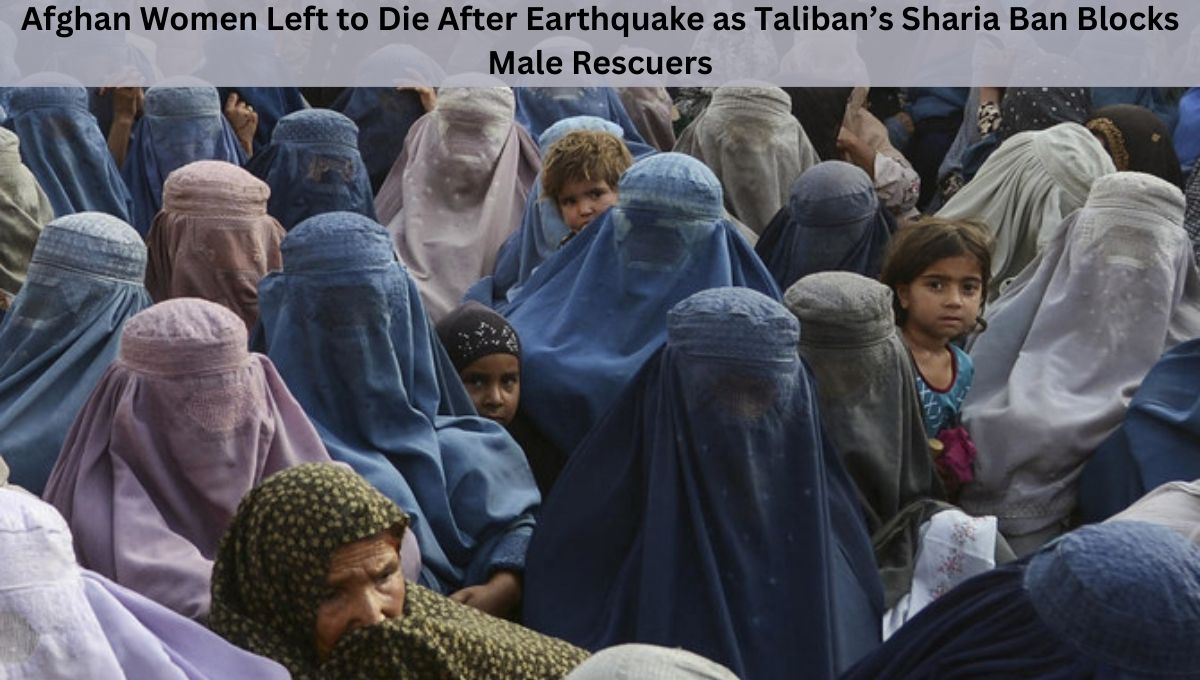
With no female doctors or rescue workers, Afghan Women Left to Die After Earthquake as Taliban’s Sharia Ban Blocks Male Rescuers. When a powerful earthquake ripped through Afghanistan last week the third in just seven days killing more than 2,200 people and leaving thousands injured, the devastation was not just natural but deeply human-made.
Reports emerging from the quake-hit provinces paint a horrifying picture: women trapped beneath collapsed homes and buildings were left to die because Taliban-imposed Sharia rules prevented male rescuers from pulling them out.
This chilling reality has exposed what Afghan women’s rights groups and global observers have long warned under Taliban rule, women in Afghanistan are caught in a lose-lose situation. Barred from education, jobs, and public life, they lack female doctors, female rescue workers, and even basic recognition as equal human beings. And when disaster strikes, these restrictions can literally mean the difference between life and death.
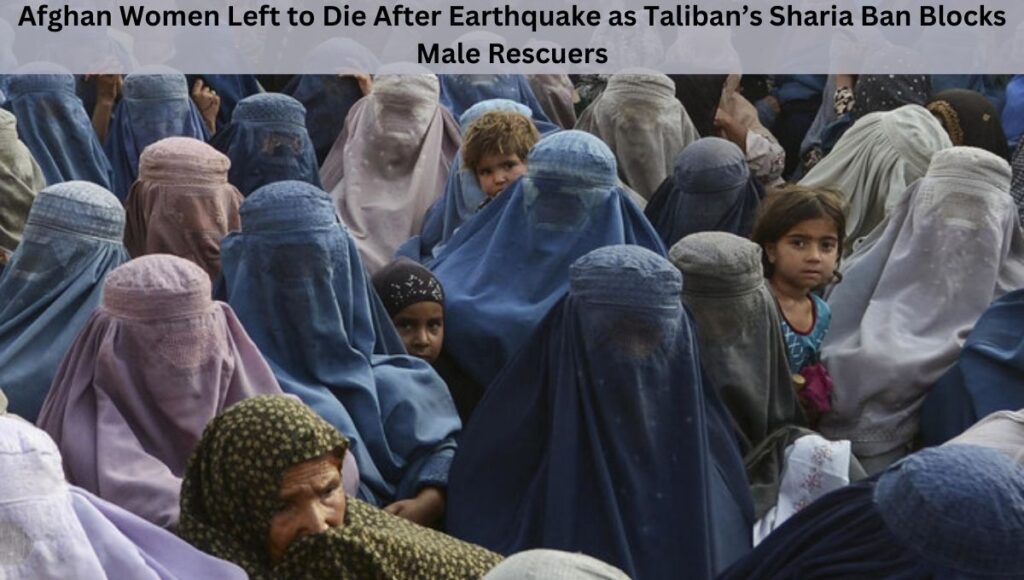
Afghan Women Left to Die After Earthquake as Taliban’s Sharia Ban Blocks Male Rescuers
Taliban authorities enforce an extreme version of Islamic Sharia law that prohibits women from having physical contact with men who are not close relatives (mahram). That means during earthquake rescue efforts, only a woman’s father, brother, husband, or son could legally pull her out of the rubble.
But in many cases, male relatives were either dead, missing, or themselves injured. With virtually no female rescue workers available thanks to the Taliban’s ban on women in most professions women remained buried beneath collapsed homes.
Survivors described scenes where men and children were immediately pulled out while women were ignored, left to bleed and suffocate.
“They gathered us in one corner and forgot about us,” said Bibi Aysha, a 19-year-old survivor from Kunar Province. Rescue workers arrived in her village 36 hours after the quake but offered no direct help to injured women.
Another volunteer, Tahzeebullah Muhazeb, told local media that women seemed “invisible” to rescue teams. “It felt like women were just invisible… the men and children were treated first, but the women were sitting apart, waiting for care,” he said. In some instances, the bodies of dead women were dragged out by their clothes to avoid physical contact.
Shortage of Female Medical Staff Left Women Untreated
The problem did not end at rescue operations. In hospitals overwhelmed by casualties, Afghan women again suffered disproportionately.
With Taliban restrictions banning women from most forms of education and employment, there are almost no female doctors, nurses, or caregivers available in affected provinces.
As a result, male patients received immediate treatment while women were left untreated, sitting apart in pain. In some hospitals, authorities even forbade staff from treating unaccompanied female patients, deepening the crisis.
The Taliban-run Ministry of Health insisted that women doctors were serving in hospitals across the quake-hit provinces, but eyewitness accounts contradict this claim.
Survivors and aid groups have consistently reported a crippling shortage of female staff, leaving many women without care.
Susan Ferguson, UN Women’s representative in Afghanistan, stressed that “their needs must be at the heart of the response and recovery.” Yet on the ground, Afghan women remain at the margins of aid, excluded both by Taliban policy and by cultural restrictions.
Taliban’s Sharia Has Made Women Invisible
The Taliban’s policies since their return to power in 2021 have systematically erased Afghan women from public life.
Girls have been banned from secondary schools and universities, women barred from most jobs including humanitarian work and female staff forced out of NGOs and international organisations.
Even public spaces such as parks, gyms, and beauty salons have been closed to women. Inspectors in Kandahar have ordered shopkeepers to deny entry to women without a male guardian, while hospitals have restricted treatment for women who come alone.
The earthquake disaster revealed the brutal consequences of these policies. By erasing women from the workforce, the Taliban also erased their right to survive in times of crisis.
When disaster struck, there were no female rescue workers to save women, no female doctors to treat them, and no space for women to demand equal treatment.
Forced Conversions and Public Punishments Continue
Beyond gender restrictions, Taliban authorities have also escalated repression against minorities and religious groups.
In Badakhshan Province, at least 50 Ismaili men were reportedly forced to convert to Sunni Islam under threat of violence between January and February this year.
Public punishments floggings, amputations, and executions have returned in Taliban-controlled Afghanistan, echoing their first regime from 1996 to 2001.
Human rights organisations report that more than 180 people, including women and girls, have been flogged for alleged offenses such as adultery or homosexuality.
The Taliban’s version of Sharia law is a political weapon of control, not a universal interpretation of Islam. Across Islamic history, Sharia has been debated and practiced with compassion in many traditions. But in Afghanistan today, it is being used to silence, control, and brutalise women.
Afghan Women: Prisoners in Their Own Country
Today, Afghan women cannot travel freely without a male guardian. They cannot attend school beyond the sixth grade. They cannot work in most professions. They cannot even attend a hospital without restrictions.
And as the earthquake revealed, they cannot even be rescued when trapped under rubble. Their lives are subject to rules that treat them not as human beings but as property of men.
When Afghan women resist these restrictions through protests, the Taliban respond with arrests, threats, and violence. Even women working with the United Nations have faced harassment, prompting agencies to ask female staff to stay home for safety.
This is not merely cultural tradition it is an orchestrated system designed to make women invisible in every sphere of Afghan life.
A Human-Made Disaster on Top of a Natural One
The earthquake was a natural tragedy, but the deaths of women who were left buried under rubble because men “could not touch them” were entirely preventable. This is what happens when ideology trumps humanity.
Afghan women are not invisible. They are human beings deserving of the same dignity, rights, and survival as men. Yet the Taliban’s Sharia laws ensure that disasters hit women hardest.
The country’s economy, too, cannot recover under these restrictions. With half the population excluded from education and employment, Afghanistan is trapped in a downward spiral of poverty and dependence.
Nearly half the population is starving, families survive on a single meal a day, and aid delivery is hampered because women workers once vital for reaching female beneficiaries are banned.
Also Read: Afghanistan Earthquake 2025: Over 800 Dead as Taliban Plead for International Aid
International Response: Silence and Cuts
While humanitarian agencies have rushed to help, the international political response remains complicated. The United States, once Afghanistan’s largest donor, has not authorised emergency aid following the latest earthquake.
Former officials revealed that the Trump administration ended virtually all aid earlier this year, citing Taliban taxation of humanitarian funds. As a result, U.S.-funded medical supplies worth over $100,000 remain stuck in storage, awaiting clearance.
Other countries, including Britain, South Korea, India, Pakistan, Iran, and Turkey, have sent aid, but far more is needed. The UN Development Programme warned that funding cuts have already crippled essential health and nutrition services for millions.
Afghan Women’s Lives Hang in the Balance
The Afghan earthquake is not just a disaster story; it is a stark reminder of what happens when half a population is denied rights, education, and opportunities. Afghan women today are facing double jeopardy:
- Crushed under rubble with no rescuers allowed to touch them.
- Left untreated in hospitals with no female doctors.
- Banned from education and jobs, with no future prospects.
- Silenced, hidden, and punished under Taliban’s extremist rule.
Until the Taliban face real pressure to change, Afghan women will continue dying not just from earthquakes or hunger, but from the suffocating brutality of laws designed to erase them.
Conclusion
The earthquake in Afghanistan revealed the deadly intersection of natural disaster and human oppression. Women, trapped beneath collapsed homes, were left to die because of Taliban-enforced restrictions that bar men from touching them and prevent women from working in rescue or medical roles.
This is not a coincidence. It is the direct outcome of a political system that seeks to make women invisible. Afghan women are paying with their lives for Taliban ideology.
The world must decide whether to keep watching in silence or to stand up and demand that Afghan women half the population of the country be given their rightful place in society. Because until Afghan women are free to study, work, and live with dignity, every earthquake, every famine, and every crisis will always be deadlier than it needs to be.
Also Read: Afghanistan earthquake: What we know – and what we don’t
Related Posts:
- 7 Shocking Details: 13-Year-Old Executes Man Before…

- Afghanistan–Pakistan War 2025: Inside the 48-Hour Ceasefire

- Another Earthquake Strikes Afghanistan After 1,400…
- 6.3-Magnitude Earthquake Devastates Northern Afghanistan
- Pakistan–Afghanistan Border Conflict 2025: Ceasefire…

- ICC Issues Arrest Warrants for Taliban Leaders Over…