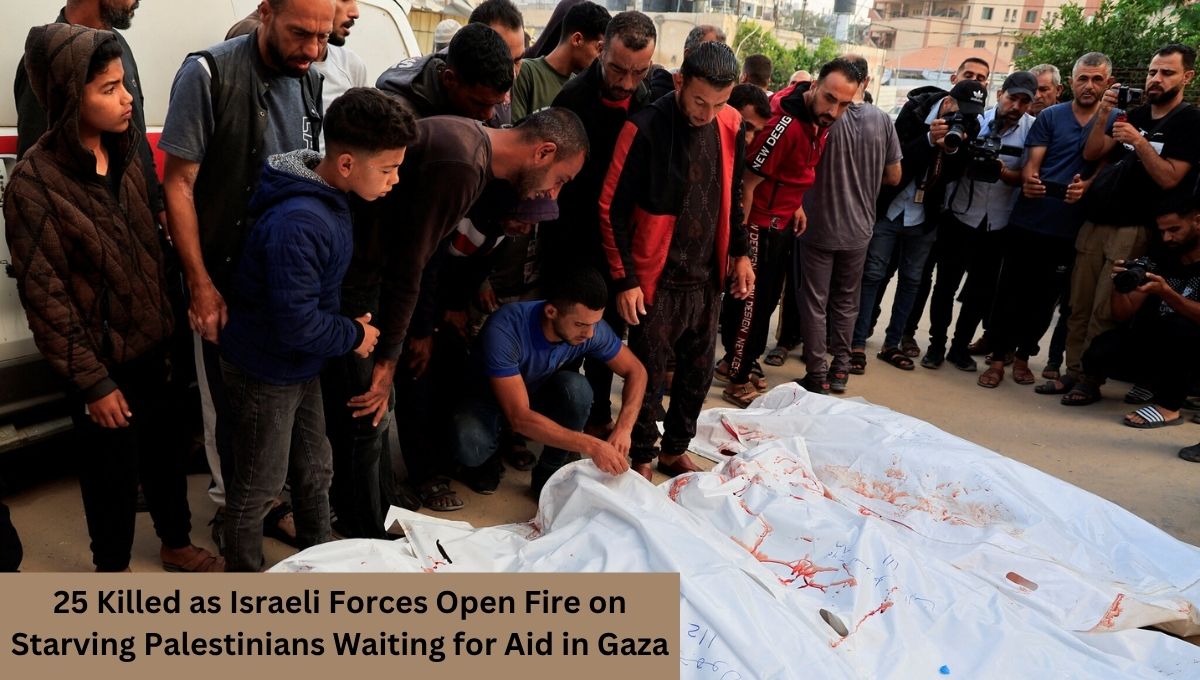
Over 146 wounded and 25 Killed as Israeli Forces Open Fire on Starving Palestinians Waiting for Aid in Gaza. In a grim escalation of Gaza’s worsening humanitarian crisis, Israeli forces opened fire on a crowd of starving Palestinians waiting for food aid along the Salah al-Din Road, south of Wadi Gaza, on Tuesday morning. At least 25 people were killed, and over 146 wounded, according to hospital officials and eyewitnesses.
The shooting, which some survivors described as a “massacre,” took place near a food distribution site reportedly operated by the Gaza Humanitarian Foundation (GHF). The incident has drawn international condemnation, with UN officials accusing Israel of the “weaponisation of food” and suggesting that such actions could constitute war crimes.
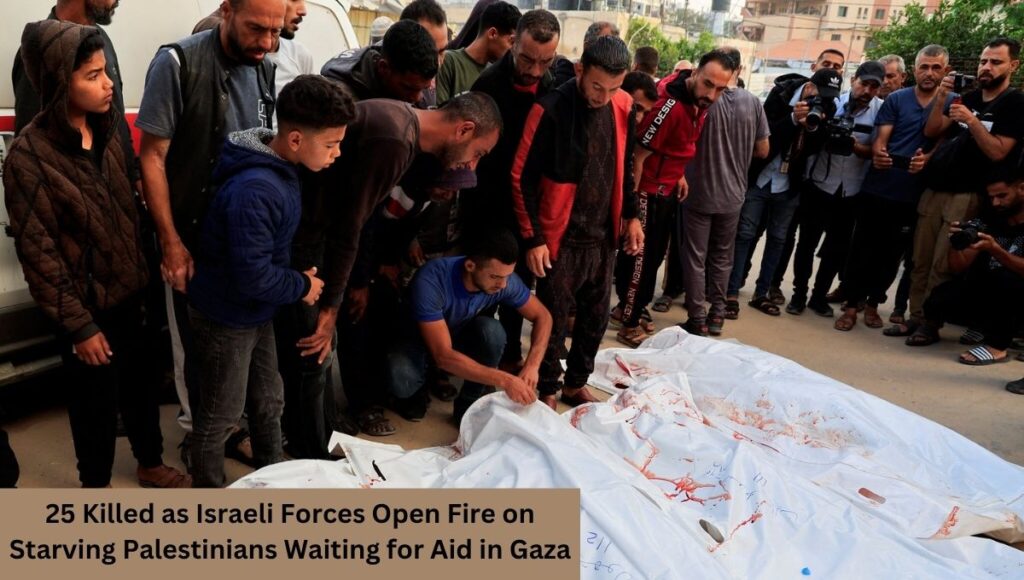
25 Killed as Israeli Forces Open Fire on Starving Palestinians Waiting for Aid in Gaza
Desperate Crowd Targeted While Waiting for Aid
According to eyewitness accounts and reports from Al-Awda Hospital in the Nuseirat refugee camp, Israeli tanks and drones fired on a crowd of civilians gathered to receive humanitarian aid.
The aid trucks were reportedly approaching the area when Israeli forces began firing, causing panic and bloodshed.
“It was a massacre,” said Ahmed Halawa, one of the survivors. “Tanks and drones fired at us even as we were fleeing. Many were killed or wounded.” Another witness, Hossam Abu Shahada, described a chaotic and bloody scene:
“The drones were flying above us. People started walking eastward to meet the approaching aid trucks. Then, the tanks and drones fired without warning.”
Hospitals Overwhelmed with Injured and Dead
Medical facilities in central Gaza were quickly overwhelmed. Al-Awda Hospital reported treating 146 injured, with 62 in critical condition transferred to other hospitals. Al-Aqsa Martyrs Hospital in Deir al-Balah confirmed receiving six bodies from the scene.
Footage from inside Al-Awda showed injured young men drenched in blood, some writhing in pain on the floor as every bed filled up. An elderly man was carried in dead, his wife weeping beside his body.
“My son went to collect food for his siblings and now he’s in the ICU,” said Umm Raed al-Nuaizi, a grieving mother. “He only wanted a grain of flour.”
UN Slams Israeli Tactics: “This Is a War Crime”
The United Nations has reacted strongly to the killings. Thameen al-Kheetan, spokesperson for the UN Human Rights Office, condemned Israel’s strategy of using militarized food distribution systems, stating:
“The weaponisation of food for civilians, and preventing their access to life-sustaining services, constitutes a war crime.”
He emphasized that hundreds of Palestinians have been killed since the GHF began operating at Israeli-backed food distribution points. “Desperate, hungry people in Gaza are being forced to choose between starving and being shot,” al-Kheetan said from Geneva. “This must end.”
UNRWA Chief: “GHF Food Distribution is a Death Trap”
Philippe Lazzarini, head of the UN agency for Palestinian refugees (UNRWA), described the GHF system as a “death trap” that humiliates and endangers civilians.
“This newly created food distribution mechanism is an abomination. It costs more lives than it saves,” Lazzarini said at a press conference in Berlin.
He urged that UNRWA and other humanitarian groups be allowed to resume operations in Gaza with dignity and neutrality. “There is no substitute for real humanitarian aid. Civilians should not have to risk death for a bag of flour.”
Israel Denies Awareness, Blames Suspicious Movement
The Israel Defense Forces (IDF) responded to initial media reports by claiming they were not aware of the Rafah shooting incident. Regarding the Salah al-Din Road shooting, they stated only that a gathering had been identified near IDF troops in the Netzarim corridor, and an investigation was underway.
Despite multiple eyewitnesses and medical confirmations, the IDF has maintained that its troops only fire in response to perceived threats.
GHF: US-Israel Backed But Widely Criticized
The Gaza Humanitarian Foundation (GHF) began distributing food in late May, after Israel eased a months-long blockade. Although GHF claims to have delivered over 680,000 meals, its operations are backed by Israel and the United States, use armed private contractors, and are not recognized by the UN or major NGOs.
UN officials and aid groups refuse to work with GHF, calling it a politicized entity that serves military objectives rather than humanitarian ones. “It’s being used to undermine what’s left of Hamas control,” said one humanitarian source. “But civilians are paying the price.”
Gaza on the Brink of Famine
The broader backdrop of this tragedy is Gaza’s humanitarian collapse. The UN warns that 100% of Gaza’s population is at risk of famine, with widespread starvation already underway.
Many Palestinians say they have no choice but to risk death to feed their families.
“My family eats bread and salt,” said Mahmoud al-Ghura, a father of four. “But I will not go to the GHF centers. They are death zones.”
Over 410 Palestinians Killed Since Aid Began
Since GHF began operating, more than 410 Palestinians have reportedly been killed trying to access food at aid sites, according to Gaza health authorities and international NGOs.
The UN has said it is verifying these numbers but agrees the scale of the crisis is “catastrophic.” Another 93 people have allegedly been killed by Israeli forces while trying to reach UN or NGO convoys, often amid chaotic, desperate crowds.
“These deaths must be independently investigated,” said al-Kheetan. “Each case demands accountability.”
Background: Gaza War, Blockade, and Aid Collapse
The current Gaza war began after Hamas attacked southern Israel on October 7, 2023, killing 1,200 people and taking over 250 hostages.
Israel responded with a full-scale military campaign, which has since killed more than 56,000 Palestinians, according to Gaza’s health ministry.
For months, Israel imposed a total blockade on food, water, and medicine. GHF was launched in May to fill the vacuum, but its controversial methods have only deepened the crisis.
Aid Mechanism or Military Strategy?
Critics argue that Israel’s support for GHF reflects a military strategy, not a humanitarian commitment. GHF’s food centers are often located in areas under IDF control, and their visibility has made them targets of both crowd crushes and violence.
“This is not aid; it’s a form of control,” said a Gaza-based aid worker. “People are being herded into kill zones under the guise of help.”
International Outcry Grows
As videos and survivor testimonies spread online, international condemnation is mounting. Human rights groups, UN officials, and even some Israeli voices are demanding a halt to militarized aid distribution.
“Israel must stop shooting at hungry civilians,” said al-Kheetan. “Humanitarian assistance must never be used as a bargaining chip.”
What Happens Next?
With famine looming and violence escalating, the future for civilians in Gaza grows darker by the day. UN officials are calling for:
- Immediate international investigations
- Restoration of UN-led aid distribution
- Protection for civilians and aid workers
- Unfettered humanitarian access
Whether the international community acts or remains silent will shape the next phase of this already devastating conflict.
Conclusion: Hunger, Death, and the Breakdown of Humanity
The Salah al-Din Road shooting is a tragic symbol of Gaza’s descent into despair. As civilians are gunned down while reaching for food, the humanitarian catastrophe is no longer just about war it’s about the collapse of humanity itself.
Aid should never come at the cost of life. And yet, in Gaza, it increasingly does.
Also Read: Chaos Erupts at US-Backed Aid Center in Gaza as Starving Civilians Risk Everything for Food
Also Read: ‘The Hunger Games’: Inside Israel’s aid death traps for starving Gazans
Related Posts:
- Horror at Gaza Aid Centers: Israeli Troops Kill 32…

- Chaos at Gaza Aid Centers: 31 Killed as Hunger and…
- Gaza Aid Sites Turn Deadly: Over 70 Killed, UN Warns…
- Chaos Erupts at US-Backed Aid Center in Gaza as…
- 13 Shocking Facts About the Brown University…

- Afghanistan–Pakistan War 2025: Inside the 48-Hour Ceasefire
