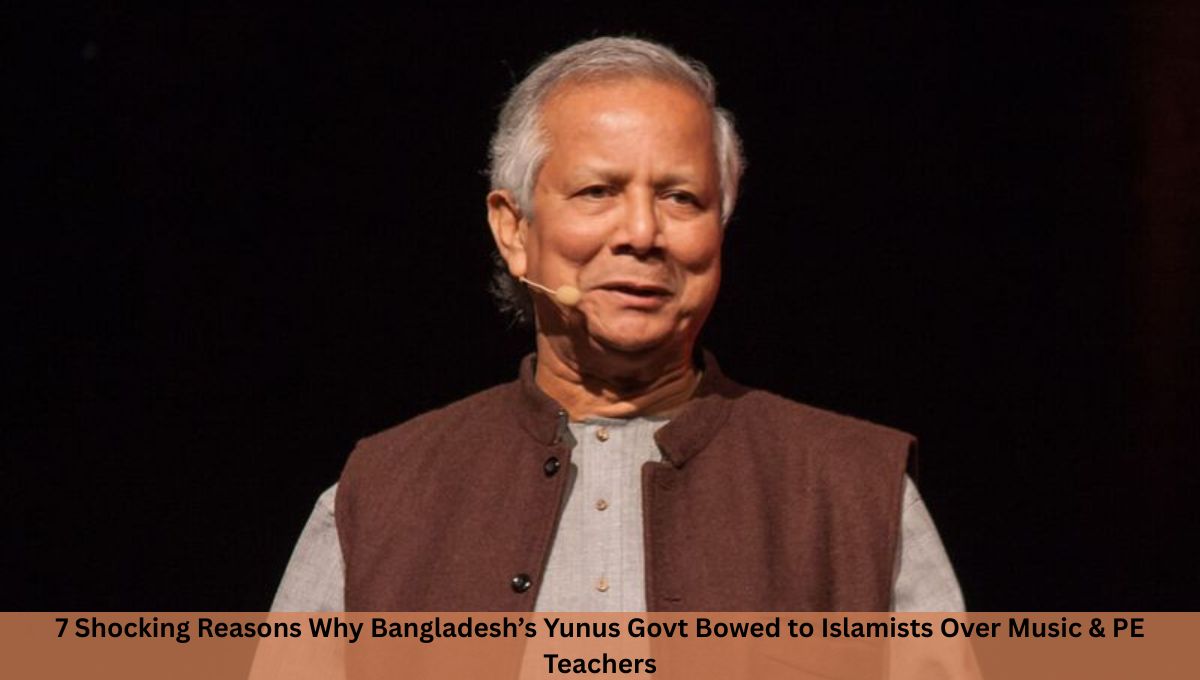
7 Shocking Reasons Why Bangladesh’s Yunus Govt Bowed to Islamists Over Music & PE Teachers — shrinking secular space in Bangladesh’s education system. Bangladesh’s interim government, led by Nobel laureate Muhammad Yunus, has drawn widespread criticism after scrapping plans to appoint music and physical education teachers in government-run primary schools.
The decision came just months after Islamist organisations fiercely opposed the move, calling it part of an “un-Islamic agenda.” The U-turn underscores a growing shift in Bangladesh’s education and cultural policy — one that critics say reflects the increasing influence of hardline Islamist groups in shaping public discourse and government decisions.
7 Shocking Reasons Why Bangladesh’s Yunus Govt Bowed to Islamists Over Music & PE Teachers
A Sudden Reversal Amid Islamist Pressure
The controversy began when the Ministry of Primary and Mass Education announced in August 2024 that it would create new posts for music and physical education teachers in primary schools.
The move was seen as part of Muhammad Yunus’s broader plan to modernize Bangladesh’s education system and promote holistic learning.
However, on Monday, the ministry reversed its decision, saying the newly created posts had been dropped from recruitment rules.
“Although the rules issued last August had four categories of posts, two categories have been included in the amendment.
The posts of assistant teachers for music and physical education are not in the new rules,” said Masud Akhtar Khan, a senior ministry official, speaking to BDNews24.
When asked if the rollback was due to Islamist pressure, Khan declined to comment, stating only, “You can check for yourself.”
1. Islamist Groups Labelled the Move “Un-Islamic”
The strongest opposition came from powerful Islamist networks, including Jamaat-e-Islami, Islami Andolon Bangladesh, Khelafat Majlish, and Hefazat-e-Islam. At mass gatherings, clerics condemned the decision to introduce music and dance education, calling it an attack on Islamic values.
“Imposing music and dance is a conspiratorial move and goes against Islam,” said Sajidur Rahman, a senior leader of Hefazat-e-Islam, in a statement quoted by AFP. These groups warned that government-run schools should only employ religious teachers and threatened to launch mass protests if the decision wasn’t reversed.
2. Religious Rallies Framed Music as ‘Atheistic Indoctrination’
In September, a large gathering of Islamist clerics under the Jatiya Olama Mashayekh Aima Parishad — attended by hardline leaders from Jamaat-e-Islami, Islami Andolon, and others — described the policy as an “atheistic conspiracy” aimed at corrupting youth.
“You want to appoint music teachers? What will they teach? You want to make our children disrespectful, unruly, and characterless? We will never tolerate that,” thundered Syed Rezaul Karim, the chief of Islami Andolon Bangladesh.
He added that the government’s plan was “indirectly connected to an atheistic philosophy aimed at making the future generation faithless.”
3. Government Capitulation: Echoes of Taliban-Style Conservatism
The Yunus administration’s decision marks a sharp departure from Bangladesh’s secular founding values.
Analysts warn that the move mirrors Taliban-style restrictions, where music and arts are banned as “un-Islamic.” While Bangladesh has not reached that extreme, critics say the latest policy shows it is sliding down a dangerous slope.
Education expert Rasheda K. Chowdhury expressed disappointment, saying the government should have stood firm and educated citizens about cultural coexistence.
“What kind of nation are we trying to create? The government should have convinced them that religious studies and music can go hand in hand; there is no conflict between them,”
she told AFP.
4. Emboldened Islamists After Sheikh Hasina’s Ouster
The incident cannot be viewed in isolation. Since the fall of former Prime Minister Sheikh Hasina in August 2024, Islamist groups — once held in check by her administration — have grown increasingly assertive under the Yunus-led interim setup.
Analysts point out that Islamists infiltrated student protests that led to Hasina’s exit and subsequently capitalized on political instability to expand their influence.
With the new government perceived as weak and dependent on broad support, religious pressure groups have found a louder voice, pushing conservative narratives and targeting minority communities.
5. Pattern of Retreat: Women’s Reform Commission Shelved
This is not the first time the Yunus government has backtracked under Islamist pressure. Earlier this year, Islamists warned the administration against implementing the proposals of a women’s reform commission, threatening violent retaliation.
One Islamist group even declared that Yunus’s ministers “wouldn’t even get five minutes to escape” if they defied their warning — a chilling reference to the 45 minutes Sheikh Hasina reportedly had to flee the country.
Following the threats, the women’s commission’s proposals were quietly shelved, revealing a troubling pattern of capitulation that continues with the education reversal.
6. Rise of Anti-Hindu and Anti-India Narratives
Alongside education and women’s rights, hardliners have amplified anti-Hindu and anti-India rhetoric, further polarizing Bangladesh’s society.
Groups such as Hefazat-e-Islam and Jamaat-e-Islami have even demanded a ban on ISKCON, calling it an “extremist organisation.”
This campaign, analysts argue, reflects a broader ideological agenda to erase secular and pluralistic influences from Bangladesh’s cultural landscape.
The targeting of Hindu institutions and the demonization of India are seen as attempts to consolidate Islamist control over national identity.
7. The Broader Implication: Secularism Under Siege
Bangladesh was founded in 1971 on principles of secularism and cultural pluralism. Over the decades, despite political upheavals, music, dance, and arts have remained central to its social fabric.
The current reversal, however, has raised alarms among educators, artists, and civil society groups. They warn that this rollback could erode secular education, weaken creative development among students, and embolden extremists to demand more concessions.
“If the government continues to yield to such pressure, we risk losing the cultural soul of Bangladesh,” said a Dhaka University sociologist who spoke on condition of anonymity. “This is not just about music teachers — it’s about who controls the country’s future.”
What the Decision Means for Education Policy
The exclusion of music and physical education teachers means that primary schools will now focus solely on academic and religious subjects.
This will likely deprive millions of children of opportunities to explore creative and physical development, essential for a balanced education.
Educators warn that the long-term impact could be severe — leading to lower student engagement, reduced diversity in learning, and a more rigid education system shaped by ideological interests rather than pedagogical needs.
Critics Question the Silence of the Yunus Government
So far, Nobel laureate Muhammad Yunus has not made any public statement addressing the controversy. His silence, many say, suggests either political caution or a deliberate strategy to appease powerful Islamist blocs to maintain stability during the interim period.
Political observers note that Yunus, who came to power after a period of turmoil, faces the delicate task of balancing governance with appeasement — but that the balance appears to be tipping dangerously toward the latter.
Parallels with Regional Trends
The developments in Bangladesh come amid a broader regional trend where religious conservatism is reshaping education and social policy.
From Afghanistan’s Taliban rule to Pakistan’s radical madrasa influence, the rollback of secular subjects is becoming a defining pattern in parts of South Asia.
Bangladesh, once seen as a model of moderate Islam, now risks joining that list — a concern voiced by both local and international observers.
Global and Domestic Backlash
The decision has drawn criticism from civil rights activists, educators, and cultural organisations across Bangladesh.
International observers have expressed concern that a country once admired for its artistic and literary traditions is now retreating into religious orthodoxy.
Social media in Bangladesh has been abuzz with users expressing shock, with many accusing the government of surrendering to “Taliban-like” elements.
A teacher from Rajshahi posted, “Our children deserve music, art, and creativity — not fear and censorship.”
Conclusion: A Crossroads for Bangladesh’s Identity
The Yunus government’s withdrawal of music and physical education teacher posts marks more than just a policy change — it symbolizes a battle for Bangladesh’s identity.
Once celebrated as a cultural beacon of South Asia, the country now stands at a crossroads between its secular heritage and a rising tide of religious conservatism.
As hardline Islamists gain ground, the question remains:
Will Bangladesh reclaim its pluralistic soul, or continue down the path of ideological submission?
Also Read: Bangladeshi Diaspora Protests Yunus Govt at UN, Alleges Minority Atrocities
Also Read: Yunus leading a quiet Islamist coup in Bangladesh
Related Posts:
- Bangladeshi Diaspora Protests Yunus Govt at UN,…

- 5 Key Shifts in Bangladesh–Pakistan Relations as…

- Dramatic Moments Behind Trump’s Gaza Peace Push and…

- Bangladesh’s Muhammad Yunus Decides to Stay Amid…
- Chemistry Nobel Prize 2025: Groundbreaking Discoveries

- 15 Explosive Facts as Iran Jails Nobel Laureate…