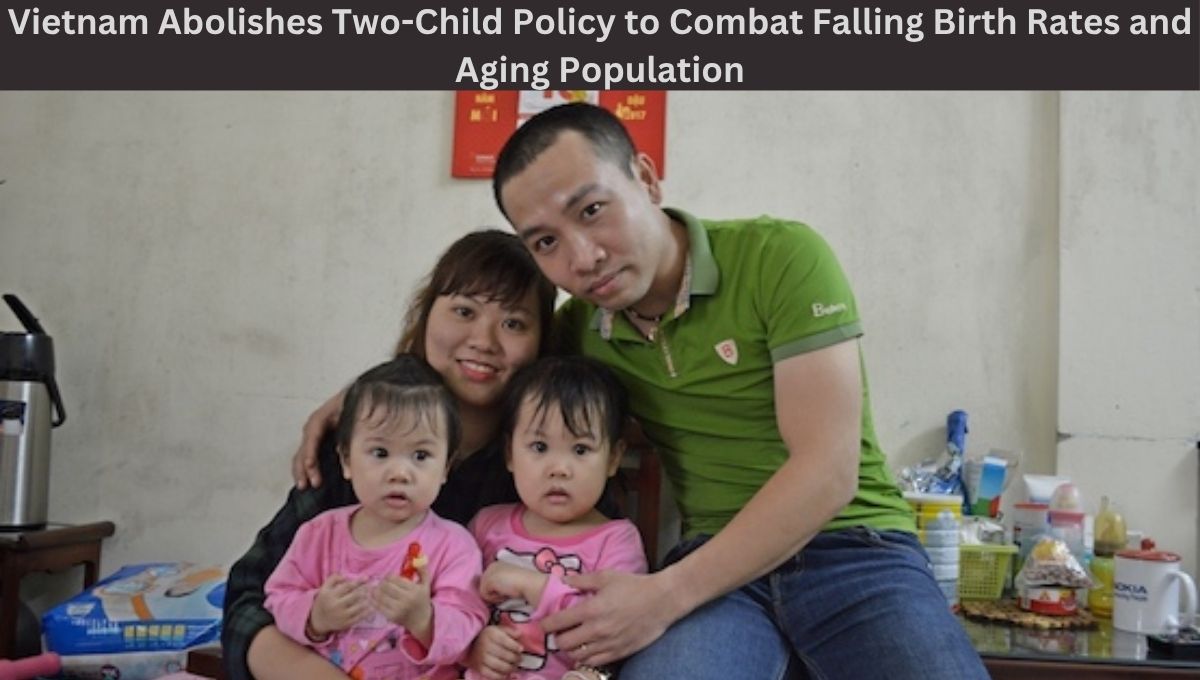
In a historic shift, Vietnam Abolishes Two-Child Policy to Combat Falling Birth Rates and Aging Population. Amid alarming fertility decline, the Vietnamese government has officially scrapped its decades-old two-child policy. The country faces a deepening demographic crisis marked by a falling birth rate, an ageing population, and growing concerns over long-term socio-economic development.
The announcement, confirmed by state-run Vietnam News Agency, marks the end of a policy introduced in 1988, when the country was still recovering from the scars of war and transitioning into a market-oriented economy. Now, amid fears of “getting old before getting rich,” the government has declared that family size is solely a personal choice a dramatic pivot in national population planning.
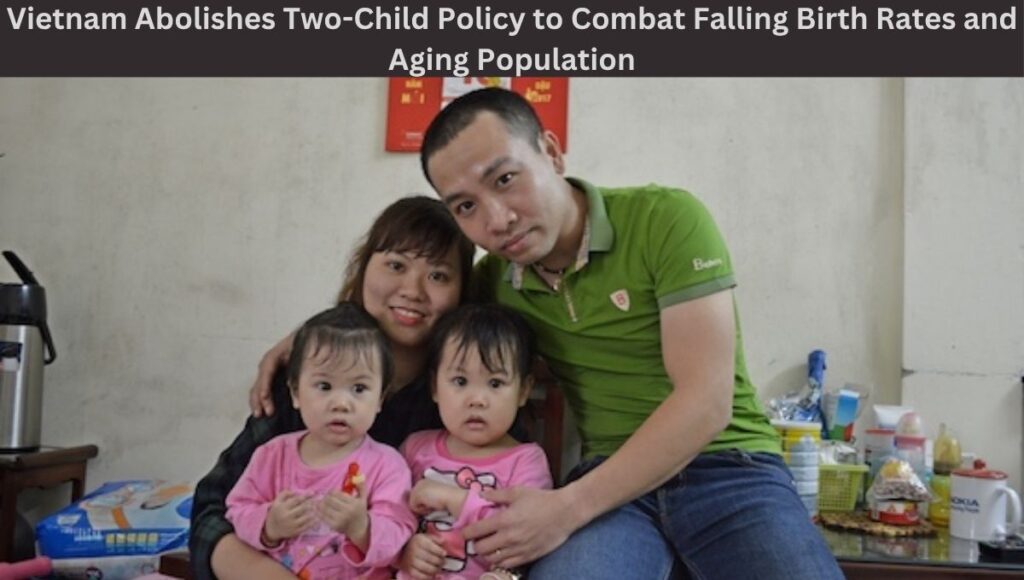
Vietnam Abolishes Two-Child Policy to Combat Falling Birth Rates and Aging Population
Declining Birth Rates Raise Red Flags
Vietnam’s fertility rate has steadily declined over the past three years, dropping below the replacement level of 2.1 children per woman. According to the Ministry of Health:
- In 2021, the fertility rate stood at 2.11
- In 2022, it dropped to 2.01
- In 2023, it fell further to 1.96
- And in 2024, it hit a historic low of 1.91 children per woman
This downward trend is especially visible in urban areas like Hanoi and Ho Chi Minh City, where the cost of living and pressure to succeed economically have discouraged young families from having children.
Deputy Health Minister Nguyen Thi Lien Huong admitted earlier this year that the government’s efforts including public campaigns and revised incentives have had limited success.
Urbanization, Career Pressures, and Cost of Living
The declining birth rate is not just a statistical issue it reflects broader societal shifts. In major cities, rising expenses, long work hours, and a desire to maintain higher living standards are pushing couples to delay or avoid parenthood altogether.
For example, Tran Minh Huong, a 22-year-old office worker, expressed her disinterest in motherhood. “Even though I’m an Asian, with social norms that say women need to get married and have kids, it’s too costly to raise a child,” she told AFP.
Similarly, Nguyen Thu Linh, a 37-year-old marketing manager in Hanoi, and her husband chose to raise only one child, prioritizing quality education over expanding their family. “There’s so much financial and time pressure if you have another child,” she shared.
Economic Growth vs. Demographic Reality
The birth rate crisis is forcing the Vietnamese government to rethink its population strategy. Health Minister Dao Hong Lan warned that the country’s shrinking population could seriously hinder Vietnam’s economic and social development and even threaten national security.
According to World Bank projections, Vietnam’s working-age population will peak around 2040, potentially exposing the country to the dreaded demographic dilemma: “ageing before becoming rich.”
Ending the Two-Child Policy: What It Means
With the policy now abolished, families across Vietnam are free to have as many children as they wish. The law had been strictest for Communist Party members, who faced penalties such as missed promotions or reduced bonuses for having a third child.
In general society, families often lost government benefits and subsidies for violating the two-child rule. For many, the removal of this restriction is welcome even if it doesn’t immediately change their choices.Hoang Thi Oanh, a 45-year-old mother of three, welcomed the policy shift but remained realistic: “Raising more than two kids nowadays is too hard and costly.
Only brave couples and those better-off would do so. I think the authorities will even have to give bonuses to encourage people to have more than two children.”
Addressing Vietnam’s Gender Imbalance
In addition to falling birth rates, Vietnam is also battling a persistent gender imbalance fueled by a cultural preference for boys. In 2023, the sex ratio at birth remained skewed at 112 boys for every 100 girls well above the natural ratio.
The imbalance is most severe in North Vietnam’s Red River Delta and the Northern Midlands and Mountains, and lowest in regions like the Central Highlands and Mekong River Delta.
Though sex-selective abortion is illegal, the practice continues discreetly, with doctors often using coded language to reveal fetal gender. To curb this trend, the Health Ministry has proposed tripling the fine for foetal gender selection to $3,800.
Challenges Moving Forward: Policy Is Not Enough
Vietnam’s experience mirrors that of neighboring China, which scrapped its own one-child policy in 2016 and later allowed families to have up to three children. But despite these changes, China’s birth rate continues to fall, with the population shrinking for a third consecutive year in 2024.
Vietnam faces a similar challenge. As social attitudes evolve and economic pressures mount, policy alone may not be enough to encourage larger families. Deputy Minister Nguyen Thi Lien Huong has called for a societal mindset shift from a narrow focus on family planning to a broader view of population and development.
What’s Next for Vietnam’s Demographic Future?
Removing the two-child policy is a crucial first step, but the real challenge lies ahead. With urban youth disengaged, financial stress mounting, and gender imbalances persisting, the government will likely need to offer incentives, education, and support systems to reverse current trends.
Some experts suggest implementing financial bonuses, parental leave reforms, free education, and affordable childcare as potential motivators for larger families. Ultimately, Vietnam’s demographic destiny depends not just on laws but on how society adapts to modern economic realities while preserving its social cohesion and long-term growth potential.
Also Read: 9 Uncomfortable Truths About Australia’s Under-16 Social Media Ban
Also Read: Vietnam scraps 2-child policy as aging threatens economic growth
Related Posts:
- 11 Explosive Revelations From Ted Cruz’s Leaked…

- In 8 Moves, EU Targets China-Linked Refineries and…

- Trump Threatens Military Action in Nigeria Over…

- Afghanistan–Pakistan War 2025: Inside the 48-Hour Ceasefire

- 7 Powerful Measures: Trump Sanctions Russian Oil…

- Paul Kapur: Confirmed as US Assistant Secretary 2025
