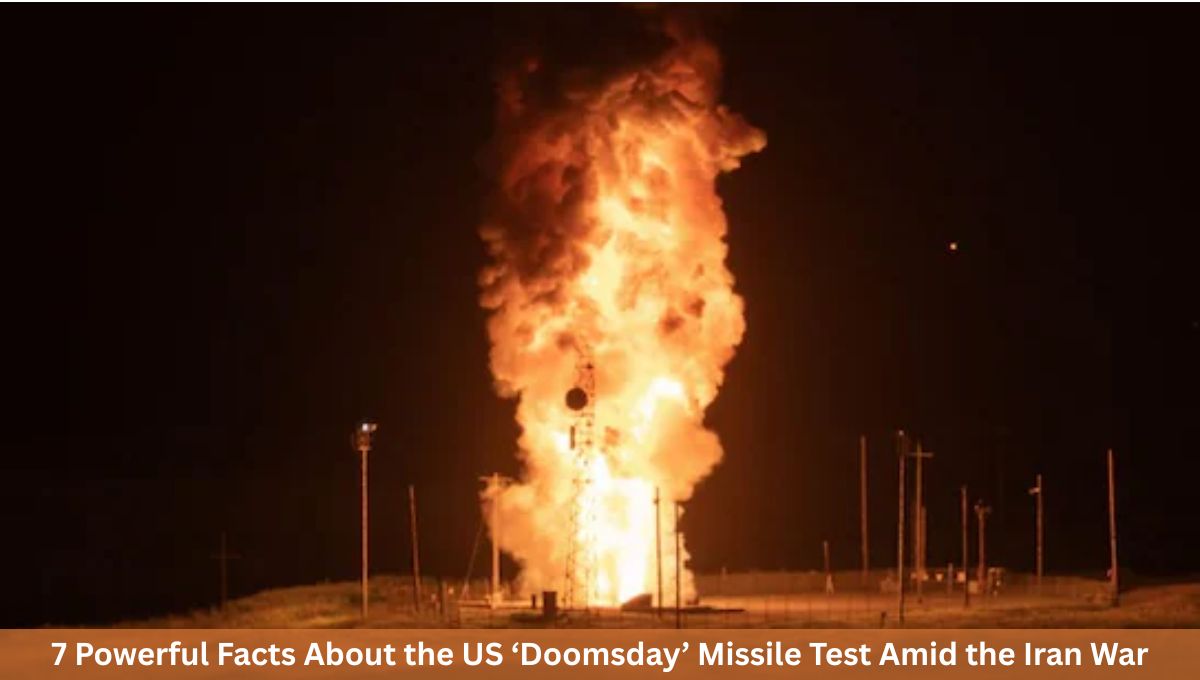
7 Powerful Facts About the US ‘Doomsday’ Missile Test Amid the Iran War entering its sixth day. As the conflict in the Middle East entered its sixth day, the United States carried out a test launch of one of its most powerful strategic weapons — the nuclear-capable Minuteman III intercontinental ballistic missile (ICBM).
Often nicknamed the “doomsday missile,” the Minuteman III forms the land-based backbone of the US nuclear arsenal. The missile is capable of delivering nuclear warheads across continents at extraordinary speeds and with devastating force.
The test launch occurred late Tuesday night from Vandenberg Space Force Base in California, sending the missile thousands of miles across the Pacific Ocean before it struck its designated target area near the Marshall Islands.
While US officials emphasised that the launch had been scheduled years in advance and was not linked to current geopolitical tensions, the timing of the test has drawn widespread global attention. The demonstration of such a powerful nuclear-capable system comes at a moment when the United States, Israel and Iran are locked in an escalating regional conflict.
The test highlights the continuing importance of nuclear deterrence in global security — and underscores the destructive power that modern nuclear weapons systems still hold.
7 Powerful Facts About the US ‘Doomsday’ Missile Test Amid the Iran War
A Routine Test Amid a Global Crisis
The Minuteman III missile test was conducted by the Air Force Global Strike Command, which oversees the United States’ strategic nuclear forces.
According to the US Space Force, the missile launched during the test was unarmed and carried two experimental re-entry vehicles designed to collect data about the missile’s performance.
Officials said the launch was part of a long-running evaluation programme used to ensure the reliability and readiness of the country’s land-based nuclear deterrent.
Over the past several decades, the United States has conducted more than 300 similar missile tests to confirm that the system works exactly as designed.
Military leaders emphasised that routine tests like these are necessary because nuclear weapons systems must remain fully operational even after decades in service.
Lt. Col. Karrie Wray, commander of the 576th Flight Test Squadron, explained the purpose of the launch.
“GT-255 allowed us to assess the performance of individual components of the missile system. By continually assessing varying mission profiles, we are able to enhance the performance of the entire ICBM fleet.”
In other words, the test ensures that the United States maintains a credible nuclear deterrent capable of responding if the country ever faced a nuclear attack.
What Is the Minuteman III Missile?
The LGM-30G Minuteman III is an intercontinental ballistic missile designed to deliver nuclear warheads across vast distances.
First deployed in 1970 during the Cold War, the missile remains one of the most important weapons in the United States’ strategic arsenal.
Today, around 400 Minuteman III missiles remain on active alert, housed in underground silos across three US states:
- Montana
- North Dakota
- Wyoming
These missiles are controlled by crews operating from deep underground command centres, where strict safeguards ensure that the weapon cannot be launched without proper authorization.
The system requires two operators to simultaneously turn launch keys, preventing a single individual from firing the weapon alone.
Despite its age, the Minuteman III continues to undergo regular upgrades to maintain its reliability and effectiveness.
Key Capabilities of the ‘Doomsday Missile’
The Minuteman III is capable of extraordinary performance.
Range
The missile can travel approximately 6,000 miles (9,600 kilometres), allowing it to strike targets across continents.
Speed
During flight, it can reach speeds exceeding 15,000 miles per hour, making interception extremely difficult.
Warhead Power
In wartime configuration, the missile can carry nuclear warheads up to 20 times more powerful than the atomic bomb dropped on Hiroshima in 1945.
Multiple Warheads
Earlier versions of the missile were capable of deploying multiple independently targetable re-entry vehicles (MIRVs), allowing one missile to strike several targets.
However, arms control agreements between the United States and Russia have reduced the number of warheads deployed on each missile.
Even with these reductions, the destructive potential of the Minuteman III remains enormous.
Why It Is Called the “Doomsday Missile”
The Minuteman III’s nickname — “doomsday missile” — reflects the devastating consequences that could follow its use.
Nuclear weapons carried by such missiles have the capacity to destroy entire cities within seconds. But the danger extends far beyond the immediate blast.
Scientists warn that large-scale nuclear conflict could trigger “nuclear winter.”
What Is Nuclear Winter?
A nuclear winter scenario occurs when massive fires created by nuclear explosions send huge quantities of smoke and soot into the atmosphere.
This debris could block sunlight for months or even years, potentially collapsing global agriculture and causing widespread famine.
While a single missile would not trigger such a catastrophe, a full-scale nuclear exchange between major powers could.
The very existence of such weapons is intended to deter war by making the consequences of nuclear conflict too catastrophic to contemplate.
The Role of the Missile in the US Nuclear Triad
The Minuteman III represents the land-based component of the United States’ nuclear triad.
The nuclear triad is a three-part system designed to guarantee that the country can respond to a nuclear attack even if one or two parts of its arsenal are destroyed.
The three components include:
1. Land-Based Missiles
Intercontinental ballistic missiles such as the Minuteman III.
2. Submarine-Launched Ballistic Missiles
Nuclear missiles carried aboard stealthy submarines hidden in the oceans.
3. Strategic Bombers
Aircraft capable of delivering nuclear weapons across long distances.
Together, these systems create redundancy and survivability, ensuring that no enemy could eliminate the United States’ nuclear forces in a surprise attack.
How an Intercontinental Ballistic Missile Works
Understanding how a ballistic missile operates helps explain why these weapons are so difficult to stop.
Launch Phase
The missile launches from an underground silo using powerful solid-fuel rocket engines.
Boost Phase
During the first few minutes, the rocket accelerates rapidly into the upper atmosphere.
Midcourse Phase
Once outside the atmosphere, the missile follows a ballistic trajectory, similar to a projectile thrown through the air.
Re-Entry Phase
Near the end of its flight, the warhead re-enters Earth’s atmosphere at extremely high speed.
The warhead then descends toward its target, completing the entire journey from launch to impact in around 30 minutes.
Missile Test Comes During Escalating Iran War
The Minuteman III test took place as the conflict involving Iran, Israel and the United States intensified across the Middle East.
The war entered its sixth day as Iran launched a fresh barrage of missiles toward Israel, triggering air-raid sirens in major cities and sending millions of civilians into bomb shelters.
The exchange of missile attacks has raised fears that the conflict could expand into a wider regional war. Meanwhile, political debate in Washington has intensified.
A resolution in the United States Senate aimed at limiting military operations against Iran failed after lawmakers voted largely along party lines.
The vote effectively allowed the administration of President Donald Trump to continue military operations without additional congressional authorization.
Rising Global Tensions
The growing confrontation between Iran and its adversaries has spread beyond the Middle East.
Reports indicate that the conflict has begun to affect regions across the Persian Gulf, the Mediterranean and even parts of the Indian Ocean.
Drone attacks targeting US diplomatic facilities in several Gulf countries have raised concerns about a broader regional escalation.
Military analysts warn that prolonged fighting could destabilize critical shipping routes and energy supplies.
At the same time, global powers are closely monitoring developments to prevent the conflict from spiraling into a wider war.
The Debate Over Nuclear Readiness
The missile test also comes amid renewed debate in the United States about the future of its nuclear arsenal.
Some policymakers argue that the country must modernize its nuclear forces to address emerging threats from rival powers.
Others believe that the continued reliance on nuclear weapons increases the risk of catastrophic escalation.
The Minuteman III system itself is already more than five decades old, prompting plans for a replacement.
The Future: Sentinel ICBM
The United States is currently developing a new intercontinental ballistic missile known as the Sentinel ICBM. The Sentinel is intended to eventually replace the Minuteman III system.
However, delays in the development programme mean that the Minuteman III may remain in service until at least 2050. Until then, routine testing will continue to ensure the system remains fully operational.
Why Routine Missile Tests Matter
Although the latest missile launch occurred during a period of intense geopolitical tension, US officials stress that such tests are routine and essential.
Testing allows engineers to verify that the missile system remains reliable after years of operation.
It also enables the military to gather data that can improve the performance of future weapons systems. Without regular testing, the credibility of a nuclear deterrent could weaken.
A Symbol of Deterrence
For decades, nuclear deterrence has shaped global security policy.
The central idea behind deterrence is simple:
if potential adversaries know that a devastating nuclear response is guaranteed, they are less likely to initiate a nuclear attack.
The Minuteman III missile is a key part of that strategy. Even though it has never been used in combat, its presence alone plays a role in preventing nuclear war.
The Global Implications
In a world already facing growing geopolitical instability, demonstrations of nuclear capability inevitably attract international attention.
Countries around the globe monitor such tests closely because they reflect the balance of power among nuclear-armed states.
While the latest launch was officially routine, its timing during a major international conflict has heightened its significance.
For now, the missile test remains a reminder of both the technological sophistication and destructive potential of modern military power.
Conclusion
The United States’ test launch of the Minuteman III “doomsday” missile highlights the enduring role of nuclear weapons in global security.
Although officials insist that the launch was routine and planned years in advance, the timing — amid a rapidly escalating war involving Iran and Israel — has inevitably drawn international scrutiny.
As tensions rise across multiple regions, the demonstration of nuclear readiness underscores the fragile balance that continues to define the modern world.
For many analysts, the test serves as both a reassurance and a warning:
reassurance that nuclear deterrence systems remain operational, and a warning of the catastrophic consequences that could follow if such weapons were ever used in conflict.
Also Read: 7 Explosive Reasons Iran’s Missile Program Is a Non-Negotiable Red Line in US Talks
Also Read: US test-fires nuclear-capable ‘doomsday’ missile amid Iran war: What to know about Minuteman III
Related Posts:
- 7 Stark Claims as China Denies 100 ICBMs Near…

- 7 Urgent Takeaways as North Korea Launches Ballistic Missile

- Trump Ends 33-Year Pause: U.S. to Resume Nuclear…

- Trump Ends 33-Year Pause on US Nuclear Testing

- 5 Explosive Global Implications of Trump’s Nuclear…

- Trump Relocates U.S. Space Command Headquarters from…