7 Critical Fault Lines in the High-Stakes US-Brokered Russia-Ukraine Peace Push ends without agreement. The latest attempt to chart a path toward ending Europe’s deadliest conflict since World War II concluded in Abu Dhabi with cautious words, weary faces, and no tangible breakthrough.
After two days of intensive, US-brokered trilateral talks involving Russia, Ukraine, and the United States, negotiators departed the United Arab Emirates acknowledging progress in dialogue—but not in resolution.
As diplomats discussed peace, Russian drones and missiles struck Ukraine’s cities and energy infrastructure, plunging millions into darkness amid sub-zero winter temperatures.
The contrast could not have been starker:
measured diplomacy inside guarded conference rooms versus the raw violence unfolding on the ground.
Yet despite the absence of an agreement, all sides signaled willingness to continue.
Another round of talks is scheduled for February 1, raising a pivotal question for the international community:
is this the beginning of a genuine diplomatic thaw—or merely another pause in a grinding war defined by maximalist demands and mutual distrust?
7 Critical Fault Lines in the High-Stakes US-Brokered Russia-Ukraine Peace Push
The Abu Dhabi Talks: What Was on the Table
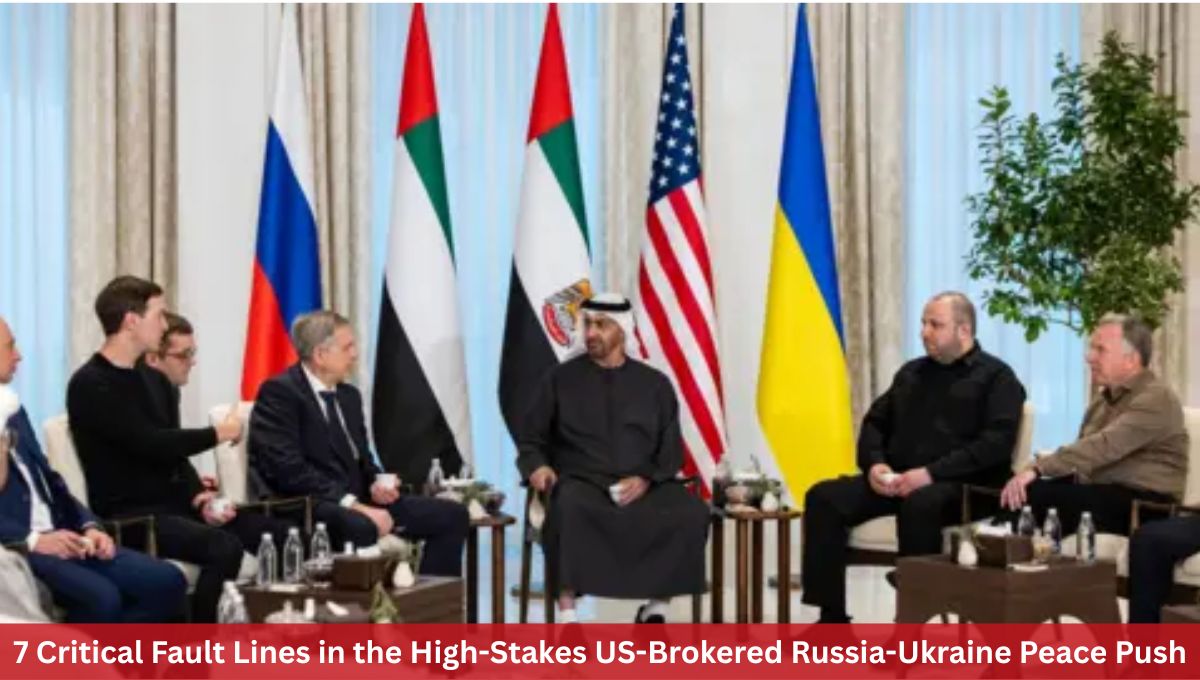
The Abu Dhabi meetings marked the first known instance of direct, US-mediated trilateral talks involving senior representatives from Washington, Kyiv, and Moscow since Russia launched its full-scale invasion nearly four years ago.
Who Attended
Ukraine’s delegation was led by Chief Negotiator Rustem Umerov and military intelligence head Kyrylo Budanov. Russia sent senior military intelligence and army representatives.
The US delegation included special envoy Steve Witkoff and Jared Kushner, President Donald Trump’s son-in-law and trusted intermediary.
According to Ukrainian President Volodymyr Zelenskyy, the discussions focused on:
- Possible parameters for ending the war
- Post-war security conditions
- Confidence-building measures
- Oversight and monitoring mechanisms
- The fate of contested territories, particularly Donbas
A UAE government spokesperson described the atmosphere as “constructive and positive,” emphasizing the rarity of direct engagement between Russian and Ukrainian officials.
But beneath the diplomatic language lay unresolved fault lines that continue to define the conflict.
Donbas: The Core Territorial Impasse
Why Donbas Matters
The eastern Ukrainian region of Donbas—comprising Donetsk and Luhansk—is the central unresolved issue in the peace talks. Rich in coal, steel, and industrial capacity, the region has both economic and symbolic value.
Russia currently controls all of Luhansk and approximately 80 percent of Donetsk. President Vladimir Putin has made it clear that Moscow’s minimum condition for peace is Ukraine’s full withdrawal from the remaining areas it still holds.
Kyiv’s Red Line
Ukraine has categorically rejected this demand. Zelenskyy has repeatedly stated that Kyiv will not surrender territory that Russia has failed to capture militarily.
“It’s all about the eastern part of our country. It’s all about the land,” Zelenskyy said ahead of the Abu Dhabi talks.
Public opinion in Ukraine reinforces this stance. Polls consistently show little appetite among Ukrainians for territorial concessions, particularly after years of devastating warfare.
Why This Issue Is So Hard to Resolve
From Moscow’s perspective, Donbas is framed as “historical Russian land.” From Kyiv’s standpoint, conceding Donbas would legitimize aggression and invite future invasions.
This zero-sum framing makes compromise politically toxic for both leaders—and potentially fatal to any peace agreement.
Talks Amid Missiles: Diplomacy Undermined by Violence
Energy Infrastructure Under Attack
On the eve of the second day of talks, Russia launched a major barrage of drones and missiles targeting Ukraine’s energy grid.
According to Ukrainian officials:
- About 1.2 million people lost electricity
- Nearly half of Kyiv’s apartment blocks lost heating
- Temperatures dropped to around −10°C
- At least one person was killed and dozens wounded
Ukraine’s Deputy Prime Minister Oleksii Kuleba described the strikes as catastrophic for civilians already stretched by winter conditions.
Ukrainian Reaction: ‘Cynical’ Timing
Ukrainian Foreign Minister Andrii Sybiha accused Putin of acting cynically.
“His missiles hit not only our people, but also the negotiation table,” Sybiha wrote on X.
Opposition lawmaker Kira Rudik echoed the sentiment, calling the attacks a deliberate strategy designed to weaken Kyiv’s negotiating position.
For many Ukrainians, the timing reinforced a long-held belief: that Moscow uses diplomacy as cover while continuing military pressure.
The US Peace Framework: Progress or Pressure?
Washington’s Central Role
The talks are being driven by the Trump administration, which has made ending the war a signature foreign-policy objective.
US officials described the Abu Dhabi meetings as a “big step,” emphasizing that simply bringing both sides into the same room was a breakthrough.
According to US sources, the discussions covered:
- A potential ceasefire, possibly starting with energy infrastructure
- Security guarantees for Ukraine
- Oversight mechanisms led by the United States
- Economic incentives for post-war reconstruction
Criticism of the Initial Draft
An early US-proposed peace framework drew sharp criticism in Kyiv and Western Europe for appearing to align too closely with Russia’s territorial ambitions.
Later revisions, which included the idea of European peacekeepers, were rejected by Moscow.
This balancing act—pressuring Ukraine to compromise while keeping Russia engaged—has fueled concerns that Washington may prioritize a deal over durability.
Security Guarantees: The ‘Gold Standard’ Problem
Ukraine’s Core Demand
For Kyiv, any peace deal without iron-clad security guarantees is unacceptable. Ukraine’s leadership remains haunted by past agreements that failed to prevent Russian aggression.
European proposals for multinational monitoring forces have been discussed, with France and Germany expressing limited willingness to contribute troops.
But Ukrainian officials have been blunt: only the United States can provide the “gold standard” security guarantee capable of deterring future attacks.
Trump’s Red Line: No US Boots
President Trump has publicly ruled out deploying American combat troops to Ukraine.
Instead, Washington is offering:
- Intelligence sharing
- Persistent surveillance
- Logistical and air defense support
- Monitoring and oversight mechanisms
European diplomats privately admit this may not be enough.
“A ceasefire without a credible US kinetic backstop is a house of cards,” one senior EU diplomat said.
Energy, Nuclear Power, and Confidence-Building Measures
Zaporizhzhia Nuclear Power Plant
One unexpected area of discussion was the Zaporizhzhia nuclear power plant, Europe’s largest, currently occupied by Russian forces.
US officials revealed tentative understandings that:
- The plant’s power output could be shared equitably
- The facility could serve as a confidence-building mechanism
- International oversight, possibly involving the IAEA, remains unresolved
While control of the plant is still undecided, diplomats view progress on nuclear safety as a potential template for broader cooperation.
“If they can find common language on nuclear safety,” one official remarked, “they can find it on almost anything.”
The ‘Prosperity Plan’: Selling the Peace
Economic Incentives at the Core
The US strategy relies heavily on economic carrots alongside diplomatic pressure. Central to the talks is a proposed US-backed “Prosperity Plan” for Ukraine, coupled with potential post-war economic openings for Russia.
The aim is to shift negotiations from attrition to incentives.
According to US officials, the change in atmosphere was striking. Delegates reportedly shared meals and engaged in fluid discussions across military and economic working groups.
“At moments, they almost looked like old colleagues discussing a difficult merger,” one diplomat said.
European Anxiety: A Deal at Any Cost?
While European governments welcome renewed diplomacy, many fear a settlement brokered primarily on American terms could leave the continent exposed if US commitment wanes.
The memory of past security failures looms large.
“The political cost for Zelensky and Putin remains astronomical,” warned one Western diplomat. “Neither wants to be the leader who conceded sovereignty or trusted the untrustworthy.”
Life in Kyiv: Hope Exhausted
On the streets of Kyiv, optimism is scarce.
After another sleepless night of explosions, residents expressed resignation rather than hope.
“They’ll just say everything is fine, that nothing has been agreed, and again there will be rockets,” said Anastasia Tolkachov, who spent the night sheltering in a parking garage.
For many civilians, the talks feel abstract—overshadowed by cold apartments, blackouts, and fear.
What Comes Next: February 1 and Beyond
Negotiators have agreed to reconvene in Abu Dhabi on February 1 after a week of intensive drafting in their respective capitals.
There is growing speculation about a possible high-level summit involving Trump, Putin, and Zelenskyy. US officials say momentum is building—but caution that trust remains nonexistent.
“Trust is a non-factor right now,” one US official said. “But for the first time in years, we have a framework where trust could actually survive.”
Conclusion: A Fragile Shift, Not a Breakthrough
The Abu Dhabi talks did not end the war. They did not stop the missiles. They did not resolve Donbas.
But they marked something subtler—and potentially significant.
For the first time in years, the conversation among the principal actors has shifted from how to win the war to how to survive the peace.
In diplomacy, that shift often signals the beginning of the end, even if the road ahead remains long, uncertain, and dangerous.
The killing continues. The cities still burn. Yet behind closed doors, a fragile framework is taking shape—one that may determine whether Ukraine’s future is defined by reconstruction or repetition. In the cold arithmetic of geopolitics, that alone makes these talks impossible to ignore.
Also Read: 7 Critical Reasons the Donbas Is the Most Explosive Issue in Ukraine Peace Talks
Also Read: U.S.-brokered peace talks break off without a deal after overnight Russian bombardment of Ukraine
Related Posts:
- 7 Alarming Signals as Russia Pounds Ukraine’s Energy Grid

- 7 Critical Signals Behind Trump’s Claim of a Ukraine…

- 9 Alarming Impacts of a Massive U.S. Winter Storm

- 7 Crucial Developments as Zelenskyy Says US Security…

- In 8 Moves, EU Targets China-Linked Refineries and…

- 7 Critical Reasons the Donbas Is the Most Explosive…