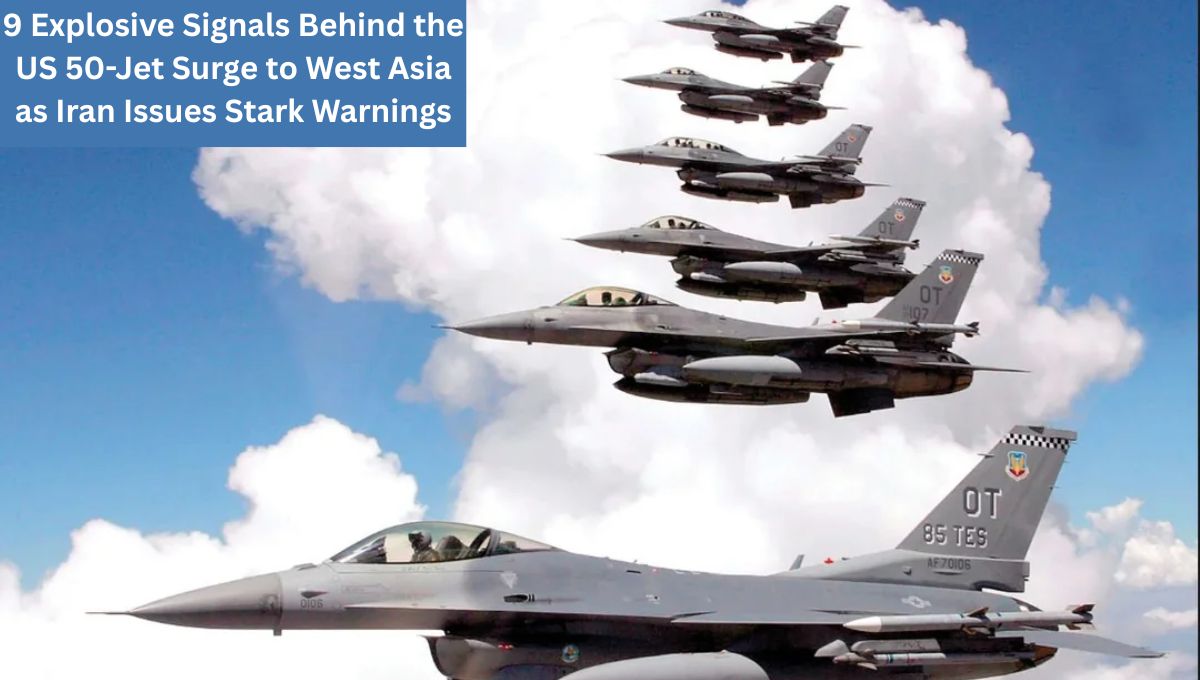
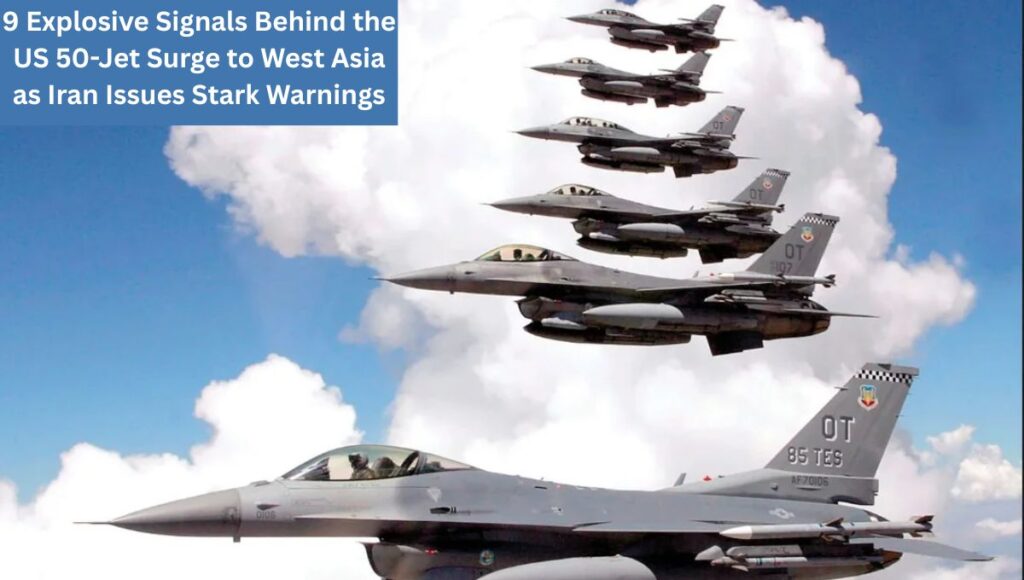
9 Explosive Signals Behind the US 50-Jet Surge to West Asia as Iran Issues Stark Warnings, fueling fears of a wider regional conflict. The United States has dramatically expanded its military footprint across West Asia, deploying more than 50 advanced fighter jets in just 24 hours, even as indirect nuclear negotiations with Iran resumed in Geneva.
The rare speed and scale of the air deployment have sent a clear signal:
Washington is pursuing diplomacy with Tehran while simultaneously preparing for worst-case military scenarios.
The surge includes F-16, F-22, and F-35 fighter aircraft, supported by aerial refuelling tankers, indicating readiness for sustained operations rather than symbolic positioning. Independent flight trackers and military aviation monitors confirmed the movements, which were later acknowledged by US officials cited by Axios.
The buildup coincides with heightened rhetoric from Iran’s leadership, new military drills near the Strait of Hormuz, and growing unease among regional allies who fear that a single miscalculation could trigger a broader Middle East conflict.
9 Explosive Signals Behind the US 50-Jet Surge to West Asia as Iran Issues Stark Warnings
Why This Deployment Is Different
Unlike routine force rotations, the latest US deployment stands out for three reasons:
- Speed – Over 50 combat aircraft repositioned within a single day
- Capability – Inclusion of fifth-generation stealth fighters
- Timing – Occurring during active nuclear negotiations
US officials describe the move as a “reinforcement,” but regional analysts see it as a deliberate demonstration of coercive leverage as talks reach a sensitive phase.
What Aircraft Has the US Sent?
Fifth- and Fourth-Generation Firepower
According to open-source flight data and US officials:
- F-35 Lightning II stealth fighters
- F-22 Raptor air-dominance fighters
- F-16 Fighting Falcon multirole aircraft
- Multiple aerial refuelling tankers
The presence of refuelling aircraft is particularly significant, suggesting preparations for long-range missions and extended loiter time over contested airspace.
Military analysts note that this combination gives Washington the ability to conduct:
- Precision strikes
- Air superiority missions
- Intelligence, surveillance, and reconnaissance (ISR) operations
All within hours of an order.
Second Carrier Strike Group En Route
The air surge is unfolding alongside major naval movements.
The USS Gerald R. Ford carrier strike group has departed the Caribbean and is currently transiting the Atlantic toward the Middle East.
According to a US Navy official cited by the Associated Press, the carrier is accompanied by three guided-missile destroyers:
- USS Mahan
- USS Bainbridge
- USS Winston Churchill
While the group remains more than a week away from waters near Iran, its deployment adds a second carrier presence to a region where the USS Abraham Lincoln is already operating.
Together, the two carrier groups provide the United States with:
- Hundreds of strike aircraft
- Dozens of Tomahawk cruise missiles
- Submarine-launched strike capability
Iran’s Supreme Leader Issues Stark Warning
As the US buildup unfolded, Iran’s Supreme Leader Ali Khamenei delivered one of his strongest warnings yet, addressing US President Donald Trump directly during a speech in Tehran.
“The US President keeps saying they have the strongest military force in the world. The strongest military force may at times be struck so hard that it cannot get up again.”
Khamenei also addressed Washington’s naval deployments:
“A warship is a dangerous piece of military hardware. However, more dangerous than that warship is the weapon that can send that warship to the bottom of the sea.”
The remarks were widely interpreted as a reference to Iran’s:
- Anti-ship ballistic missiles
- Naval mines
- Swarm attack tactics using fast boats and drones
A Message of Defiance, Not Retreat
Khamenei rejected decades of US pressure outright, declaring that Washington had failed to dismantle the Islamic Republic despite sustained sanctions and confrontation.
“You were not able to do this in the past, and you will not be able to do this now.”
The speech reinforced Tehran’s core message:
negotiations will proceed, but under no threat of submission.
Strait of Hormuz: Iran Raises the Stakes
Adding to the tension, Iran announced a temporary closure of parts of the Strait of Hormuz for live-fire military drills — an unusual step even by Tehran’s standards.
The Strait of Hormuz is one of the world’s most strategically vital waterways, carrying roughly 20% of global oil supply.
Iranian state media said missiles were fired toward the waterway during exercises conducted for “safety and maritime concerns.”
Why Hormuz Matters to the World
At its narrowest point, the strait is just 33 kilometers wide.
Yet it serves as the main export route for oil and gas from:
- Saudi Arabia
- Iran
- Iraq
- Kuwait
- United Arab Emirates
- Qatar
Any sustained disruption would:
- Drive up global energy prices
- Disrupt shipping insurance
- Hit Asian and European economies hardest
Iran has threatened full closure of the strait in the past but has never carried it out.
IRGC Flexes Its Muscle
The drills were conducted by the Islamic Revolutionary Guard Corps, which plays a central role in Iran’s regional strategy.
IRGC-affiliated media described the exercise as simulating “real maritime threats,” underscoring Iran’s readiness to respond to any attack with consequences beyond its borders.
Geneva Talks: Diplomacy Under Pressure
Despite the escalating military signals, indirect nuclear talks resumed in Geneva, with Oman acting as mediator.
The US delegation is being led by:
- Steve Witkoff
- Jared Kushner
Iran’s side is headed by Foreign Minister Abbas Araghchi.
Cautious Optimism From Both Sides
After the talks, Araghchi struck a notably measured tone:
“The discussions were serious, constructive and positive. We reached a general understanding on guiding principles.”
However, he cautioned against expectations of a quick breakthrough:
“This does not mean an agreement can be reached quickly, but at least the path has begun.”
US Vice President JD Vance echoed the mixed assessment, saying the talks went well “in some ways,” while stressing that major gaps remain.
The Core Sticking Points
Despite progress, fundamental disagreements persist:
US Demands
- Zero uranium enrichment on Iranian soil
- Expanded talks covering missiles and regional activity
Iran’s Red Lines
- No surrender of enrichment rights
- Missile program off the table
- Sanctions relief as a precondition
These positions leave limited room for compromise without political risk on both sides.
Trump’s Shadow Over the Talks
President Trump has said he is involved “indirectly” in the negotiations, warning Tehran of severe consequences if talks fail.
“If they’re not successful, it’s going to be a very bad day for Iran.”
Trump has also referenced last year’s US-Israeli strikes on Iranian nuclear sites, suggesting Tehran is now more motivated to negotiate.
IAEA Concerns and Nuclear Uncertainty
Parallel to the talks, Araghchi met Rafael Grossi, head of the International Atomic Energy Agency.
The IAEA has raised concerns over Iran’s stockpile of highly enriched uranium following strikes on:
- Natanz
- Fordow
- Isfahan
Iran has limited inspections, citing radiation risks and security concerns.
Why the Military Pressure Matters Now
Analysts say the US buildup serves multiple purposes:
- Strengthen Washington’s negotiating leverage
- Deter Iranian attacks on US assets or allies
- Reassure regional partners
- Maintain strike options if talks collapse
However, critics warn that simultaneous diplomacy and military escalation increase the risk of miscalculation.
Regional Allies on Edge
Gulf Arab states are deeply concerned that US military action could destabilize the region. According to diplomats familiar with the talks, most regional players are urging restraint.
“Everybody is pushing against a strike,” one regional diplomat said. Israel remains the strongest advocate for tougher action against Iran.
What Happens if Talks Fail?
US military planners now have extensive options:
- Tomahawk missile strikes
- Air campaigns targeting nuclear and military sites
- Joint US-Israel operations
Yet US officials privately acknowledge uncertainty over what would follow a collapse of Iran’s leadership, with intelligence gaps surrounding the IRGC’s internal power structure.
A High-Risk Parallel Track
The current moment is defined by parallel escalation:
- Diplomats negotiating in Geneva
- Fighter jets repositioning across West Asia
- Warships converging on the Gulf
- Missiles fired near critical sea lanes
Each track amplifies the other.
Conclusion: A Narrow Path Forward
The deployment of more than 50 US fighter jets to West Asia underscores the fragile balance between diplomacy and deterrence shaping US-Iran relations today.
For now, talks continue. But with military forces massing, rhetoric hardening, and strategic waterways under strain, the margin for error is shrinking rapidly.
Whether Geneva delivers compromise — or merely buys time — may determine not only the future of Iran’s nuclear program, but the stability of the Middle East and the global energy system itself.
Also Read: 9 Explosive Signals Behind the US Carrier Move as Iran Tensions Boil
Also Read: Trump Issues Stark Warning to Iran As High-Stakes Nuclear Talks Kick Off
Related Posts:
- 15 Explosive Signals as the US Masses War-Ready…
- 9 Explosive Claims as Venezuela Slams US ‘Extortion’ at UN

- 7 Explosive Signals as Hegseth Warns Iran and Trump…
- In 8 Moves, EU Targets China-Linked Refineries and…

- 7 Powerful Measures: Trump Sanctions Russian Oil…

- 11 Explosive Signals From US–Iran Nuclear Talks as…