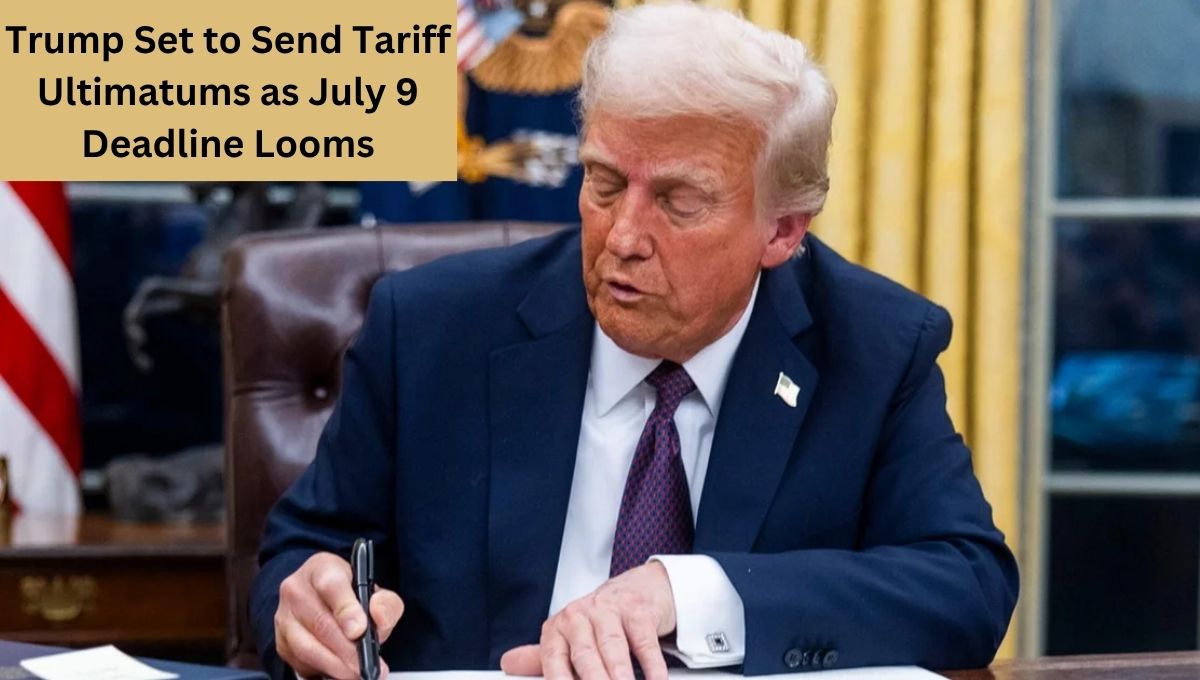
In a bold trade action Trump Set to Send Tariff Ultimatums as July 9 Deadline Looms. In a dramatic shift poised to redefine U.S. trade relations, President Donald Trump has announced that his administration will issue unilateral tariff letters to key U.S. trading partners within the next two weeks. The move comes as the July 9 tariff deadline looms, ending a 90-day pause that was instituted following global market chaos in April.
Trump’s new approach summed up in his own words as “take it or leave it” represents a stark pivot from traditional negotiation-heavy diplomacy to a hardline trade strategy designed to force quick decisions from America’s global partners.
Trump Set to Send Tariff Ultimatums as July 9 Deadline Looms
Unilateral Tariff Letters: A Direct Approach
Speaking on June 11 at the Kennedy Center, Trump confirmed the plan to bypass prolonged trade talks by sending written ultimatums directly to negotiating countries. These letters will outline fixed tariff terms and demand swift compliance.
“At a certain point, we’re just going to send letters out,” Trump said. “This is the deal. You can take it, or you can leave it.”
The Trump tariff letters are expected to be sent before the July 9 tariff deadline, which marks the end of the pause initiated after the controversial ‘Liberation Day’ tariff announcement on April 9.
Deadline Pressure: July 9 on the Horizon
Markets and diplomats alike are watching the calendar. The July 9 deadline is when the 90-day suspension on broad tariffs expires a pause that temporarily stabilized global markets after Trump’s original tariff move triggered a 12% drop in the S&P 500 and rattled global investors.
Many experts fear that if Trump follows through with aggressive tariffs and no deals are reached, the economic fallout could echo the chaos of April.
Trump Hints at Flexibility for ‘Good-Faith’ Partners
While President Trump’s rhetoric is uncompromising, his administration has hinted at some room for flexibility. In testimony before the House Ways and Means Committee, Treasury Secretary Scott Bessent stated that countries negotiating “in good faith” may be granted deadline extensions.
“It is highly likely that those countries or trading blocs like the EU who are negotiating in good faith, we will roll the date forward,” Bessent told lawmakers.
This development offers a lifeline to nations like Japan, India, and the EU, who are still engaged in talks but haven’t finalized agreements.
EU Could Be Last to Seal a Deal
Commerce Secretary Howard Lutnick echoed the President’s frustrations with multilateral talks, singling out the European Union as particularly slow due to its complexity as a 27-nation bloc.
“We’ve had frustrations with the EU,” Lutnick said. “Bilateral deals are simpler and more effective.”
Despite this, there are signs that the EU is now negotiating more seriously, with Bessent confirming that talks are progressing.
Deals with the UK and China Show Mixed Results
So far, the Trump administration has finalized just one trade agreement with the United Kingdom. A tentative truce with China is also in place, which includes increased Chinese exports of rare earths and the relaxation of U.S. student visa restrictions for Chinese nationals.
However, that deal faces a separate deadline of August 10 and remains fragile. Trump praised the deal but emphasized it would need final approval from both himself and Chinese President Xi Jinping.
TACO Trade: Wall Street’s Eye-Roll
On Wall Street, skepticism remains. The term “TACO trade” (Trump Always Chickens Out) has gained traction to describe Trump’s pattern of backing off tariff threats when markets panic.
This nickname resurfaced after Trump walked back proposed triple-digit tariffs earlier this year following a major sell-off. During a press event, Trump lashed out at a reporter who mentioned the TACO label, calling it “the nastiest question.”
Still, traders and investors are cautious, having seen the market rebound every time Trump eases his stance.
The April Shock: Liberation Day Fallout
The roots of the current crisis lie in Trump’s April 9 ‘Liberation Day’ tariff announcement, where he proposed sweeping tariffs on nearly all trading partners. The result was catastrophic a 12% plunge in the S&P 500 in just four days, soaring bond yields, and a weakened U.S. dollar.
The subsequent 90-day pause, which expires on July 9, was meant to calm markets and provide time for deal-making. But with just weeks remaining, few comprehensive trade agreements are in place.
Legal Questions Still Cloud Trump’s Tariffs
Though Trump appears ready to act, legal uncertainty remains. A recent federal appeals court ruling upheld his tariff authority temporarily, reversing a lower court decision. However, critics argue that unilateral tariffs could face renewed legal scrutiny if they are deemed to violate international trade norms or domestic laws.
Conclusion: The World Watches, Markets Hold Breath
President Trump’s decision to send tariff ultimatum letters is a high-stakes gamble that may either solidify U.S. leverage or plunge global markets into another tailspin. While some nations may secure extensions by negotiating in “good faith,” the broader uncertainty is already unsettling investors.
With the July 9 tariff deadline fast approaching, the world watches with bated breath. Whether Trump follows through or retreats in classic TACO trade fashion will likely shape the next chapter in global trade policy.
Also Read: Trump’s July 9 Tariff Deadline Nears: Where Trade Talks Stand
Also Read: Russia may face Trump tariffs in 50 days, what does US import from Russia?
Related Posts:
- 9 Explosive Revelations as Trump Declares His Health…
- What’s Next for Donald Trump After Court Rules His…
- Trump’s ‘Take-It-Or-Leave-It’ Tariff Letters Shake…
- Trump’s 2025 Gaza Peace Plan Signing and Historic…

- Trump to Host 2026 G20 Summit at His Florida Golf…

- 7 Explosive Revelations Behind Trump’s Move to…
