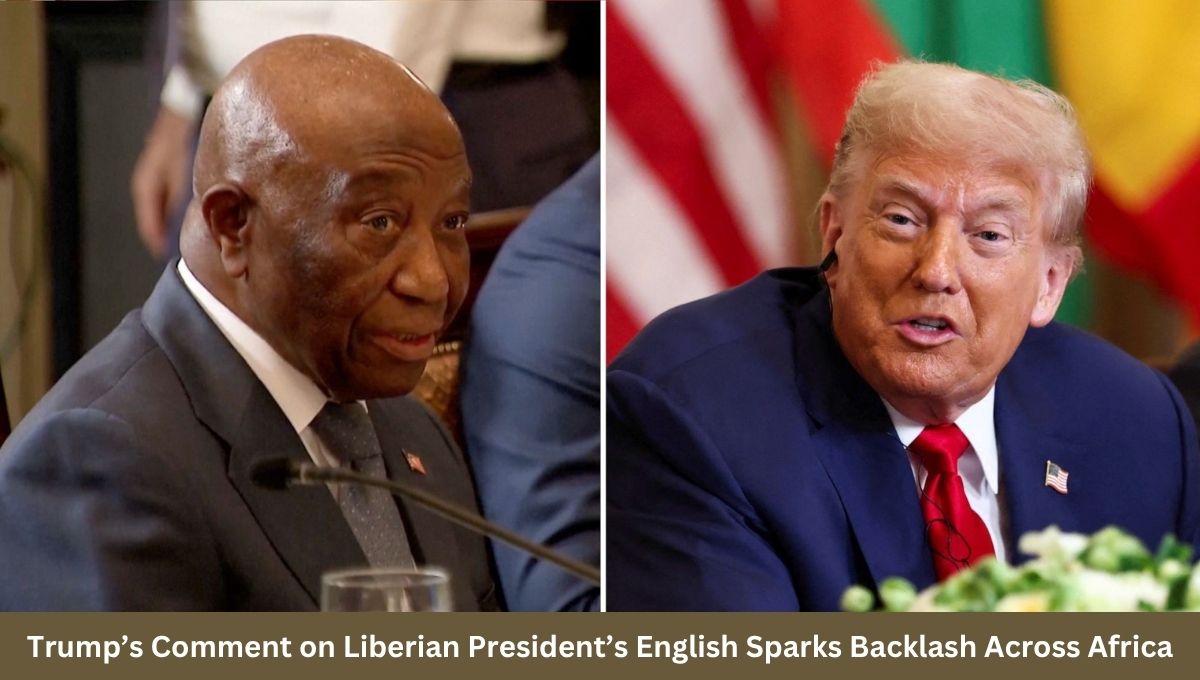
At a White House lunch with five African leaders this week, Trump’s Comment on Liberian President’s English Sparks Backlash Across Africa. President Donald Trump sparked fresh controversy by praising Liberian President Joseph Boakai for his “beautiful English” seemingly unaware that English is the official language of Liberia.
The remark, made during what was intended to be a diplomatic gathering, quickly went viral, igniting criticism from Liberians and observers across the African continent. “Such good English, it’s beautiful. Where did you learn to speak so beautifully?” Trump asked Boakai, visibly impressed.
Boakai responded that he was educated in Liberia, prompting Trump to express surprise: “That’s very interesting,” he said. “I have people at this table who can’t speak nearly as well.” While Trump likely meant the comment as a compliment, critics have slammed it as condescending, ignorant, and emblematic of lingering colonial attitudes toward African nations.
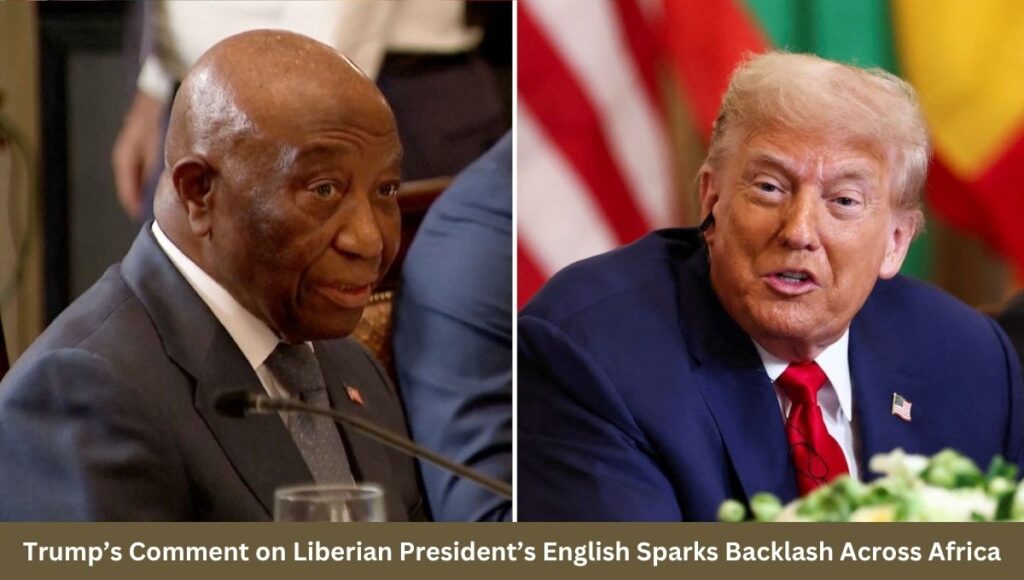
Trump’s Comment on Liberian President’s English Sparks Backlash Across Africa
Liberia’s History: Founded by Free Black Americans, Speaks English
To understand the backlash, it’s essential to examine Liberia’s historical connection to the United States. The West African nation was established in 1822 by the American Colonization Society, a group funded by members of the U.S. Congress and slaveholders, who sought to resettle freed Black Americans in Africa.
Liberia declared its independence in 1847, becoming Africa’s first republic. Many of its early leaders were descendants of formerly enslaved people from the U.S., and the country’s legal, educational, and political systems were heavily modeled on the American system.
As a result, English became and remains the official language of Liberia, used in government, law, media, and education.
Despite the presence of dozens of indigenous languages like Kpelle, Kissi, and Mende, English has always been the lingua franca, particularly in urban areas and government settings.
Social Media Reacts: “No Sugar Coating to His Ignorance”
Trump’s comment was widely criticized online. Social media users, particularly Liberians, pointed out the irony and ignorance of asking a Liberian president why he speaks English fluently.
“I felt insulted because our country is an English-speaking country,” said Archie Tamel Harris, a Liberian youth advocate. “I don’t see it as a compliment. I feel that people in the West still see Africans as uneducated villagers.”
South African politician Veronica Mente asked pointedly on X (formerly Twitter): “What stops [Boakai] from standing up and leav[ing]?”
Others said Trump’s tone was reminiscent of the colonial mindset that views African leaders with suspicion or surprise when they display competence in Western norms such as language.
A Liberian diplomat, speaking anonymously to CNN, called the remark “not appropriate,” and added that it was “a bit condescending to an African president who’s from an English-speaking nation.”
Trump Administration Defends the Comment
Despite the backlash, the White House defended Trump’s remarks. Massad Boulos, Trump’s senior advisor for Africa, said that all the African leaders at the table appreciated the president’s time and words.
“The continent of Africa has never had such a friend in the White House as they do in President Trump,” Boulos said in a statement.
Deputy Press Secretary Anna Kelly doubled down, calling the remark a “heartfelt compliment” and accused critics of politicizing Trump’s intention.
She claimed that “reporters should recognize that President Trump has already done more to restore global stability and uplift countries in Africa and around the world than Joe Biden did in four years.”
Liberia’s Foreign Minister: “No Offense Taken”
Interestingly, the Liberian government downplayed the controversy. Foreign Minister Sara Beysolow Nyanti told CNN that President Boakai took no offense.
“What President Trump heard distinctly was the American influence on our English in Liberia, and the Liberian president is not offended by that,” she said.
“We know that English has different accents and forms, and so him picking up the distinct intonation that has its roots in American English for us was just recognizing a familiar English version.”
However, critics argue that Trump’s lack of cultural and historical awareness especially about a country as closely tied to American history as Liberia reveals a deeper problem in his diplomatic approach.
A Pattern of Insensitive Comments on Africa
This isn’t the first time Trump has been criticized for controversial comments about African nations. In 2018, he reportedly referred to countries in Africa, along with Haiti and El Salvador, as “shithole countries.”
The comment drew global outrage and led to formal protests from African Union members and several embassies.
In May 2025, Trump made headlines again by lecturing South African President Cyril Ramaphosa on false claims of genocide against white farmers, sparking diplomatic tension.
Despite these incidents, Trump maintains that his administration has done more for Africa than previous U.S. governments.
On Wednesday, he described the continent as full of “very vibrant places with very valuable land, great minerals, great oil deposits, and wonderful people.”
Boakai’s Response: Diplomacy Amid Awkwardness
President Boakai remained composed during the exchange. A business graduate, Boakai is fluent in Mende, Kissi, and English, the latter of which he used seamlessly during his White House speech.
“Liberia is a longtime friend of the United States and we believe in your policy of making America great again,” he said.
His choice to remain diplomatic in the face of an awkward comment reflects a broader strategy: securing U.S. investment in Liberia’s development and strengthening international relations.
Boakai’s presence at the White House, along with leaders from Gabon, Guinea-Bissau, Mauritania, and Senegal, marked a rare moment of high-level U.S.–Africa engagement during the Trump administration.
Conclusion: A Missed Opportunity for Respectful Engagement
While Trump’s compliment may have been intended as flattery, it once again revealed the cultural blind spots that continue to plague U.S. foreign policy under his leadership. Praising a Liberian president for speaking his own country’s official language may seem harmless on the surface, but the historical, cultural, and diplomatic implications run much deeper.
At a time when U.S.–Africa relations are more important than ever amid global shifts, growing Chinese influence, and the rise of African-led initiatives Trump’s words underscore the need for greater awareness, respect, and preparation in international diplomacy. Liberians, and Africans at large, are increasingly vocal about how they are represented on the global stage. Moments like this only reinforce the perception that the West still struggles to fully recognize Africa’s sovereignty, history, and dignity.
Also Read: Trump’s Tariff Tsunami: 50% on Copper, 200% Warning on Pharma – India in the Crossfire
Also Read: Trump’s ‘English’ compliment to Liberia’s president turns into ‘national embarrassment’; Here’s why