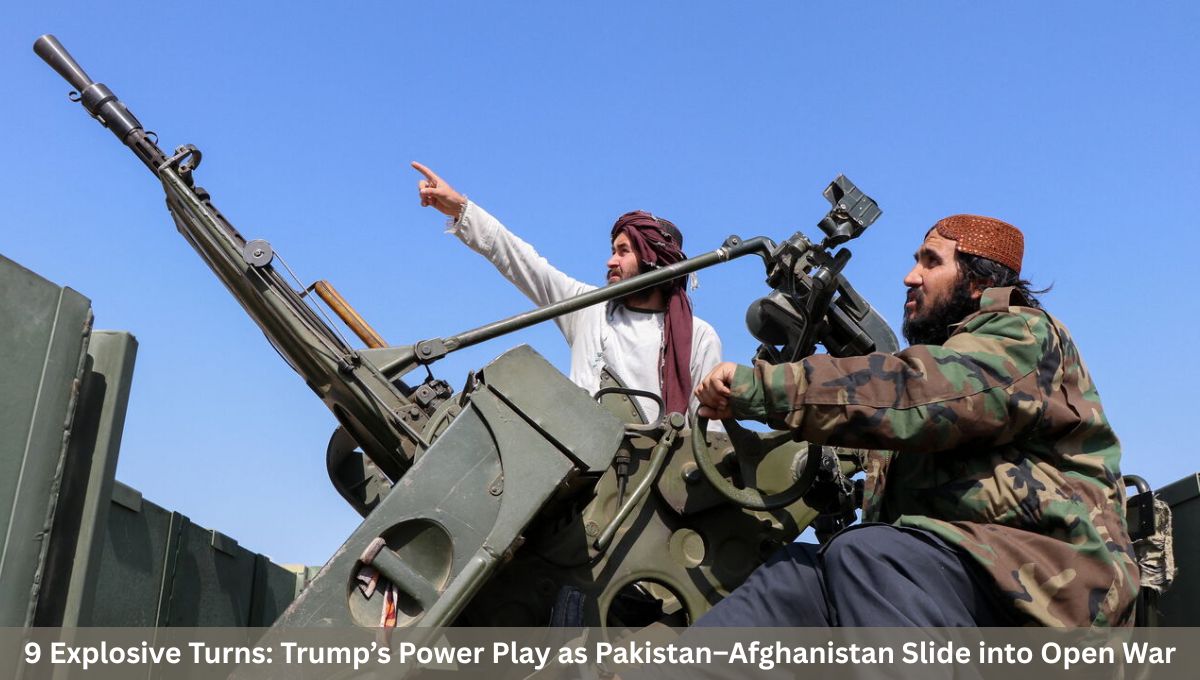
9 Explosive Turns: Trump’s Power Play as Pakistan–Afghanistan Slide into Open War, while global powers urge de-escalation. The fragile fault line between Pakistan and Afghanistan has ruptured once again — but this time with a declaration that has sent shockwaves across South Asia and far beyond.
Pakistan has formally declared “open war” against Taliban-ruled Afghanistan after launching direct airstrikes on Kabul, Kandahar, and multiple provinces, marking the most dramatic escalation since the Taliban returned to power in 2021.
As the two neighbors trade lethal claims and counterclaims, U.S. President Donald Trump has stepped into the spotlight — not as a mediator, but as a cautious power broker signaling support for Islamabad while stopping short of direct intervention.
What follows is a deep dive into how and why the conflict erupted, what makes this escalation uniquely dangerous, and how global powers are responding as fears of regional chaos — and global terror spillover — intensify.
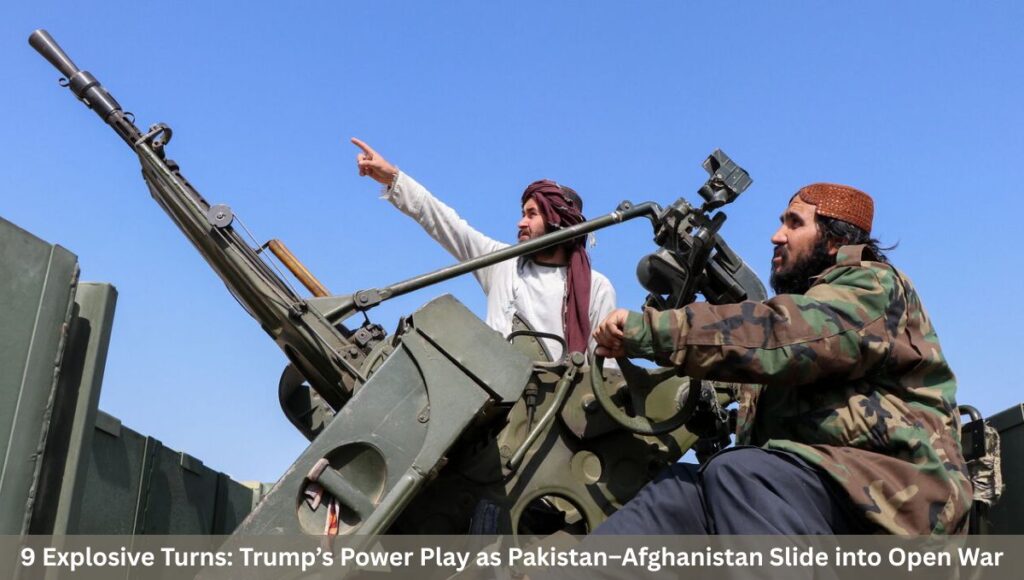
9 Explosive Turns: Trump’s Power Play as Pakistan–Afghanistan Slide into Open War
From Border Skirmishes to Declared War
Pakistan and Afghanistan share more than 2,600 kilometers of rugged, porous frontier, much of it defined by the disputed Durand Line, a colonial-era boundary Kabul has never formally recognized.
Clashes along this border are not new. What is new is the scale, intensity, and political framing of the latest violence.
Late Thursday night, Taliban forces launched rocket and mortar attacks on Pakistani military positions across multiple border districts in Khyber Pakhtunkhwa, triggering panic among civilians and prompting Islamabad to respond with overwhelming force.
By early Friday morning, Pakistan’s military had launched Operation Ghazab lil-Haq (“Righteous Fury”), striking deep inside Afghan territory — including Kabul, Kandahar, and Paktia — for the first time ever against the Taliban government itself.
Hours later, Pakistan’s Defence Minister Khawaja Muhammad Asif declared:
“Our cup of patience has overflowed. Now it is open war between us and you.”
That single sentence transformed a volatile border conflict into a full-scale geopolitical crisis.
Trump’s Calculated Stance: Praise Without Intervention
As the world watched anxiously, attention turned to Washington.
Speaking to reporters, Donald Trump was asked whether the United States would intervene in the spiraling conflict. His response was revealing.
“I would intervene. But I get along with Pakistan very, very well. They have a great Prime Minister, a great General. Two people I really respect a lot. Pakistan is doing terrifically well.”
Trump went out of his way to praise Pakistan’s civilian and military leadership — Prime Minister Shehbaz Sharif and Army Chief Asim Munir — signaling a clear diplomatic tilt toward Islamabad.
While stopping short of military involvement, Trump’s words were widely interpreted as political backing — a message not just to Kabul, but to Beijing, Tehran, Moscow, and New Delhi.
Washington’s Position: Support for Pakistan’s “Right to Defend Itself”
The Trump administration’s position was reinforced by the U.S. State Department.
Allison Hooker, the U.S. Under Secretary of State for Political Affairs, confirmed that Washington supports Pakistan’s right to self-defense against Taliban attacks.
The State Department went further, sharply criticizing the Taliban for failing to uphold counterterrorism commitments, accusing them of allowing Afghanistan to become a launchpad for regional violence.
This matters because, despite Pakistan being a major non-NATO ally, the Taliban remain designated by the U.S. as a terrorist organization — a legal and diplomatic distinction that shapes every American policy decision.
Why Did Fighting Erupt Again? The Core Drivers
1. The TTP Factor
At the heart of Pakistan’s anger lies Tehrik-e-Taliban Pakistan (TTP) — a militant group responsible for hundreds of deadly attacks inside Pakistan.
Islamabad accuses Kabul of harboring and enabling TTP fighters, who allegedly plan cross-border attacks from Afghan soil.
Kabul denies these allegations — but the TTP’s own leadership has publicly urged retaliation against Pakistan following the airstrikes.
2. Post-2021 Blowback
Ironically, Pakistan once served as the Taliban’s most critical backer during the U.S.-led war in Afghanistan. After the Taliban’s return to power in 2021, Islamabad expected cooperation.
Instead, Pakistan experienced a sharp surge in militant violence, with more than 1,200 civilians and soldiers killed in 2025 alone, according to Pakistani military data.
As Pakistan’s defence minister himself admitted in a prior interview, the current crisis represents classic strategic blowback.
Operation Ghazab lil-Haq: A Strategic Shift
Pakistan’s latest response is unprecedented.
Unlike previous limited strikes targeting alleged militant camps, Operation Ghazab lil-Haq directly targeted Taliban government and military infrastructure in major Afghan cities.
Pakistani officials claim:
- Over 270 Taliban fighters killed
- Dozens of military posts destroyed
- Multiple positions captured
The Taliban countered with their own claims:
- 55 Pakistani soldiers killed
- 19 Pakistani posts seized
- Civilians among the dead in Kabul and Kandahar
Independent verification remains impossible, but one fact is undeniable:
this is the deepest military confrontation since 2021.
Voices From Kabul: Fear and Uncertainty
For Afghan civilians, the escalation has been terrifying.
Residents of Kabul described being jolted awake by explosions, jets roaring overhead, and flames lighting the night sky.
Ambulance sirens echoed through neighborhoods as families fled buildings in panic.
With nearly 22 million Afghans dependent on humanitarian aid, the risk of a prolonged conflict threatens to worsen one of the world’s worst humanitarian crises.
Military Balance: Asymmetry With Dangerous Implications
Pakistan’s Strength
According to the International Institute for Strategic Studies:
- ~660,000 active-duty troops
- Nuclear weapons capability
- Modern air force including F-16s, Mirages, and JF-17s
- Advanced missile and drone systems
Taliban’s Edge
The Taliban lack air power — but compensate with:
- Guerrilla warfare expertise
- Suicide bombers and drone tactics
- Deep ideological motivation
- Urban attack capabilities
As analysts warn, Pakistan may dominate the skies — but Taliban retaliation is likely to target cities, not battlefields.
Global Reaction: Calls for Calm Amid Alarm
The international response has been swift:
- United Kingdom: Urged de-escalation
- China: Called for an immediate ceasefire
- Iran: Offered to mediate
- Qatar & Turkey: Quiet diplomatic engagement resumes
- United Nations: Secretary-General António Guterres urged immediate cessation of hostilities
Even Russia, the only country to formally recognize the Taliban government, expressed concern.
Why This Conflict Matters Beyond South Asia
Analysts warn that escalation benefits global terrorist networks.
As regional instability deepens:
- ISIS-K and Al-Qaeda gain operational space
- Refugee flows increase
- Nuclear-armed Pakistan faces urban terrorism risks
- Global security — including U.S. homeland interests — is threatened
As one analyst put it bluntly: “Chaos is what terrorist networks need to flourish.”
Is Diplomacy Still Possible?
Despite the rhetoric, channels remain open.
Taliban spokesman Zabihullah Mujahid reiterated Kabul’s willingness to negotiate, even as bombs fell on Afghan cities.
History suggests flare-ups between Pakistan and Afghanistan often cool after days — not weeks — of fighting. But this time, the psychological and political thresholds crossed are far higher.
Conclusion: A Region on the Edge
Pakistan and Afghanistan are now locked in their most dangerous confrontation in decades — one shaped by history, betrayal, terrorism, and shifting global power dynamics.
Donald Trump’s words signal support without entanglement, but the margin for miscalculation is razor thin.
With nuclear weapons on one side, hardened insurgents on the other, and millions of civilians caught in between, the stakes could not be higher.
Whether this “open war” becomes a brief inferno or a prolonged regional nightmare may depend on what happens next — not what has already happened.
Also Read: 7 Explosive Frontlines: Pakistan Launches Fierce Retaliation After Afghanistan Border Attacks
Also Read: Durand Line Ignites, Why Pakistan And Afghanistan Are Drifting Toward Conflict
Related Posts:
- Pakistan’s Bold Airstrikes in Kabul: Af-Pak Crisis…

- Afghanistan–Pakistan War 2025: Inside the 48-Hour Ceasefire

- Pakistan–Afghanistan Border Conflict 2025: Ceasefire…

- Afghanistan–Pakistan Border Clashes 2025: Key Facts…

- 7 Shocking Details: 13-Year-Old Executes Man Before…

- 7 Alarming Signs of Escalation as Pak-Afghan…