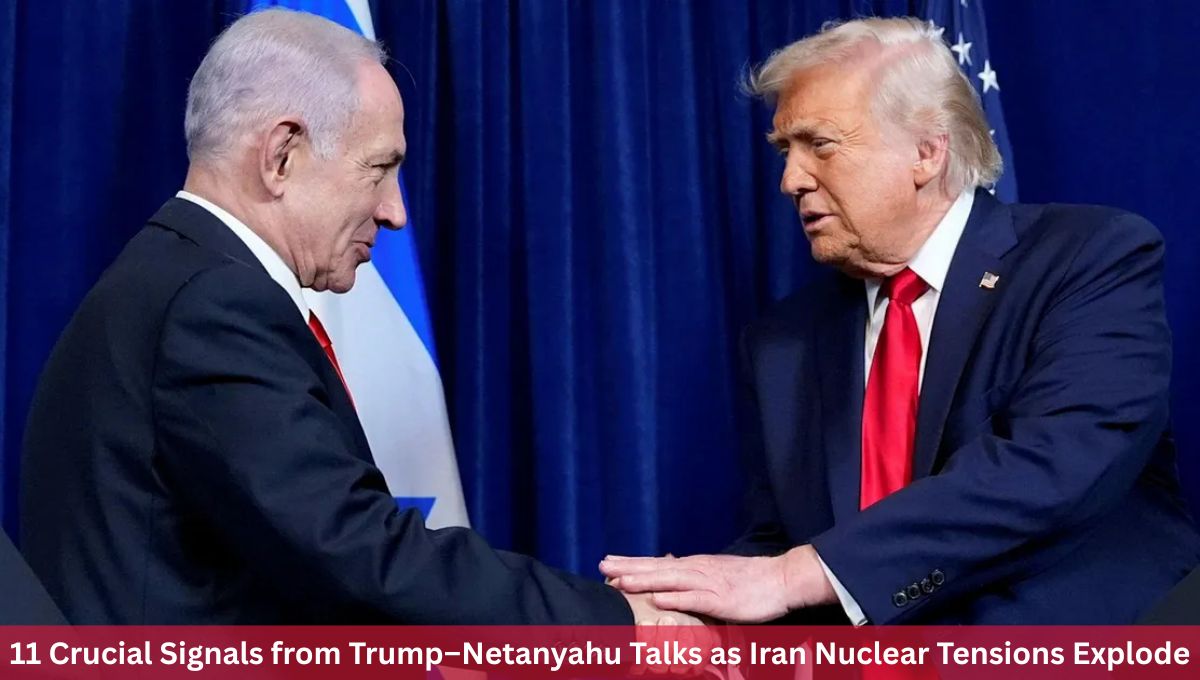
11 Crucial Signals from Trump–Netanyahu Talks as Iran Nuclear Tensions Explode — but US–Iran talks to continue. United States President Donald Trump and Israeli Prime Minister Benjamin Netanyahu emerged from a highly anticipated White House meeting with no definitive agreement on Iran, but with one clear message:
Washington will continue negotiations with Tehran — for now.
The three-hour, closed-door meeting marked the seventh encounter between the two leaders since Trump returned to office, unfolding against a backdrop of US–Iran nuclear talks, military brinkmanship in the Gulf, mounting pressure over Gaza, and fears of a wider Middle East war.
Despite weeks of speculation that Netanyahu would extract firmer US commitments on confronting Iran — particularly on its missile program and regional proxy network — Trump publicly resisted locking himself into Israel’s maximalist demands. Instead, the US president emphasized diplomacy first, warning Tehran of consequences while making clear that a deal remains Washington’s preferred outcome.
This article breaks down what was said, what was avoided, and what it means for the Middle East and global security.
11 Crucial Signals from Trump–Netanyahu Talks as Iran Nuclear Tensions Explode
1. “Nothing Definitive”: Trump Draws a Line on Commitments
Trump’s own words set the tone.
“There was nothing definitive reached other than I insisted that negotiations with Iran continue to see whether or not a Deal can be consummated.”
That single sentence underscored the core outcome of the meeting:
- No joint statement
- No press conference
- No announced red lines
- No public endorsement of Israeli military demands
While Trump described the encounter as a “very good meeting,” his refusal to commit publicly reflects a calculated effort to preserve strategic ambiguity.
For Netanyahu, who arrived in Washington hoping to shape the next round of US–Iran talks, the absence of concrete commitments was telling.
2. Diplomacy Over War — But With a Loaded Warning
Trump made clear that diplomacy is not unconditional.
“If it can [work], that will be a preference. If it cannot, we will just have to see what the outcome will be.”
He reinforced that warning by referencing “Midnight Hammer”, the US military operation that struck Iranian nuclear facilities during the 12-day Israel–Iran war last June.
The message to Tehran was unmistakable:
- Talks are preferred
- Failure carries consequences
- Military options remain on the table
This dual-track approach — negotiations backed by force — mirrors Trump’s broader foreign policy style, designed to pressure adversaries without prematurely closing diplomatic doors.
3. Netanyahu’s Core Demand: Go Beyond the Nuclear File
Netanyahu’s objective going into the meeting was clear: expand the scope of US–Iran diplomacy.
Israel fears Washington may pursue a narrow nuclear deal that:
- Limits uranium enrichment
- Leaves Iran’s ballistic missile program untouched
- Does not curb support for Hamas, Hezbollah, Houthis, or Iraqi militias
Israeli officials have repeatedly warned that such a deal would legitimize Iran’s long-term military threat.
Yet after the meeting, Netanyahu offered no indication that Trump accepted those demands.
His office merely stated:
“The Prime Minister emphasized the security needs of the State of Israel… and the two agreed to continue close coordination and ongoing communication.”
The carefully worded statement reflects alignment on dialogue — not on strategy.
4. Iran’s Red Line: Missiles Are ‘Non-Negotiable’
If Israel is pushing to widen negotiations, Iran is moving in the opposite direction.
Ali Shamkhani, an adviser to Iran’s Supreme Leader, made Tehran’s stance explicit:
“The Islamic Republic’s missile capabilities are non-negotiable.”
Iran has consistently maintained that:
- Its nuclear program is peaceful
- Missile development is defensive
- Regional alliances are sovereign policy
This creates a structural problem for diplomacy.
While Trump has suggested a “good deal” would mean “no nuclear weapons, no missiles”, Iran has ruled out missile talks entirely — a gap that threatens to derail negotiations before they mature.
5. Oman Talks: Fragile Progress, Heavy Expectations
The meeting came days after indirect US–Iran nuclear talks in Oman, the first since last year’s war.
Both sides described the discussions as:
- “Positive”
- “Constructive”
- Worth continuing
But beneath the cautious optimism lies deep mistrust.
Iran insists on:
- Sanctions relief
- Retaining domestic uranium enrichment
- No linkage to missiles or proxies
The US, meanwhile, has sent mixed signals — endorsing diplomacy while deploying major military assets to the region.
6. The Military Shadow: Carriers, Jets, and Pressure
Even as talks continue, Washington is escalating its military posture.
Trump confirmed he is considering:
- Deploying a second aircraft carrier strike group
- Expanding naval and air assets near Iran
The Pentagon has already:
- Moved the USS Abraham Lincoln
- Reinforced regional air defenses
- Positioned warships capable of striking Iranian targets
This buildup serves multiple purposes:
- Deterrence against Iranian escalation
- Leverage at the negotiating table
- Reassurance to Israel and Gulf allies
But it also raises the risk of miscalculation.
7. Gaza on the Agenda — But No Breakthrough
Iran was not the only issue discussed.
Trump said he and Netanyahu talked about:
“The tremendous progress being made in Gaza, and the Region in general.”
Yet on the ground, progress remains fragile.
Trump’s 20-point Gaza ceasefire plan, adopted last October, has stalled over:
- Hamas disarmament
- Phased Israeli troop withdrawals
- Governance of post-war Gaza
Netanyahu’s far-right coalition has resisted concessions, while Trump faces pressure to keep the ceasefire alive amid rising civilian casualties.
8. Quiet Tensions Over Palestinian Statehood
Another point of divergence lurks beneath the surface.
Trump has floated the idea that his Gaza plan could eventually open a pathway to Palestinian statehood — a position Netanyahu’s government firmly rejects.
Recent Israeli cabinet decisions to:
- Expand settlement land purchases
- Grant broader control in the occupied West Bank
have drawn international condemnation.
Trump reiterated his opposition to annexation, saying:
“We don’t need to be dealing with the West Bank.”
This signals a subtle but significant rift between the two leaders on the future of the Palestinian territories.
9. The Muted Optics: Why This Meeting Looked Different
Veteran observers noticed something unusual:
- No Oval Office press pool
- No joint remarks
- Netanyahu entered via a side entrance
The low-profile nature of the visit contrasts sharply with previous Trump–Netanyahu meetings, often marked by public displays of unity.
Possible explanations include:
- Sensitivity of Iran negotiations
- Desire to avoid signaling divisions
- Political caution on both sides
Whatever the reason, the optics reinforced the sense that this was a working meeting — not a victory lap.
10. Vice President Vance: No Regime Change — For Now
US Vice President JD Vance sought to clarify Washington’s position.
Asked about regime change in Iran, he said:
“If the Iranian people want to overthrow the regime, that’s up to them.”
The administration’s stated priority remains:
- Preventing Iran from obtaining nuclear weapons
Yet Trump’s past remarks encouraging Iranian protesters, and reports of strike planning, suggest policy debates are still active inside Washington.
11. What This Means for the World
This meeting matters far beyond Washington and Jerusalem.
For the Middle East
- A deal could delay another regional war
- Failure could trigger strikes, retaliation, and escalation
For Global Security
- Iran’s nuclear status affects nonproliferation norms
- Energy markets remain vulnerable to conflict
- Shipping lanes in the Gulf face renewed risk
For Diplomacy
- Trump is testing whether pressure-backed talks can succeed
- Netanyahu is signaling Israel will preserve freedom of action
- Iran is betting the US will blink first
Conclusion: A Pause, Not a Resolution
The Trump–Netanyahu meeting delivered no definitive deal, but it clarified the current moment:
- Diplomacy is still alive
- Military force remains an option
- Israel and the US are aligned — but not identical
- Iran is under pressure but defiant
For now, talks continue, carrier groups move, and the Middle East waits.
Whether this path leads to a breakthrough — or another confrontation — depends on choices yet to be made in Tehran, Washington, and Jerusalem.
Also Read: 7 Explosive Signals: Netanyahu’s Stark Iran Warning as US Forces Mass
Also Read: Trump says no ‘definitive’ agreement with Netanyahu, US talks with Iran to continue
Related Posts:
- 11 Explosive Warnings as Trump Vows to ‘Knock the…

- Trump’s 2025 Gaza Peace Plan Signing and Historic…

- 5 Powerful Highlights as Trump Lands Second Nobel…

- Trump’s Historic Gaza Ceasefire Deal 2025 - Powerful…

- 9 Explosive Revelations as Trump Declares His Health…

- Trump’s 20-Point Gaza Peace Plan Gains Urgent Global…
