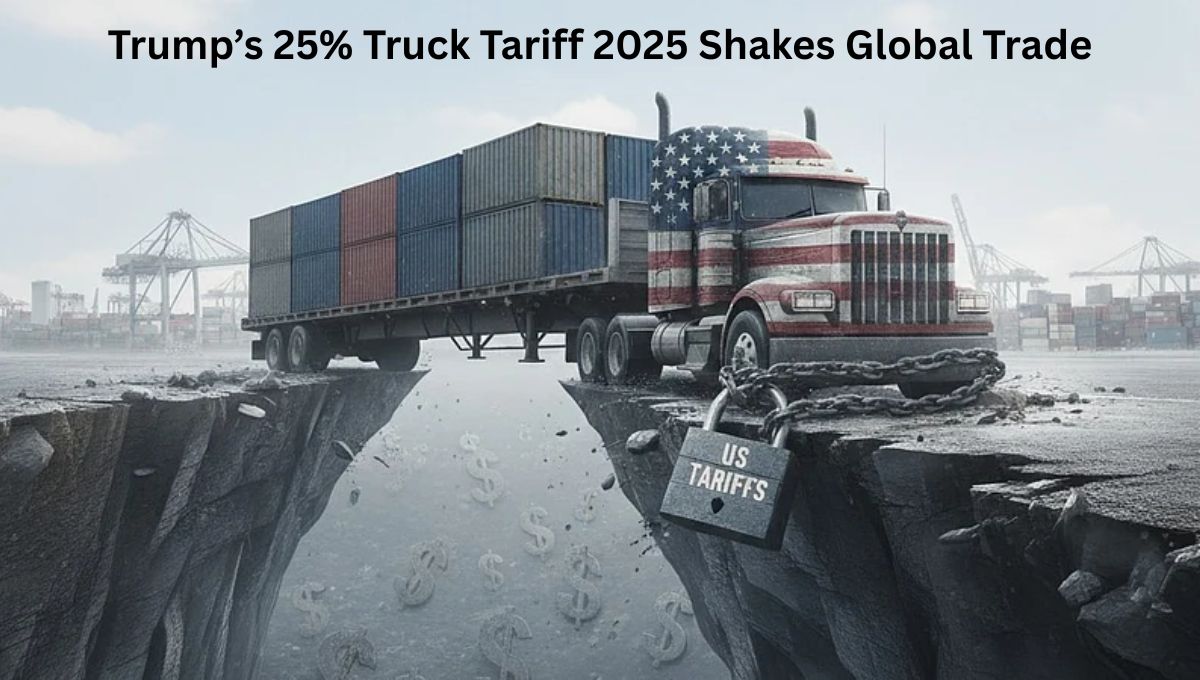
Trump’s 25% Truck Tariff 2025 Shakes Global Trade, disrupts automakers and supply chains. US President Donald Trump announced on Monday that all medium- and heavy-duty trucks imported into the United States will face a 25% tariff starting November 1, 2025. The move marks a significant escalation in the administration’s ongoing efforts to protect domestic manufacturers from foreign competition. Trump stated that the new tariffs are intended to support American truck manufacturers and address what he calls “unfair outside competition.”
Trump’s 25% Truck Tariff 2025 Shakes Global Trade
Trump’s Trade Protectionism Escalates
Trump has made trade protectionism a cornerstone of his economic agenda. In a Truth Social post, he wrote:
“Beginning November 1st, 2025, all Medium and Heavy Duty Trucks coming into the United States from other Countries will be Tariffed at the Rate of 25%. Thank you for your attention to this matter.”
The president had previously indicated that similar tariffs would take effect from October 1, citing national security concerns. He highlighted that domestic truck companies, such as Paccar-owned Peterbilt and Kenworth, as well as Daimler Truck’s Freightliner, would benefit from the measure.
Scope of the Tariff
The 25% tariff covers a broad range of medium and heavy-duty vehicles, including:
- Delivery trucks
- Garbage trucks
- Public utility trucks
- Transit and shuttle buses
- School buses
- Semi-trucks and vocational heavy-duty vehicles
According to S&P Global, medium- and heavy-duty trucks represent about 5% of the US automotive market, with the US accounting for roughly 80% of North American demand for such vehicles.
In the US, medium-duty trucks typically weigh 14,000-33,000 pounds, while heavy-duty trucks are over 33,000 pounds, primarily serving logistics, construction, and waste management.
Also Read: Trump announces 25% tariff on all imported medium and heavy-duty trucks starting November 1, 2025
Global Impact and Key Trade Partners
European and North American Suppliers
The tariff is expected to hit European automakers most directly, many of whom are key suppliers of commercial vehicles to the US market. Analysts warn the move could disrupt global supply chains and increase prices for American consumers.
Mexico, the largest exporter of medium- and heavy-duty trucks to the US, shipped around 340,000 units in 2024, with a combined value of $15.6 billion, according to the US Department of Commerce. Canada exported roughly $4.5 billion worth of trucks.
The US-Mexico-Canada Agreement (USMCA) allows medium- and heavy-duty trucks to move tariff-free if 64% of a truck’s value originates in North America. It remains unclear whether this new tariff will respect that provision.
Impact on Automakers
- Stellantis, which produces Ram trucks in Mexico, may face higher costs and has reportedly lobbied the White House to avoid tariffs.
- Volvo Group is investing $700 million in a new heavy-truck factory in Monterrey, Mexico, scheduled to start production in 2026.
- Other impacted manufacturers include Navistar, Daimler, and Tesla, particularly in the electric truck sector.
Industry experts note that automakers may localize final assembly to circumvent tariffs, potentially boosting domestic production and encouraging investment in North America.
India’s Position
India is largely unaffected directly because it does not export trucks to the US. However, the country has already faced tariffs of up to 50% on goods such as steel, aluminum, and electronics under previous Trump trade measures.
India’s auto component exports to the US totaled $6.79 billion in 2023-24. Analysts estimate that 15-20% of these exports could be indirectly affected by the automotive sector tariffs, especially for components used in trucks and commercial vehicles.
Pricing Implications
According to Automotive Manufacturing Solutions, the 25% tariff on Class 8 trucks could push prices from $170,000 to $212,500 before additional federal taxes. This represents a significant increase for logistics companies and fleet operators.
OEMs operating in Canada and Mexico are expected to adjust production strategies, potentially shifting assembly to the US to minimize costs.
Trade Agreement Considerations
Existing agreements currently impose 15% tariffs on light-duty vehicles from countries like Japan and members of the EU. The new heavy truck tariffs create uncertainty regarding:
- Exemptions for USMCA-compliant vehicles
- Tariff treatment for trucks assembled outside North America
- Future trade negotiations and potential retaliatory measures
Analysts Neil Shearing and Stephen Brown of Capital Economics note:
“If there’s no USMCA exemption, then Mexico will be most heavily affected by the large truck tariffs.”
National Security and Legal Ground
Trump’s sector-specific tariffs are viewed as being on firmer legal ground, particularly compared to broader tariffs imposed under emergency economic powers. Previous broad tariffs have faced legal challenges, with the US Supreme Court scheduled to hear arguments in November 2025.
The truck tariffs, along with additional duties on softwood timber, kitchen cabinets, and wood products, reflect a targeted strategy that allows the administration flexibility while avoiding some legal obstacles.
Broader Trade Strategy
This move is part of Trump’s industry-specific tariff strategy, which includes:
- 100% tariffs on patented drugs
- 25% levies on heavy-duty trucks
- Duties on lumber and furniture products, starting October 14, with some increases in January 2026
The administration’s approach signals a continued focus on protecting US industries while navigating trade deal obligations and potential legal scrutiny.
Market Reactions
Industry analysts warn that the tariffs could:
- Disrupt supply chains for global automakers
- Increase prices for consumers
- Encourage local production and assembly in North America
- Impact electric truck adoption, as companies like Tesla benefit from localized assembly
The commercial vehicle market may see shifts in investment, production locations, and pricing, potentially altering the competitive landscape in North America and globally.
Summary
President Trump’s announcement of a 25% tariff on medium- and heavy-duty truck imports starting November 1, 2025 is a major escalation in US trade policy.
The tariff is aimed at protecting domestic manufacturers, especially in the heavy-duty and commercial truck segments, while potentially impacting global supply chains and international trade partners, including Mexico, Canada, and European automakers.
The move comes amid a broader tariff strategy targeting multiple industries, reflecting the administration’s focus on trade protectionism and national security concerns. While India is largely shielded from the direct impact, the global automotive component market could experience indirect effects.
As the tariffs take effect, manufacturers and governments alike will closely watch pricing, production adjustments, and supply chain adaptations, shaping the future of the US and North American trucking industry.
Also Read: Trump Urges EU to Slap 100% Tariffs on China and India to Pressure Russia Amid Ukraine War
Related Posts:
- Trump’s 2025 Gaza Peace Plan Signing and Historic…

- What’s Next for Donald Trump After Court Rules His…

- Tariff After Tariff: Donald Trump Imposes 100%…

- 5 Powerful Highlights as Trump Lands Second Nobel…

- Trump’s 2025 Tariffs: Shocking Impacts on Global Peace

- Can the EU and NATO Impose Tariffs on India and…
