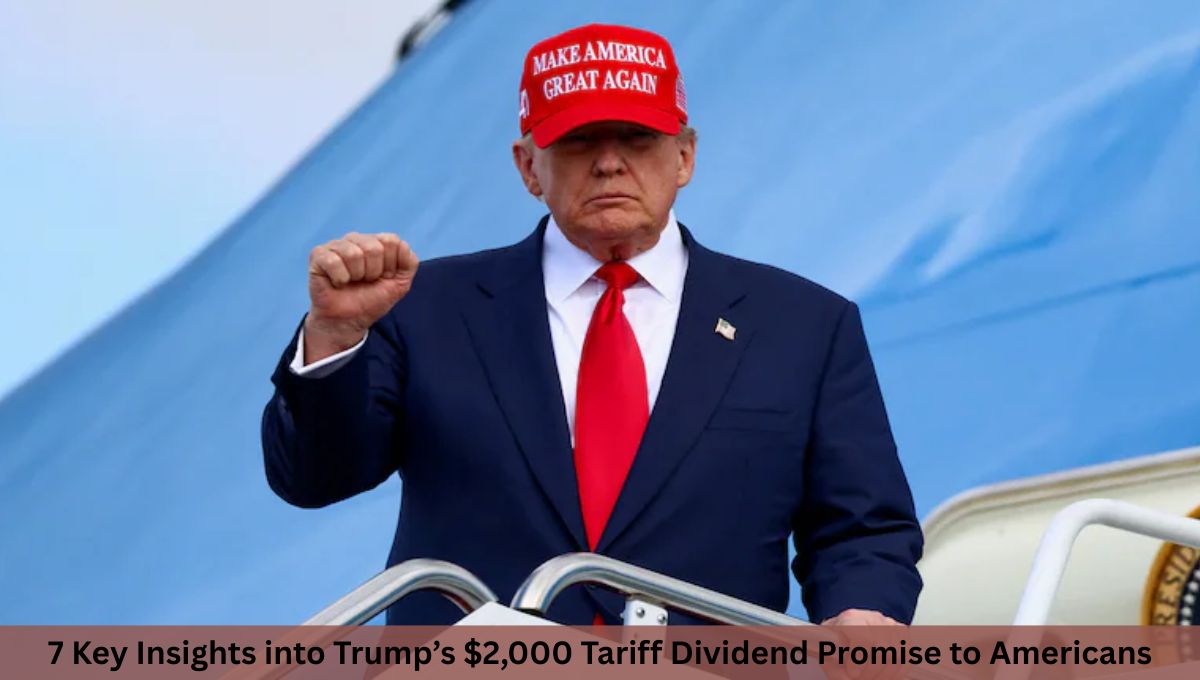
7 Key Insights into Trump’s $2,000 Tariff Dividend Promise to Americans — funded by tariff revenues. US President Donald Trump has announced that most Americans—excluding high-income earners—could soon receive a $2,000 “tariff dividend” funded by revenue from his administration’s sweeping trade duties. The declaration, made on Truth Social, comes as the Supreme Court weighs the legality of Trump’s aggressive tariff strategy, a signature element of his economic agenda.
The proposal has sparked widespread interest and debate across Washington, with questions arising about how the payments would work, who would qualify, and whether such a plan would require congressional approval.
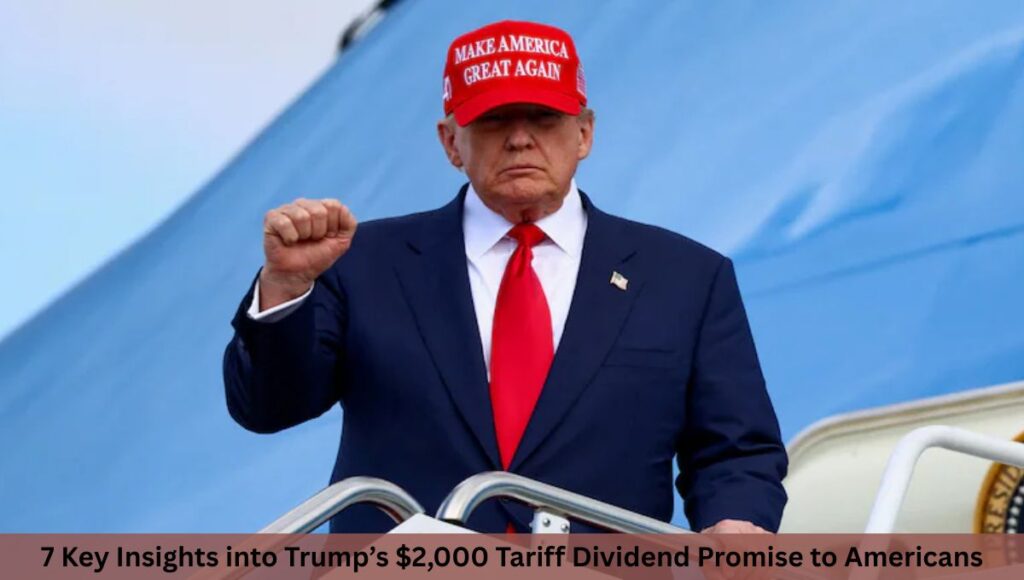
7 Key Insights into Trump’s $2,000 Tariff Dividend Promise to Americans
Trump’s Announcement on Truth Social
In a series of posts on his social media platform, Truth Social, President Trump defended his tariff policy while unveiling his latest pledge to American households.
“People that are against Tariffs are FOOLS!” Trump wrote. “We are now the Richest, Most Respected Country in the World, with Almost No Inflation, and a Record Stock Market Price. 401k’s are Highest EVER.”
He added that “a dividend of at least $2,000 a person (not including high-income people!) will be paid to everyone.”
Trump claimed that the United States is now collecting “trillions of dollars” from tariffs and that the funds will not only be used to pay down the $37 trillion national debt but also reward Americans directly.
“We will soon begin paying down our enormous debt,” he wrote. “Record investment in the USA, plants and factories going up all over the place.”
The president did not, however, provide details on the timeline or mechanism for distributing the payments.
Bessent: Tariff Dividend May Come Through Tax Cuts
Following Trump’s post, Treasury Secretary Scott Bessent addressed the proposal during an interview on ABC’s “This Week.” Bessent said he had not discussed the idea directly with the president but noted that the “$2,000 dividend” could take different forms—including as part of tax cuts that were already enacted earlier this year.
“The $2,000 dividend could come in lots of forms, in lots of ways,” Bessent said. “It could be just the tax decreases that we are seeing on the president’s agenda — no tax on tips, no tax on overtime, no tax on Social Security, deductibility on auto loans.”
He pointed out that these measures were included in Trump’s “Big Beautiful Bill,” an economic package passed in July that eliminated certain taxes and deductions for middle-income workers.
Bessent suggested that these tax reductions could effectively serve as a “tariff dividend,” fulfilling the president’s pledge without direct government checks.
What Is the $2,000 Tariff Dividend?
Trump’s proposal refers to a cash or tax-based benefit funded by the revenue collected through tariffs on imports. The administration has argued that the United States is earning “trillions of dollars” in new revenue due to these duties, which have been imposed on a wide range of countries and goods.
Under this plan, the money would be redistributed to ordinary Americans in the form of a one-time $2,000 payment or tax relief, while excluding high-income earners.
The president has framed the dividend as a reward to taxpayers who have supported his trade policy, portraying tariffs as both a source of national revenue and a tool for economic fairness.
Supreme Court Scrutiny: Tariffs Under Legal Challenge
Trump’s statement comes at a tense time for his economic policy. On November 5, the US Supreme Court heard oral arguments in two consolidated cases challenging the legality of his tariffs.
The lawsuits, brought by small businesses and several states, argue that Trump exceeded his presidential authority under the International Emergency Economic Powers Act (IEEPA)—a 1970s law that allows limited executive trade action during national emergencies.
During the three-hour hearing, several justices expressed skepticism that the law grants Trump “near-limitless power” to impose and adjust import duties.
Chief Justice John Roberts questioned whether tariff revenue should be viewed as a form of taxation, which constitutionally falls under Congress’s authority.
If the Court rules against Trump, the decision could trigger refunds exceeding $100 billion to importers and potentially undermine the president’s plan to use tariff income for domestic dividends.
Trump’s ‘Liberation Day’ Tariffs
Central to the legal challenge are Trump’s “Liberation Day” tariffs, announced on April 2, which imposed levies ranging from 10% to 50% on most US imports.
Trump has defended the policy as a bold move to correct the longstanding trade deficit, arguing that tariffs are necessary to rebuild American industry and strengthen economic independence.
“These duties are justified to rebalance trade and make it more fair,” Trump said earlier this year, adding that tariffs had attracted “record investment” and encouraged manufacturing growth in the United States.
The administration has maintained that the tariffs are not intended to raise revenue, but rather to safeguard national security—a key point in the government’s argument before the Supreme Court.
Who Would Be Eligible for the $2,000 Tariff Dividend?
While Trump has said that “high-income people” will be excluded, he has not specified the exact income thresholds.
If the White House adopts criteria similar to earlier federal stimulus programs, Americans earning below $75,000 annually (single) or $150,000 jointly (married) could potentially qualify for full benefits.
During the Covid-19 pandemic, similar thresholds determined eligibility for the $1,400 IRS stimulus checks, which were phased out for higher earners.
The lack of clear guidance from the administration has fueled speculation that the “tariff dividend” may not be a direct payout, but rather a policy rebranding of recent tax cuts and deduction allowances.
No Confirmation on Timing or Implementation
As of now, there is no official confirmation regarding when or how the proposed dividend will reach Americans.
Neither the Treasury Department nor the White House has issued detailed implementation plans, and no legislation has been introduced in Congress to authorize direct cash transfers.
Experts say that if the dividend requires new spending or redistribution of federal funds, it would likely need congressional approval, making near-term payouts unlikely.
A senior White House official, quoted by Bloomberg, said:
“The Administration is committed to putting this money to good use for the American people. The tariffs have strengthened our economy and created opportunities to invest in debt reduction and tax relief.”
Public Reaction and Economic Context
Trump’s proposal comes amid mixed public sentiment on tariffs. While supporters see them as a tool for economic nationalism, critics argue that tariffs raise consumer costs and strain international trade relations.
According to the Yale Budget Lab, as of mid-October, the average effective US tariff rate had reached 18%—the highest since 1934. Economists say that while tariffs have boosted government revenue, businesses often pass the costs on to consumers through higher prices.
Nonetheless, Trump insists that tariffs have not fueled inflation and instead have revitalized domestic manufacturing. His administration attributes the modest inflation rate to fiscal discipline and increased production capacity.
Bessent’s Fiscal Strategy: Paying Down Debt
Scott Bessent, who has consistently backed Trump’s fiscal agenda, said in August that the administration’s priority is to use tariff revenue to pay down national debt, which recently exceeded $38 trillion.
“The real goal of tariffs is to rebalance trade and make it more fair,” Bessent reiterated on ABC, echoing Trump’s argument that tariffs are a means to restore trade equilibrium rather than a revenue-raising tool.
He also credited tariffs with creating “a more level playing field” for American workers, citing new investments in automotive and manufacturing plants across the Midwest.
Political Implications and Legal Uncertainty
Politically, the $2,000 tariff dividend serves both as an economic message and a campaign symbol. Analysts say the proposal highlights Trump’s effort to position himself as the champion of middle-class households, directly connecting his trade policy to personal financial gains for Americans.
However, the timing of the announcement—just days after the Supreme Court’s skeptical hearing—has led to questions about whether the plan was intended to shore up public support amid legal challenges to his trade authority.
If the Court strikes down major portions of the tariff regime, it could jeopardize the revenue stream Trump intends to use for the dividend, complicating any future payout plans.
Comparison with Past Economic Relief Programs
This is not the first time a US president has considered direct payments to citizens tied to economic policy.
During the Covid-19 pandemic, Trump’s administration approved stimulus checks to support households amid lockdowns. Those payments, however, were authorized by Congress through formal legislation.
Unlike stimulus packages, the proposed tariff dividend is not yet supported by a legislative framework, and without congressional consent, it may remain a symbolic pledge rather than an immediate benefit.
What Happens Next
In the coming weeks, all eyes will remain on the Supreme Court, which is expected to rule on the tariff authority case before the end of the year.
A ruling against the administration could limit Trump’s power to impose unilateral tariffs and disrupt the flow of tariff-based revenues that underpins the proposed dividend.
If upheld, however, the decision could strengthen Trump’s control over trade policy and give his administration the flexibility to implement economic incentives such as the $2,000 tariff dividend.
For now, the proposal remains conceptual, pending legal clarity and administrative planning.
Conclusion
President Donald Trump’s announcement of a $2,000 tariff dividend has reignited debate over the economic impact and legality of his trade policies.
While the promise resonates with millions of Americans looking for tangible benefits, experts caution that no payment mechanism has been confirmed, and the policy’s future hinges on the Supreme Court’s ruling.
As Trump continues to defend his tariff agenda, Treasury Secretary Scott Bessent’s comments suggest that the dividend may materialize indirectly—through tax relief rather than direct cash transfers.
Whether Americans will soon receive a $2,000 check—or simply a lighter tax burden—will depend on how the administration translates the president’s rhetoric into actionable fiscal policy.
Also Read: Trump floats $2,000 tariff rebate checks. What you need to know
Also Read: Trump Stands Firm on Tariff Plans Amid Market Meltdown: “Sometimes You Have to Take Medicine”