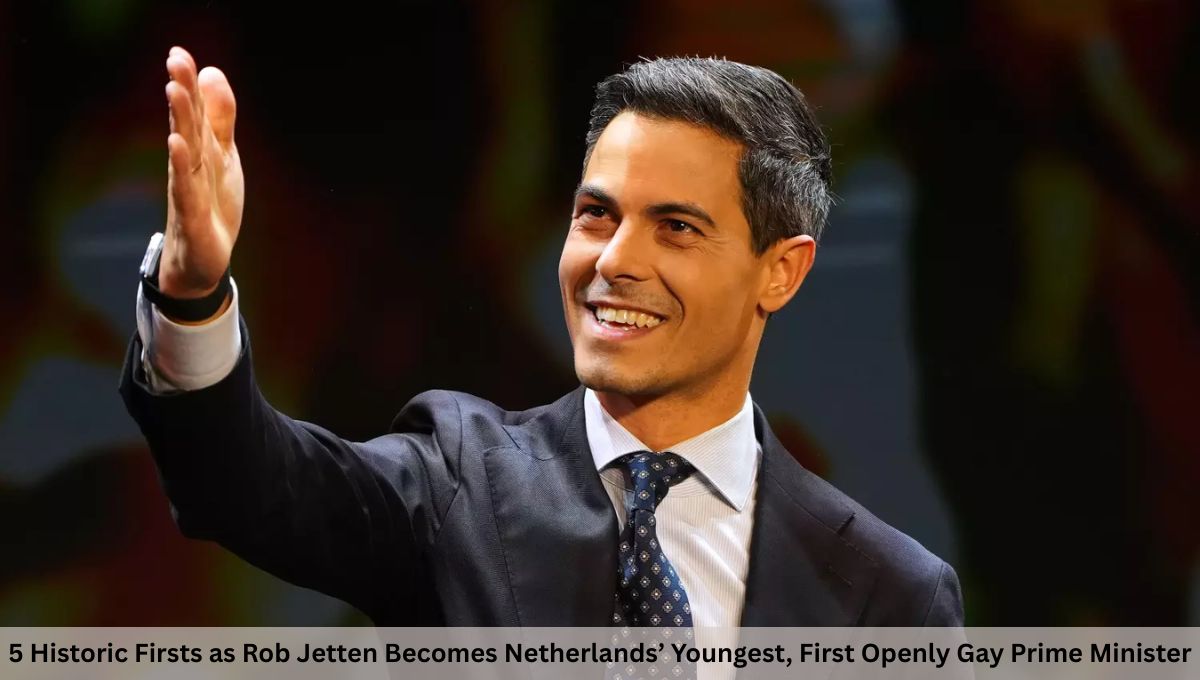
5 Historic Firsts as Rob Jetten Becomes Netherlands’ Youngest, First Openly Gay Prime Minister after defeating far-right rival Geert Wilders. The Netherlands has elected Rob Jetten, the 38-year-old leader of the centrist-liberal D66 party, as its new prime minister, marking a historic political moment for Europe. Jetten’s projected victory follows a fiercely contested national election against far-right rival Geert Wilders, who had campaigned on an anti-immigration platform and once called for banning the Quran.
If confirmed, Jetten will not only become the youngest Dutch prime minister in history, but also the first openly gay leader to head the government — a landmark for a country that was the first in the world to legalise same-sex marriage in 2001.
“A historic result for D66 and for our democracy,” Jetten told reporters in The Hague. “We’ve shown the world that populism can be defeated when you campaign with optimism and integrity.”
5 Historic Firsts as Rob Jetten Becomes Netherlands’ Youngest, First Openly Gay Prime Minister
Background: A Nation Divided but Seeking Stability
The Netherlands went to the polls on 29 October, in what became one of the tightest races in decades. Jetten’s D66 and Wilders’ Freedom Party (PVV) each secured around 26 of the 150 parliamentary seats, but projections by Dutch news agency ANP and public broadcaster NOS showed D66 pulling ahead by a small but decisive margin of 15,000 votes.
According to the Dutch Electoral Council, official results will be confirmed once mail-in ballots from Dutch citizens abroad are counted — a process expected to conclude on 3 November. Historically, overseas voters have leaned towards centrist and liberal parties, which could further consolidate Jetten’s lead.
Political scientist Dr. Sarah de Lange of the University of Amsterdam said,
“This election underlines a stabilising shift in Dutch politics. The far right remains influential, but voters appear to have opted for responsible centrism rather than ideological extremes.”
1. A Decisive Victory for the Centre
Campaign Strategy
Jetten’s campaign stood out for its positive, policy-driven messaging, contrasting sharply with Wilders’ confrontational rhetoric. His slogan, “Yes, We Can”, borrowed from Barack Obama’s 2008 campaign, was adapted to reflect confidence in collective national progress.
Despite being a relatively young leader with limited executive experience, Jetten’s disciplined debate performances and calm persona helped position him as a credible alternative to the far right.
Expert Analysis
According to Leiden University political analyst Cas Mudde,
“Jetten’s win is significant not because the far right collapsed — it didn’t — but because the liberal centre regained moral legitimacy. That matters across Europe, where populists have framed moderation as weakness.”
2. Challenges Ahead: Coalition Building and Governance
Complex Coalition Arithmetic
The Netherlands operates under a proportional representation system, meaning no single party ever secures an outright majority. To form a government, Jetten must now negotiate a coalition controlling at least 76 seats in the 150-member parliament.
D66’s most likely partners include:
- VVD (centre-right liberals) – 22 seats
- Green/Labour alliance (PvdA–GroenLinks) – 20 seats
- Christian Democrats (CDA) – 18 seats
However, relations among these potential allies are tense. VVD leader Dilan Yesilgöz has ruled out cooperation with the left, while Labour-Green’s leadership transition could further complicate negotiations.
Policy Priorities
Jetten has vowed to focus on housing, climate, and immigration reform — issues dominating the Dutch political landscape. The country faces a chronic housing shortage, high energy prices, and growing public concern about asylum seekers.
Outgoing Prime Minister Dick Schoof, who replaced Wilders earlier this year after his coalition collapsed, cautioned that coalition talks could take “months, not weeks”.
“Forming a stable centrist government in the Netherlands is like solving a Rubik’s cube,” Schoof told NOS. “Everyone agrees on the colours but not on the order.”
3. Rebuffing Populism: What Jetten’s Win Means for Europe
Across Europe, centrist parties have struggled to counter the populist wave. From Italy’s Giorgia Meloni to France’s Marine Le Pen, right-wing movements have capitalised on discontent over immigration and cost-of-living crises.
In this context, Jetten’s victory is symbolically powerful. Analysts see it as a case study in how liberal centrism can regain momentum through authenticity and inclusivity.
Chatham House fellow Dr. Hans Bevers commented,
“Jetten didn’t win by attacking Wilders — he won by refusing to play his game. That’s a valuable lesson for moderate politicians across Europe.”
The European Commission welcomed the preliminary results as a “vote of confidence in European values”. EU Council President Charles Michel privately congratulated Jetten, according to diplomatic sources quoted by Euractiv.
4. A Personal Milestone: First Openly Gay Prime Minister
Symbol of Progress
The Netherlands, long seen as a pioneer of LGBTQ+ rights, will now have its first openly gay prime minister. Jetten has been open about his sexuality throughout his career, often advocating inclusivity in sport and politics.
He is engaged to Nico Keenan, a two-time Olympian in field hockey for Argentina who now plays for the Hockey Club Klein Zwitserland in The Hague. The couple announced their engagement in 2024 and plan to marry next year.
During election night, Keenan posted a TikTok video captioned “Election night, let’s go”, showing the couple smiling and embracing — an image that resonated widely on Dutch social media.
Representation and Impact
Social researcher Prof. Ineke van der Valk from Utrecht University noted,
“For a country that legalised same-sex marriage over two decades ago, it’s extraordinary that it took this long for an openly gay leader to emerge. Representation at the highest level reinforces inclusion far beyond politics.”
5. The Narrow Margin and Wilders’ Response
The election’s final margin remains razor-thin, with both parties projected at 26 or 27 seats. Wilders has accused D66 of prematurely claiming victory, saying, “It’s the Electoral Council that decides, not ANP. How arrogant not to wait.”
Despite his frustration, most Dutch observers agree that Wilders’ Freedom Party (PVV) underperformed expectations after internal divisions and a backlash over his inflammatory remarks about Islam and immigration.
Political commentator Jeroen van der Veer wrote in NRC Handelsblad,
“This was less a rejection of the far right than a fatigue with its rhetoric. Dutch voters wanted policy solutions, not culture wars.”
Wilders has vowed to lead a “strong opposition”, warning against “left-liberal mismanagement”, but experts say his influence may wane if D66 succeeds in forging a cross-party coalition.
6. The Economic and Policy Agenda
Domestic Reforms
Jetten inherits a country grappling with rising housing costs, energy insecurity, and labour shortages. His policy agenda focuses on pragmatic economic management rather than ideological experimentation.
He has pledged to:
- Expand affordable housing
- Accelerate renewable energy adoption
- Maintain fiscal discipline while investing in green industries
Analysts at ING Economics project that a D66-led coalition would pursue “moderate but sustained” fiscal expansion, boosting infrastructure spending without breaching EU deficit rules.
Foreign Policy Outlook
Internationally, Jetten is expected to maintain the Netherlands’ strong pro-EU and NATO-aligned stance, while advocating for “values-based diplomacy”. He has called China a “strategic competitor” and expressed support for Ukraine against Russian aggression.
“We cannot build walls against globalisation, but we can defend liberal democracy within it,” Jetten said in his victory speech.
7. A Generational Shift in Dutch Politics
At 38, Jetten symbolises a new generation of leadership — pragmatic, digitally fluent, and socially liberal. He first entered parliament at age 30 and became D66 leader a year later.
Born in Uden to a family of teachers, Jetten studied public administration at Radboud University. Before politics, he was an athlete who once ran as a pacemaker for Olympic champion Sifan Hassan.
Dutch historian Dr. Mathieu Segers observes,
“Jetten represents a post-ideological generation — one less defined by left-right binaries, more by competence and communication.”
His approach contrasts sharply with the populist firebrands of recent years, signalling a return to technocratic governance with emotional intelligence.
The Road Ahead
Despite his historic win, Jetten faces formidable challenges. Coalition talks will likely drag into winter, with major policy compromises required to form a stable majority. Outgoing PM Schoof predicts he will “still be in office by Christmas”, highlighting how Dutch coalition-building can take months — the last government took 225 days to form.
European observers, however, are cautiously optimistic. Jetten’s victory, they say, could reinvigorate faith in pragmatic centrism across the continent. As The Economist noted in a recent editorial, “Rob Jetten’s success offers a counter-narrative to Europe’s populist surge. It suggests that voters still reward competence, decency, and optimism when given a credible choice.”
For now, as ballots from abroad are finalised and negotiations begin, the Netherlands stands at a symbolic crossroads — between populist grievance and liberal renewal. If Jetten succeeds in translating his message of unity into effective governance, his tenure could mark not only a historic first for representation, but also a revival of Europe’s centrist spirit.
Also Read: 5 Striking Moments as Trump Hosts Halloween Bash Amid Historic Shutdown
Also Read: Meet Rob Jetten: The liberal leader poised to become Netherlands’ youngest and first openly gay PM
Related Posts:
- 11 Defining Challenges Facing NYC’s Youngest Mayor…

- Sanae Takaichi Becomes Japan’s First Female Prime…

- 5 Key Takeaways as Zohran Mamdani Wins Historic New…

- 12 Explosive Shifts as Japan’s Iron Lady Takaichi…

- Thailand Political Shake-Up: Paetongtarn Shinawatra…
- Shigeru Ishiba Resigns as Japan’s Prime Minister…