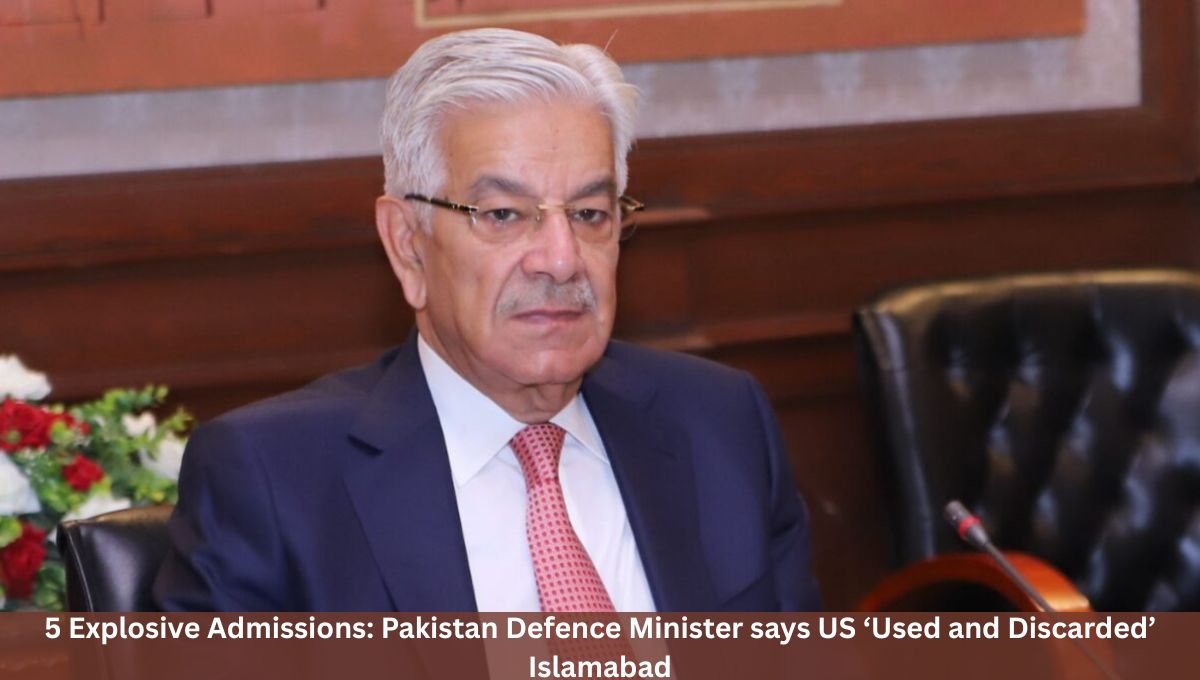
5 Explosive Admissions: Pakistan Defence Minister Says US ‘Used and Discarded’ Islamabad, calls past alliances irreversible mistakes. Pakistan’s Defence Minister Khawaja Asif has made one of the most candid and controversial acknowledgements in the country’s recent political history, accusing the United States of exploiting Pakistan for its strategic wars and then abandoning it once its objectives were achieved.
Speaking on the floor of Pakistan’s National Assembly, Asif said Islamabad was treated “worse than toilet paper”—used for a purpose and then thrown away—after aligning with Washington in two major conflicts in Afghanistan.
The remarks mark a striking departure from decades of official narratives that justified Pakistan’s involvement in regional wars as unavoidable, religiously motivated, or strategically necessary. Instead, Asif framed those decisions as grave miscalculations that inflicted irreversible damage on Pakistan’s security, economy, and social fabric.
From the misuse of jihad as a mobilising slogan to the long-term consequences of the US-led war on terror, the defence minister’s statements amount to a rare public reckoning by a senior figure within Pakistan’s ruling establishment.
5 Explosive Admissions: Pakistan Defence Minister says US ‘Used and Discarded’ Islamabad
A Rare Confession in Pakistan’s Parliament
Asif’s comments stand out not only for their blunt language, but also for their setting. Delivered in Parliament, his speech reflected a level of introspection rarely heard in official Pakistani discourse.
He acknowledged that Pakistan’s repeated decisions to realign with Washington—particularly after 1999 and following the September 11, 2001 attacks—were driven more by external pressure than by genuine national interest.
According to Asif, these choices reduced Pakistan to a pawn in global power politics, leaving it to bear the consequences long after its allies had moved on.
“The losses we suffered can never be compensated,” he told lawmakers, describing the damage as irreversible.
‘Jihad Was Misused’: Challenging a Long-Held Narrative
One of the most significant aspects of Asif’s remarks was his outright rejection of the claim that Pakistan’s involvement in Afghanistan was driven by religious obligation.
Acknowledging a Misleading Framing
Asif admitted that Pakistanis were mobilised under the banner of jihad, but called that framing misleading and destructive.
He argued that the circumstances surrounding the anti-Soviet war in Afghanistan during the 1980s never justified a declaration of jihad and that the conflict was dictated primarily by American geopolitical interests, not religious imperatives.
This admission directly challenges decades of state-sanctioned narratives that portrayed Pakistan’s role as a religious duty rather than a strategic alignment with US policy during the Cold War.
Education System Altered to Justify War
In another striking revelation, the defence minister said Pakistan’s education system itself was reshaped to legitimise these wars.
According to Asif, ideological changes were embedded into curricula to support participation in conflicts driven by foreign interests.
Many of those changes, he said, remain in place today, continuing to influence social attitudes and political discourse.
He linked this ideological legacy to the radicalisation and instability Pakistan has struggled with for decades, describing terrorism as a blowback of past mistakes rather than an external conspiracy.
Two Afghan Wars, One Lasting Fallout
Asif identified two critical periods that shaped Pakistan’s current security challenges:
1. The Anti-Soviet War of the 1980s
He said Pakistan allowed itself to become deeply involved in a conflict that served US strategic goals against the Soviet Union.
While Washington ultimately achieved its objectives, Pakistan was left with:
- Armed militant networks
- Deep ideological polarisation
- Long-term regional instability
2. The Post-9/11 War on Terror
Following the September 11 attacks, Pakistan once again aligned with Washington, this time turning against the Taliban to support the US-led war on terror.
Asif said that while the United States eventually withdrew from Afghanistan, Pakistan remained trapped in a cycle of:
- Suicide bombings
- Sectarian violence
- Radicalisation
- Economic strain
‘Used and Discarded’: The Cost of Alignment with Washington
Using unusually stark language for a sitting defence minister, Asif told Parliament that Pakistan was treated “worse than toilet paper” by the United States.
He accused Washington of pursuing its strategic objectives in the region and then abandoning Pakistan once those goals were met—without addressing the fallout left behind.
According to Asif, the damage inflicted by these alliances was not temporary but structural, affecting:
- National security
- Social cohesion
- Economic stability
- Pakistan’s global standing
Blame on Military Rulers
Asif did not spare Pakistan’s former military leadership, directly blaming General Zia-ul-Haq and General Pervez Musharraf for entangling Pakistan in wars that were not its own.
He said decisions taken by unelected rulers to appease a global superpower left Pakistan exposed to long-term consequences while those allies faced little cost.
“We deny our history and do not accept our mistakes,” Asif reportedly told lawmakers, warning that refusal to confront the past would only deepen future crises.
Terrorism as Blowback, Not Coincidence
The defence minister’s remarks framed terrorism in Pakistan as a direct consequence of past policy choices rather than an inexplicable security failure.
He argued that militancy, radicalisation, and violence are not isolated phenomena but the cumulative result of decades of strategic miscalculations.
This perspective stands in contrast to claims by some Pakistani officials that external actors alone are responsible for internal instability.
Militant Threats from Afghan Soil
Asif’s speech also came amid renewed concerns over militant activity linked to Afghanistan.
He warned that several armed groups operating from Afghan territory—some allegedly backed by foreign powers—are attempting to destabilise Pakistan.
Referring to a recent suicide attack at an Imambargah in Islamabad that killed more than 30 people, Asif said Pakistan had repeatedly raised concerns with the Taliban administration in Kabul but received no concrete guarantees.
He called the situation alarming and urged serious attention to the consequences of continued inaction.
National Assembly Backs Tough Action on Terrorism
Following the attack, Asif said Pakistan’s National Assembly unanimously supported strong measures against those responsible for terrorism.
He stressed the need for a comprehensive security plan to protect religious sites and reiterated that internal disputes must be resolved through dialogue and legal channels—not violence.
Regional Tensions and Denied Allegations
The defence minister’s remarks followed claims by Pakistan’s Interior Minister Mohsin Naqvi, who alleged that India was funding militant outfits inside Pakistan—claims made without evidence.
India strongly rejected those allegations, calling them baseless and condemning the Islamabad mosque attack.
New Delhi said Pakistan should address its home-grown problems rather than blaming external actors, a position that underscores the broader regional tensions surrounding terrorism narratives.
A Shift in Tone, Not Yet in Policy
While Asif’s comments represent a dramatic shift in rhetoric, it remains unclear whether they signal a deeper policy reassessment or are primarily an expression of political frustration.
Nevertheless, the admission that Pakistan’s involvement in US-led wars caused irreversible damage marks a significant moment—especially coming from a senior defence official.
For global audiences, the speech offers rare insight into how sections of Pakistan’s leadership now view decades of strategic alignment with Washington.
A Bitter Reckoning with the Past
Khawaja Asif’s remarks amount to more than an anti-US outburst. They represent a bitter reckoning with Pakistan’s own choices—acknowledging that the pursuit of external backing came at a cost far higher than anticipated.
By admitting that jihad was misused, wars were fought for чуж interests, and Pakistan was ultimately discarded, the defence minister has reopened an uncomfortable national debate.
Whether this leads to meaningful reform or remains a rhetorical moment will depend on whether Pakistan’s leadership is willing to confront not just foreign influence—but its own historical decisions.
For now, Asif’s words stand as one of the clearest acknowledgements yet that Pakistan’s past alliances shaped its present turmoil—and that some mistakes, once made, cannot be undone.
Also Read: 5 Explosive Viral Moments That Turned Shehbaz Sharif Into a Global Meme
Also Read: How Pak turned into toilet paper for the US with its Kashmir obsession
Related Posts:
- Afghanistan–Pakistan War 2025: Inside the 48-Hour Ceasefire

- 5 Key Takeaways as Pakistan–Afghanistan Peace Talks…

- 3 Afghan Cricketers Killed in Pakistan Airstrikes:…

- Trump’s Bold Claim: ‘Easy’ to Solve…

- In 8 Moves, EU Targets China-Linked Refineries and…

- Pakistan–Afghanistan Border Conflict 2025: Ceasefire…
