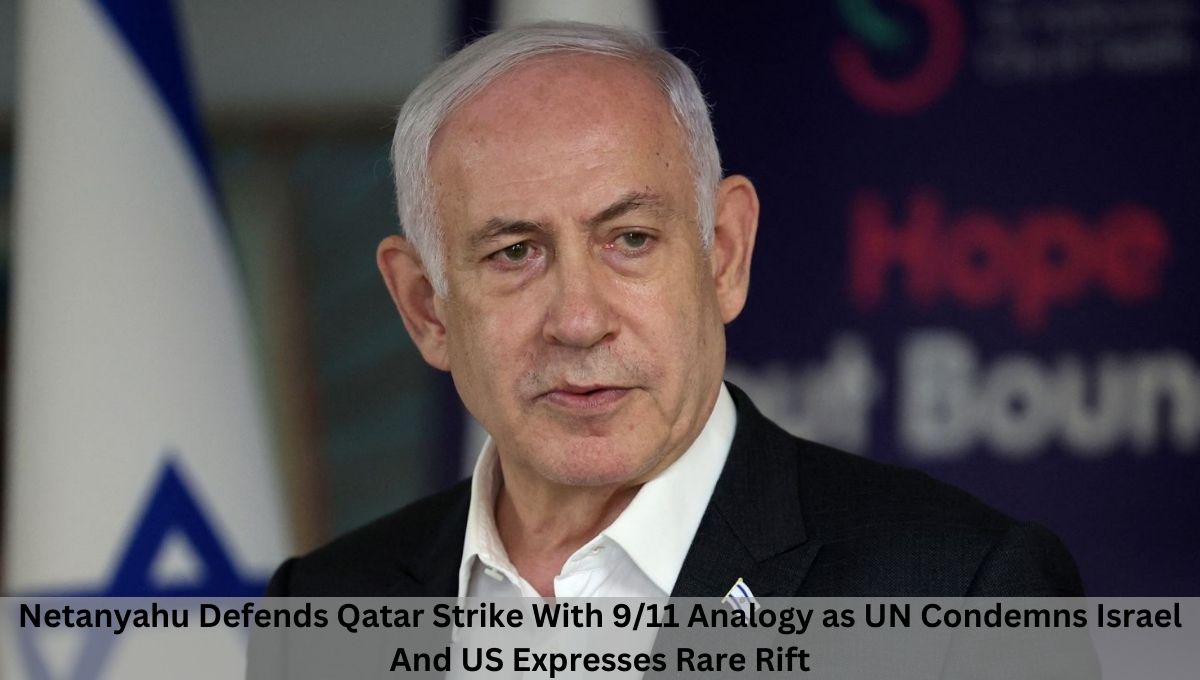
Amid sharp condemnation from Qatar, Netanyahu Defends Qatar Strike With 9/11 Analogy as UN Condemns Israel and US Expresses Rare Rift. Israeli Prime Minister Benjamin Netanyahu has invoked the memory of the September 11, 2001 attacks to defend Israel’s unprecedented airstrike in Doha, Qatar, that targeted Hamas leaders but instead killed five members of the group and a Qatari security officer.
The strike, which Israel framed as a counterterrorism mission, has drawn fierce condemnation from Qatar, Arab nations, the European Union, and the UN Security Council. Even the United States—Israel’s strongest ally—expressed rare disapproval, with President Donald Trump saying he was “very unhappy about every aspect” of the operation.
Netanyahu Defends Qatar Strike With 9/11 Analogy as UN Condemns Israel And US Expresses Rare Rift
Netanyahu’s 9/11 Analogy
Comparing Hamas to Al Qaeda
In a video address, Netanyahu argued that Israel’s action in Qatar mirrored America’s pursuit of Al Qaeda after the September 11 attacks.
“We did exactly what America did when it went after Al Qaeda terrorists in Afghanistan, and when they killed Osama Bin Laden in Pakistan,” Netanyahu declared. “Now the various countries of the world condemn Israel—they should be ashamed of themselves.”
He accused Qatar of serving as a safe haven for Hamas officials, whom he labeled as terrorists directly responsible for the October 7 attacks, which he has often called “Israel’s 9/11 moment.”
Message to Nations Hosting Hamas
Netanyahu issued a blunt warning to countries hosting Hamas figures:
“Either expel them or bring them to justice. Because if you don’t, we will.”
He insisted that just as Washington was praised for eliminating Bin Laden, Israel should be “applauded” for targeting Hamas leaders in Doha.
The Israeli Strike on Doha
Details of the Attack
On Tuesday afternoon, more than 10 Israeli fighter jets carried out precision strikes on a residential building in central Doha believed to house Hamas officials.
At least 10 bombs were dropped, killing five Hamas operatives and a Qatari security guard, but failing to eliminate the intended targets, including senior negotiator Khalil al-Hayya.
Timing Amid Ceasefire Talks
At the moment of the strike, Hamas’ negotiating team was in Doha reviewing a new ceasefire proposal presented by Qatar’s prime minister, with US and Egyptian support.
Hamas officials later alleged the strike was aimed not only at assassinating negotiators but also at deliberately sabotaging peace talks.
Qatar’s Strong Rebuttal
Foreign Ministry Condemnation
Qatar’s Foreign Ministry issued a strongly worded statement calling Netanyahu’s remarks about Hamas offices in Doha “reckless” and warning of further escalations.
“Netanyahu is fully aware that the hosting of the Hamas office took place within the framework of Qatar’s mediation efforts requested by the United States and Israel,” the statement said.
Officials insisted that all negotiations were conducted transparently, often in the presence of US and Israeli representatives.
Emir Attends Funeral
The Emir of Qatar, Sheikh Tamim bin Hamad Al Thani, attended the funeral of the Hamas operatives and the Qatari guard killed in the strike. Images showed coffins draped in Palestinian and Qatari flags, surrounded by mourners in traditional attire.
Qatar vowed to continue its mediation role but warned that Israel’s strike risked derailing hostage negotiations and “destroying hopes for a truce.”
Hamas: Strike Aimed to Derail Ceasefire
Official Hamas Response
Hamas spokesman Fawzi Barhoum accused Netanyahu of seeking to derail ceasefire talks.
“This attack was a blatant confirmation of Israel’s refusal to reach any agreement and its insistence on derailing regional and international efforts aimed at halting the genocide,” Barhoum said in a televised address.
He confirmed that five Hamas members had been killed, including the son of exiled Gaza chief Khalil al-Hayya.
Hamas’ Demands Unchanged
Despite the strike, Hamas reiterated its core conditions for a ceasefire:
- Full cessation of hostilities.
- Complete withdrawal of Israeli forces from Gaza.
- A prisoner-for-hostage exchange.
- Humanitarian relief and reconstruction.
Barhoum said the Doha strike would not alter the group’s negotiating stance.
Also Read: Hamas Survives Israeli Assassination Attempt in Doha; Qatar Condemns Strike as ‘State Terrorism’
US Reaction: A Rare Rift With Netanyahu
Trump’s Displeasure
President Donald Trump was reportedly furious at Netanyahu for not informing Washington in advance. According to aides, he viewed the strike as reckless, jeopardizing America’s largest base in the region—Al Udeid Air Base.
“I am very unhappy about every aspect of this operation,” Trump said privately, according to senior US officials.
White House Response
White House press secretary Karoline Leavitt delivered a carefully worded rebuke:
“Bombing inside Qatar, a sovereign nation and close ally of the United States, does not advance Israel or America’s goals.”
Acting US Ambassador Dorothy Shea told the UN Security Council the move was a unilateral escalation that risked undermining hostage negotiations.
UN Security Council Condemnation
A Unified Statement
In a rare display of unity, the UN Security Council adopted a statement drafted by France and the UK, affirming Qatar’s sovereignty and calling for de-escalation.
The text did not directly name Israel, but the implication was clear. The fact that the United States signed on was seen as historic, given its usual record of vetoing Israel-related resolutions.
Harsh Criticism From Diplomats
Algerian ambassador Amar Bendjama said:
“Israel behaves as if law does not exist, as if borders are illusions, as if sovereignty itself is dispensable. This is not strength—it is recklessness. It is madness.”
UN Political Affairs chief Rosemary DiCarlo warned the strike could open a “new and perilous chapter” in the conflict, with regional peace at risk.
Regional Repercussions
Gulf Response
Both Saudi Arabia and the United Arab Emirates condemned the strike, warning it risked destabilizing the region.
UAE President Sheikh Mohammed bin Zayed Al Nahyan visited Qatar immediately after the attack to coordinate Gulf responses. His diplomatic adviser called it an effort to reinforce the concept of a “common destiny” among Gulf states.
Risks for Mediation
With Qatar shaken and Hamas leadership wounded but not eliminated, analysts fear the Doha strike has weakened the fragile US-brokered ceasefire framework.
Theories on Qatar’s Role
Theory 1: Hamas a Liability
Some analysts suggest Qatar quietly welcomed the removal of Hamas operatives, who had become an obstacle to progress in negotiations.
Theory 2: Tacit Cooperation
The failure of Qatar’s advanced Patriot and THAAD systems to intercept Israeli jets fueled speculation that Doha may have allowed the strike to happen.
Theory 3: Tepid Response
Despite sharp words, Qatar avoided escalating further and reaffirmed its role as a mediator—another sign that it may be trying to balance outrage with pragmatism.
Also Read: Qatar hosts Arab-Islamic emergency summit over Israeli strike on Doha
Conclusion: A Dangerous Precedent
Israel’s Doha strike has reshaped the trajectory of the Gaza war, igniting an international backlash that has even rattled its partnership with the United States.
Netanyahu’s 9/11 analogy reflects his effort to frame Israel’s campaign as part of a global fight against terrorism. Yet for Qatar, the strike was a violation of sovereignty; for the UN, a grave threat to peace; and for Washington, a reckless gamble.
As hostages remain in captivity and the war nears its two-year mark, the Doha strike may be remembered as the moment Israel tested the limits of its alliances—and perhaps overstepped.
Related Posts:
- Netanyahu Apologises to Qatari PM Over Doha Strike…

- Hamas Survives Israeli Assassination Attempt in…

- PM Modi Condemns Israeli Strikes on Doha: Qatar…

- Marco Rubio Visits Israel After Israeli Strike on…

- Trump’s 20-Point Gaza Peace Plan Gains Urgent Global…

- GCC Activates Joint Defence Mechanism as Doha Summit…