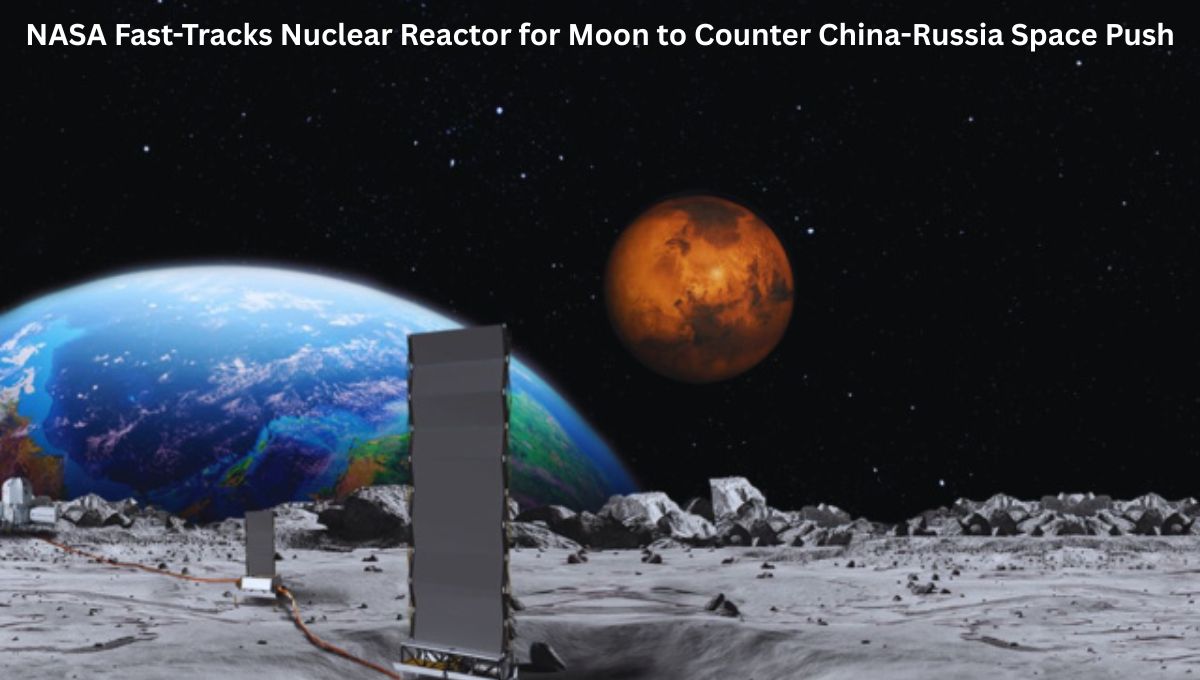
In a rush for space dominance NASA Fast-Tracks Nuclear Reactor for Moon to Counter China-Russia Space Push. In a move poised to reshape the global space race, NASA is accelerating plans to deploy a nuclear reactor on the Moon by 2030. The directive pushed forward by Sean Duffy, NASA’s newly appointed acting administrator and current US Transportation Secretary comes amid rising competition from China and Russia, who are also racing to establish lunar bases and potential “keep-out zones.”
The initiative is one of Duffy’s first major policy shifts since being named to the position by President Donald Trump. It signals the United States’ intention to lead in the next frontier of human space exploration.
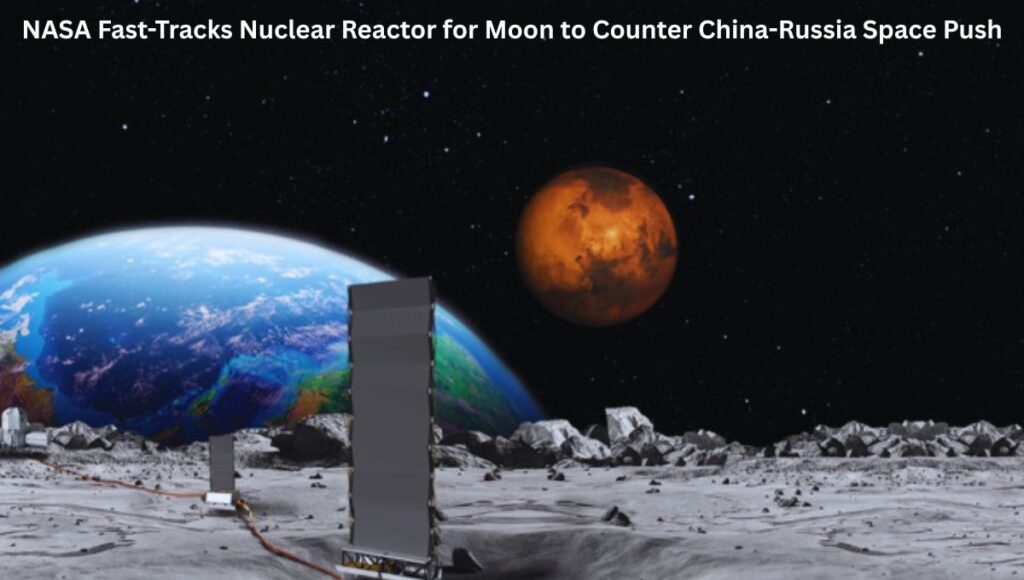
NASA Fast-Tracks Nuclear Reactor for Moon to Counter China-Russia Space Push
A Nuclear Reactor on the Moon by 2030
According to internal directives obtained by multiple US outlets including Politico and CNN, NASA has been instructed to fast-track development of a 100-kilowatt nuclear fission reactor.
The goal: to ensure continuous energy supply on the Moon, where extreme lunar day-night cycles make solar power unreliable.
A typical lunar day lasts 29.5 Earth days, including two weeks of daylight followed by two weeks of complete darkness.
For this reason, solar arrays alone can’t meet the consistent energy needs of a sustainable base.
“Nuclear energy is not just desirable, it is inevitable,” said Dr. Sungwoo Lim, senior lecturer in space exploration at the University of Surrey.
Why Now? Rising Fears Over ‘Keep-Out Zones’ on the Moon
The accelerated nuclear plan comes in direct response to fears that China and Russia who announced plans earlier this year for a joint nuclear-powered Moon base by 2035 could move to declare a ‘keep-out zone’ on parts of the Moon.
“We’re in a race to the Moon,” said Duffy during a press conference. “And to have a base on the Moon, we need energy.”
According to Duffy, being the first to establish nuclear infrastructure could enable the US to safeguard strategic zones and ensure freedom of access for future lunar operations.
A Geopolitical Space Race 2.0
The move has drawn comparisons to the Cold War-era space race, this time with an added layer of energy infrastructure and lunar sovereignty.
“It seems we’re returning to the old space race days of geopolitical competition,” said Dr. Simeon Barber, planetary science specialist at the Open University. “This time, it’s about who controls lunar resources and zones of operation.”
Duffy’s directive warns that a rival nation beating the US to build a Moon reactor may claim a safety zone around it, restricting others from entering and potentially impacting US strategic interests.
NASA’s Artemis Program and Timeline Pressures
The nuclear reactor project is expected to support NASA’s Artemis program, which aims to return astronauts to the lunar surface by 2027.
The Artemis III mission is set to be the first crewed landing on the Moon since Apollo 17 in 1972.
But the timeline is ambitious.
“If you’ve got nuclear power for a base but no way of getting people and equipment there, then it’s not much use,” Dr. Barber noted. “The plans don’t appear very joined up at the moment.”
Despite setbacks and funding issues for Artemis, Duffy’s new directive adds urgency to completing the infrastructure that will allow long-term human habitation.
What the 100-Kilowatt Reactor Means
The target is for a 100-kilowatt energy output, enough to power small lunar habitats and scientific equipment.
While this is relatively modest compared to Earth-based reactors or wind turbines, it’s a technological leap for space applications.
“Building even a modest lunar habitat to accommodate a small crew would demand megawatt-scale power. Solar arrays and batteries alone cannot reliably meet those demands,” said Dr. Lim.
NASA had earlier commissioned designs for a 40-kilowatt reactor system. The new directive raises the bar, pushing for more powerful, reliable systems.
Safety Concerns Over Launching Nuclear Material
Launching nuclear material from Earth presents real risks. NASA would need specialized safety licensing, as even a minor launch failure could have serious consequences.
“You have to have a special license to launch radioactive materials,” Dr. Barber explained. “But it is not insurmountable.”
Previous projects, like NASA’s Kilopower initiative, have explored small-scale fission systems for use in space, but launching them remains a politically sensitive topic.
Budget Cuts and Political Motivations
The Moon reactor plan comes despite steep proposed budget cuts to NASA by the Trump administration.
The agency is facing a 24% budget reduction for 2026, with programs like the Mars Sample Return mission being significantly downsized.
Critics argue the sudden emphasis on Moon-based nuclear power is politically driven.
“From a scientific perspective, it’s disappointing. We may be prioritizing geopolitical dominance over collaborative exploration,” Dr. Barber said.
NASA’s New Contracting Strategy
Duffy’s directive also includes new flexibility in how NASA awards contracts, especially for its commercial space station initiative.
The aging International Space Station (ISS) is set to retire by 2030, and NASA wants to ensure a smooth transition to privately built replacements.
NASA plans to award contracts to at least two companies within six months of releasing its next request for proposals.
The goal is to avoid a scenario where China’s Tiangong Station becomes the only permanently crewed outpost in space.
China and Russia’s Joint Moon Plans Accelerate US Response
In May 2025, China and Russia formally announced plans for an automated nuclear-powered base on the Moon by 2035.
This development has raised alarms in Washington and fast-tracked US efforts.
NASA is now working under the assumption that whoever gets there first may try to claim operational zones, which could violate the spirit of the Artemis Accords a 2020 international agreement on cooperation in lunar activities signed by 32 nations, but not by China or Russia.
“If you build a base and claim a safety zone around it, that can be interpreted as territorial staking,” said Dr. Barber.
Private Industry to Play a Crucial Role
NASA is now actively seeking commercial partners to help design, develop, and potentially deploy the Moon reactor.
The agency previously issued $5 million design contracts in 2022 for smaller fission systems.
Now, companies will be invited to submit more advanced proposals for the new 100-kilowatt system, with deployment targeted by 2030.
Technical Feasibility vs. Political Will
Many scientists believe the technology to place a small fission reactor on the Moon already exists.
“It’s just a matter of having enough Artemis launches to build the infrastructure,” said Prof. Lionel Wilson, a planetary scientist at Lancaster University. “Technically, it’s achievable.”
But questions remain over whether the political will and funding stability can align fast enough to make it happen.
NASA’s Broader Vision: From the Moon to Mars
While the immediate focus is the Moon, the longer-term goal is Mars. A functioning fission reactor on the Moon would serve as a test case for similar systems that could power Martian outposts in the 2030s and beyond.
“Energy is important. If we’re going to be able to sustain life on the Moon and eventually go to Mars this technology is critically important,” said Duffy.
The move could also bolster US space-based national security, with potential spinoffs in satellite power systems and space-based infrastructure.
International Collaboration or Competition?
The directive has reopened the debate over whether space exploration should be collaborative or competitive.
Critics of the current plan fear that a renewed “space nationalism” could lead to a fragmented and militarized approach to space.
“Competition can create innovation,” Dr. Barber admitted. “But if it narrows focus on national interest and territoriality, we risk missing the bigger scientific goals.”
Conclusion: The Moon as a New Frontier for Energy, Power, and Prestige
As the United States doubles down on its lunar ambitions, the race to place a nuclear reactor on the Moon is becoming a high-stakes contest in space exploration, geopolitics, and technological innovation.
NASA’s new directive, under the leadership of Sean Duffy, is a bold attempt to secure the US lead in lunar infrastructure. But challenges remain from funding gaps and safety regulations to technological hurdles and international tensions.
Whether or not the US can beat China and Russia to deploy the first nuclear reactor on the Moon, one thing is clear: the Moon is no longer just a scientific destination it is now a geopolitical battleground.
Also Read: A new space race: Why US is rushing plans for a nuclear reactor on the Moon