
$102-Million Louvre Heist: 7 Key Twists from Arrests to a Viral Mystery Man — and Pavel Durov’s provocative offer. The world’s most-visited museum became the scene of one of Europe’s most audacious robberies this month. Eight priceless jewels — including crowns, diadems, and necklaces belonging to French royalty — vanished from the Louvre Museum in Paris in a heist that lasted barely eight minutes.
Now, with suspects in custody and investigators combing through DNA and CCTV footage, the mystery deepens rather than fades. Here’s a complete look at how the saga unfolded — and why it still grips France and the art world alike.
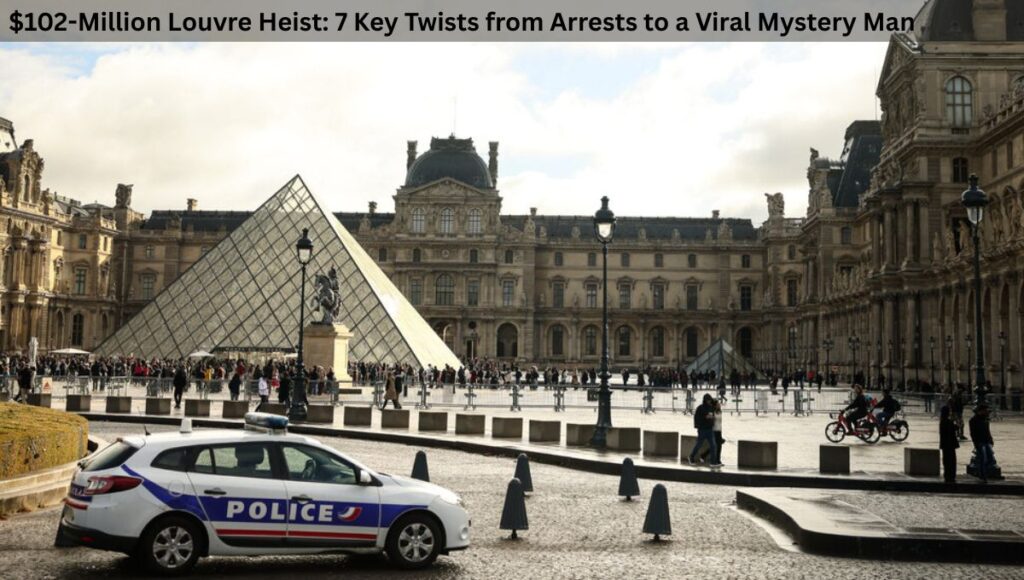
$102-Million Louvre Heist: 7 Key Twists from Arrests to a Viral Mystery Man
1. The Daylight Heist That Shook Paris
On October 19, a group of four masked men pulled off a theft so bold it stunned even veteran investigators. At around 9:30 a.m., shortly after the museum opened, they parked a truck equipped with a movable basket lift on Quai François Mitterrand beside the River Seine.
Disguised as maintenance workers, they placed traffic cones around the vehicle to make it appear legitimate. Two men climbed the ladder, cut open a window of the Apollo Gallery — home to the French Crown Jewels — and slipped inside.
Within minutes, they used disc cutters to slice through reinforced glass display cases. At 9:38 a.m., they were gone, escaping on scooters waiting below. The entire robbery lasted less than eight minutes.
Among the stolen items were jewels once owned by Empress Eugénie, Queen Marie-Amélie, and Napoleon Bonaparte’s second wife, Empress Marie-Louise. The combined estimated value: €88 million ($102 million).
Also Read: 8 Crown Jewels Stolen in a Shocking $102 Million Louvre Heist
2. A “Terrible Failure” in Security
The Louvre’s director, Laurence des Cars, told French lawmakers that the heist represented a “terrible failure.”
A preliminary audit revealed that one in three rooms near the Apollo Gallery had no CCTV coverage, and the single camera trained on the building’s exterior wall was pointing in the wrong direction. The robbers exploited this blind spot perfectly.
Justice Minister Gérald Darmanin later conceded that the robbery exposed severe security lapses. “We have failed,” he told France Inter radio. “One can wonder about the fact that the windows weren’t properly secured, and that a basket lift could operate on a public road in front of the Louvre.”
Following the theft, France ordered immediate upgrades at cultural institutions nationwide. The Louvre quietly transferred some of its most valuable jewels to the Bank of France’s underground vaults, 26 meters below ground.
3. The Arrests — and a Furious Prosecutor
After an intensive week-long manhunt involving more than 100 investigators, French police arrested two suspects late on October 26.
One man was caught at Charles de Gaulle Airport as he prepared to board a flight to Algeria; another was detained in the Paris region soon afterward.
According to Le Parisien, both men are in their 30s, hail from Seine-Saint-Denis, and were already known to police. Reports indicate they were tracked down using DNA evidence recovered from gloves and high-visibility jackets left at the scene.
However, Paris prosecutor Laure Beccuau is not celebrating — at least, not publicly. In a sharply worded statement, she condemned the premature leaks about the arrests, warning that publicity could hamper ongoing efforts “to recover the stolen jewels and apprehend all perpetrators.”
“The work of more than one hundred investigators is at stake,” she said, urging restraint from media outlets and police sources alike.
French Interior Minister Laurent Nuñez praised the detectives’ efforts, tweeting: “They worked tirelessly, as I asked them to, and always had my full confidence.”
For now, the suspects remain in custody and can be held for up to 96 hours under French law. Police believe at least two other members of the gang remain at large.
4. How the Thieves Pulled It Off
Reconstructing the sequence minute by minute has become a forensic exercise in precision.
According to a preliminary report leaked to the press:
- 9:30 a.m. – Truck parks on Quai François Mitterrand, cones placed around it.
- 9:32 a.m. – Two thieves ascend using the lift, enter through a window.
- 9:34 a.m. – Alarm triggers; guards alert command center.
- 9:35–9:37 a.m. – Glass display cases cut open with power tools.
- 9:38 a.m. – Thieves exit via same route, drop a crown while fleeing, and vanish on scooters.
The dropped crown — Empress Eugénie’s emerald-set imperial crown containing more than 1,300 diamonds — was later found damaged but repairable.
Investigators say the thieves likely had insider knowledge of the gallery’s layout and security gaps. “They knew exactly which cases to target and how long they had,” said one police source quoted by Le Figaro.
5. The Cultural Wound
For many French citizens, the theft struck deeper than material loss. The stolen items symbolized the nation’s monarchy, empire, and artistic grandeur — jewels worn by queens and empresses from the 19th century.
Historians described the crime as a “cultural wound”, likening it to the Notre-Dame Cathedral fire in 2019.
Visitors to the reopened museum expressed a mix of disbelief and anger. “It’s important for our heritage,” said Parisian resident Freddy Jacquemet. “A week later, it feels too late — but it was important that the culprits are caught.”
Another visitor, Diana Ramirez, added, “The main thing now is whether they can recover the jewels. That’s what really matters.”
6. Telegram CEO’s Provocative Offer
While investigators combed through DNA samples, Telegram founder and CEO Pavel Durov added a bizarre twist to the unfolding story.
Taking to social media platform X (formerly Twitter), the Russian-born tech billionaire offered to buy the stolen jewels and return them — but only to Louvre Abu Dhabi, not the Paris museum.
“Happy to buy the stolen jewelry and donate it back to the Louvre. I mean Louvre Abu Dhabi, of course; no one steals from Louvre Abu Dhabi,” Durov wrote, in what many interpreted as a sarcastic jab at French security.
He prefaced his remark with a broader critique: “Not at all surprised by the Louvre heist. It’s another sad sign of the decline of a once-great country — where the government distracts people with phantom threats instead of confronting real ones.”
French officials did not respond publicly, but art-world commentators called Durov’s posts “provocative,” while others accused him of leveraging tragedy for attention.
7. The Viral “Mystery Man” in a Fedora
As if the case needed more intrigue, a photograph from the crime scene sparked a viral sensation online.
In the image, a man in a three-piece suit, gold waistcoat, dark jacket, and fedora stands near the Louvre, umbrella in hand like a walking stick. His sharply dressed appearance led thousands on social media to mistake him for either the lead detective or a suspect in disguise.
Users compared him to fictional sleuths like Inspector Clouseau and Hercule Poirot. “He looks like he stepped out of a 1940s film noir,” one post read. Another joked: “Surely the real detective must now feel underdressed.”
The truth turned out to be far less dramatic. AP photographer Thibault Camus, who captured the image, clarified that the man was simply a passerby. “He appeared in front of me, I took the photo, and he walked away,” Camus said.
Even the Paris prosecutor’s office joined in on the joke, telling reporters: “We’d rather keep the mystery alive.”
The photo, though unconnected to the crime, captured global attention — illustrating how the heist had seeped into pop culture within days.
Inside the Investigation: DNA, Fingerprints, and Forensics
Forensic teams collected dozens of DNA samples and fingerprints from the Apollo Gallery, the lift truck, and discarded items nearby.
Police sources confirmed to Le Parisien that investigators found traces linking at least one suspect to previous burglaries. The antigang brigade (BRI) is leading the probe, assisted by the OCBC, France’s specialized unit for art thefts.
Detectives have traced the suspects’ movements across Paris and neighboring regions using public and private surveillance footage. The path suggests professional coordination — two teams working in synchrony with getaway drivers waiting outside.
So far, authorities have not recovered the missing jewels. Experts fear that the pieces may have been broken up or melted down, making recovery nearly impossible.
“Gold and silver can be melted; gems can be recut. Once that happens, tracing them back becomes virtually impossible,” said Dutch art detective Arthur Brand in an interview with the BBC.
Mounting Pressure on French Cultural Institutions
The Louvre heist has triggered a government-wide review of museum security. Within days, a museum in eastern France reported the theft of gold and silver coins; the Paris Natural History Museum also lost gold nuggets worth over $1.5 million last month.
Cultural Minister Rachida Dati described the spate of crimes as a “wake-up call.” She said guards at the Louvre had acted “courageously” by prioritizing visitor safety over confrontation, but she acknowledged the need for more surveillance technology and rapid-response systems.
Experts argue that France’s cultural security network is overstretched and underfunded, with many heritage sites relying on outdated alarms and limited staff.
Public Reaction: Pride, Shock, and Cynicism
On Paris streets, reactions have ranged from patriotic outrage to resigned cynicism. “France is the custodian of the world’s culture — we should protect it like gold,” said museum visitor Jean Michaud.
Others noted the irony that the Louvre’s treasures — symbols of monarchy and colonial glory — could be stolen in broad daylight amid a sea of cameras and tourists. “It shows how fragile even the most iconic places can be,” said art historian Clémence Roussel.
The arrests have offered a measure of relief, but uncertainty lingers. “Catching two people isn’t the same as catching the jewels,” one Louvre employee told Le Monde.
Where the Case Stands Now
As of this week, the two arrested suspects remain in custody, facing potential charges of organized theft and criminal conspiracy.
Investigators are pursuing leads in Belgium, Spain, and North Africa, following evidence that portions of the loot may have been trafficked through international art-crime networks.
Police continue to analyze recovered tools and digital evidence, including cellphone data and encrypted messaging records. Officials say the probe could take “months, not weeks.”
Prosecutor Beccuau emphasized that her office’s priority is to recover the jewels intact. “Every hour matters,” she said. “These are not just valuable items — they are fragments of our national identity.”
A Heist That Will Enter French Legend
The 2025 Louvre heist will likely be remembered alongside the greatest museum robberies in modern history.
From the precision of its planning to the cultural symbolism of its loot, the theft has gripped global imagination — equal parts tragedy, thriller, and farce.
In a country that treasures its art as much as its liberty, the robbery has become a metaphor for something larger: a test of France’s ability to protect the beauty it represents to the world.
Whether the jewels resurface or remain forever lost, the story continues — with two suspects behind bars, others on the run, a prosecutor demanding silence, and a sharply dressed mystery man still haunting the public imagination.
Also Read: After shocking Louvre heist, another French museum gets robbed of 2000 Gold and Silver coins
Related Posts:
- 8 Crown Jewels Stolen in a Shocking $102 Million…

- 7 Astonishing Twists in the $100 Million Louvre…

- 7 Shocking Facts: 600+ Artefacts Stolen in UK Museum Heist

- 5 Alarming Failures: Water Leak Hits Louvre Weeks…

- 5 Shocking Facts About the Racially Aggravated Rape…

- 7 Big Takeaways: Macron’s High-Stakes China Visit…
